Dioscorea dodecaneura
Vell.
Cara barbado

iNaturalist · cc-by-nc-sa
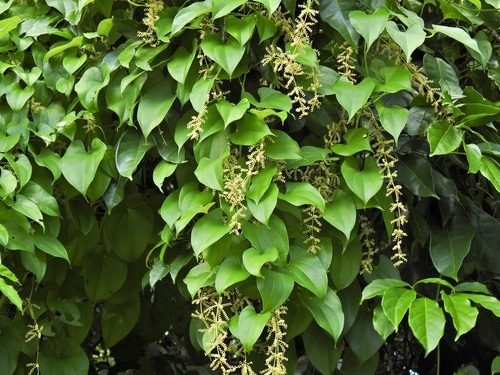
(c) Rich Hoyer, some rights reserved (CC BY-NC-SA), uploaded by Rich Hoyer
(c) Rich Hoyer, some rights reserved (CC BY-NC-SA), uploaded by Rich Hoyer

iNaturalist · cc-by-nc
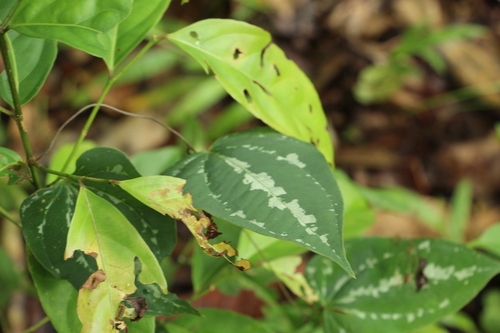
(c) dpriz, some rights reserved (CC BY-NC)
(c) dpriz, some rights reserved (CC BY-NC)
What to Eat
Edible parts: Tubers, Root
The tubers and roots are eaten.
Where to Find It
A tropical plant.
Brazil, Central America, Colombia, Ecuador, French Guiana, Guianas, Guyana, Paraguay, Peru, South America, Suriname,
How to Identify
A cultivated yam in the Dioscoreaceae family with edible tubers, native to tropical regions. About 650 species of Dioscorea exist, of which this is one.
Nutrition Score: 2/100
| Part | Moisture | kJ | kcal | Protein | Vit A | Vit C | Iron | Zinc |
|---|---|---|---|---|---|---|---|---|
| Tubers | — | — | 9.7 | — | — | — | — | — |
Medicinal Uses
The root is said to be cardiotonic. It is used in the treatment of diabetes.
Other Information
It is a cultivated yam.
Notes
There are about 650 species of Dioscorea.
Names & Synonyms
Cara mimosa, Caratinga roxa, Inhame branco, Inhame de folha pintada, Maguma
Dioscorea anthropophagorum A. Chev. ex Jum.Dioscorea bangii R. KnuthDioscorea discolor KunthDioscorea dodecandra Steud. [Spelling variant]Dioscorea dodecaneura var. maronensis Uline ex R. KnuthDioscorea dodecaneura var. villosa R. KnuthDioscorea hebantha Mart. ex Griseb.Dioscorea huallagensis R. KnuthDioscorea illustrata W. BullDioscorea kita QuevaDioscorea racemosa Rusby [Illegitimate]Dioscorea sativa Thunb.Dioscorea vittata W. Bull ex Baker
References (11)
- Bernal, 2016, Catalogo de Plantas y Liquenes de Colombia, Volumen 1 p 1005
- Bortolotto, I. M., et al, 2018, Lista preliminar das plantas alimenticias nativas de Mato Grosso do Sul, Brasil. Iheringia, Serie Botanica, Porto Alegre, 73 (supl.):101-116
- Fl. flumin. icon. 10: t. 123. 1831 ("1827")
- Chu, E. P., Figueiredo-Ribeiro, R. C. L., 1991, Native and Exotic Species of Dioscorea Used as Food In Brazil. Economic Botany, Vol. 45, No. 4, pp. 467-479 (Also as Dioscorea illustrata)
- Gard. Chron. 1873:1730. 1873 (As Dioscorea illustrata)
- INFOODSUpdatedFGU-list.xls
- Keller, H., et al, 2010, Ethnobotanical resources of multipe-use Guarani Reserve, Misiones (Argentina): their importance to indigenous communities of Caramelito and Taruma Poty-1. Ethnobotany Bol. 22, 2010 pp 38-54
- Kermath, B. M., et al, 2014, Food Plants in the Americas: A survey of the domesticated, cultivated and wild plants used for Human food in North, Central and South America and the Caribbean. On line draft. p 308
- Kinupp, V. F., 2007, Plantas alimenticias nao-convencionais da regiao metropolitana de Porto Alegre, RS, Brazil p 76
- Kinupp, V. F. & Bergman, I., 2008, Protein and minerals of native species, potential vegetables and fruits. Cienc.Tecnol. Aliment. Vol. 28 No. 4 Campinas Oct/Dec.
- Mansfeld's Encyclopedia of Agrocultural and Horticultural Crops. Hanelt, P. (ed) p 2160