Dioscorea dumetorum
(Kunth) Pax
African bitter yam, Cluster yam, Three leafed yam

(c) Scamperdale, some rights reserved (CC BY-NC)
(c) franceschase, some rights reserved (CC BY-NC)
(c) franceschase, some rights reserved (CC BY-NC)
What to Eat
Edible parts: Tubers, Caution, Leaves, Vegetable, Root
The tubers are processed through boiling, peeling, slicing, pounding, and steeping in running water (preferably salted) before drying and eating. They are also used to make an alcoholic drink. The leaves are eaten as a vegetable.
Known Hazards
Where to Find It
A tropical plant. It is native to tropical Africa. It grows between 15°N and 15°S. It grows on the edges of forests and along river banks. It occurs between 500-1,400 m altitude.
Africa, Angola, Asia, Benin, Burkina Faso, Cameroon, Central Africa, Central African Republic, CAR, Congo DR, Congo R, Côte d'Ivoire, East Africa, Ethiopia, Gabon, Ghana, Guinea, Guinée, Guinea-Bissau, India, Ivory Coast, Kenya, Malawi, Mali, Mozambique, Nigeria, Rwanda, Sao Tome and Principe, Senegal, Sierra Leone, South Africa, Southern Africa, Sudan, Tanzania, Togo, Uganda, West Africa, Zambia, Zimbabwe,
How to Identify
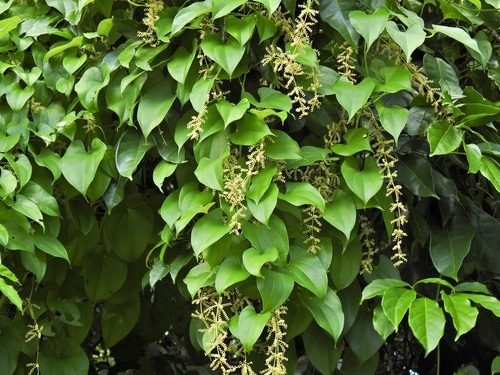
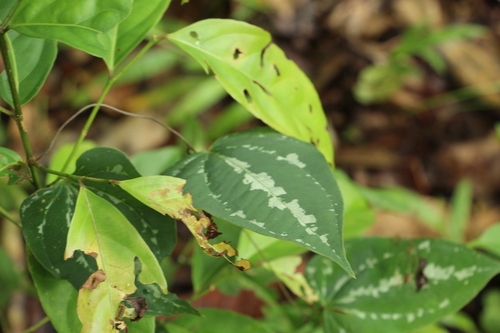
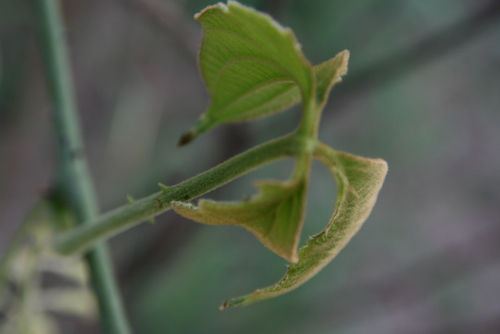
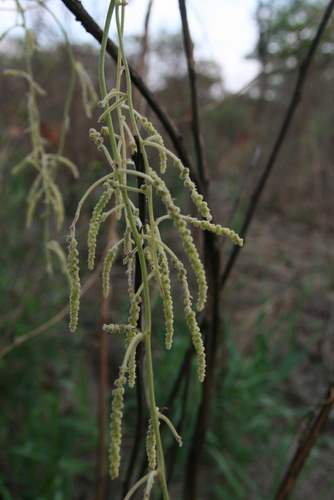
A climbing yam plant. It can be 10 m long. The vine twines left or clockwise. The vine is robust and has prickles near the base. The leaf has 3 leaflets. The flowers are small and round. Sometimes it forms bulbils or small aerial yams along the stem. Underground the tubers are usually fused together to form a cluster. Some wild forms are very poisonous. The tubers vary in shape and colour. There is often a main tuber with deep lobes then small tubers around it. They are near the soil surface and 3-7 cm across. The flesh can be white, pale yellow or dark yellow.
Nutrition Score: 36/100
| Part | Moisture | kJ | kcal | Protein | Vit A | Vit C | Iron | Zinc |
|---|---|---|---|---|---|---|---|---|
| Tuber | 67 | 520 | 124 | 3.2 | — | — | — | — |
How to Grow
Plants are grown from setts or section of the tubers. Sections of the vine can be used.
Propagation: Seed - not normally used to propagate this species. Cuttings of tubers. Small tubers can be cut into 2 - 4 sections, larger ones into 6 - 8 sections. Each section should have 2 - 3 dormant buds. The cut tuber is often left in the sun for several hours to promote wound healing and reduce the risk of fungal infection.
Medicinal Uses
The tuber is boiled and eaten, or the liquid can be drunk, in the treatment of jaundice and malaria. The root is considered a cure for schistosomiasis. The powder obtained from dried and pounded roots is soaked in water and used to treat bilharzia. The root is used topically as an anodyne to relieve pain. In Sudan it is used on rheumatic arthritis
Wikipedia
Source ↗Dioscorea dumetorum, also known as the bitter yam, cluster yam, trifoliate yam, or three-leaved yam, is a species of flowering plant in the yam family, Dioscorea. It is native to sub-Saharan Africa and especially common in the tropical regions of West Africa, including Nigeria, Benin, and Ghana. D. dumetorum has both toxic and non-toxic varieties.
Production
A crop takes 8-10 months to maturity. Tubers are collected soon after the rainy season finishes.
Other Information
It is a commercially cultivated vegetable. A famine food.
Notes
There are about 650 species of Dioscorea. The tuber contains a water soluble toxicant, dioscorine, which is leached out.
Names & Synonyms
Chinkolongo, Cinkolongo, Dimhue, E-dyeny, Ekesya-bangoya, Elenge, Esuri yam, Esuru, Idiya, Ikamba, Inkolongo, Kigongo, Kikwa, Kinana, Kotonto, Kulu sanga, Lefe, Ma-nyeny, Mabaia, Mpeta, Ndiga, Ndiya, Nkanfo, Nkasa, Rogon biri, Trifoliate yam, Tugu, Yayii
References (49)
- Asfaw, Z. and Tadesse, M., 2001, Prospects for Sustainable Use and Development of Wild Food Plants in Ethiopia. Economic Botany, Vol. 55, No. 1, pp. 47-62
- Baa-Poku, F. & Asante, I. K., 2020, Use of Neglected and Underutilized Crop Species (NUCS) in some farming communities in the Upper Afram and Upper Dayi River Basins in Ghana. International Journal of Technology and Management Research 5 (2): 48-63
- Bruschi, P., et al, 2014, Traditional use of plants in a rural community of Mozambique and possible links with Miombo degradation and harvesting sustainability. Journal of Ethnobiology and Ethnomedicine. 2014, 10:59
- Burkill, H. M., 1985, The useful plants of west tropical Africa, Vol. 3. Kew.
- Burkill, I.H., 1966, A Dictionary of the Economic Products of the Malay Peninsula. Ministry of Agriculture and Cooperatives, Kuala Lumpur, Malaysia. Vol 1 (A-H) p 830
- Codjia, J. T. C., et al, 2003, Diversity and local valorisation of vegetal edible products in Benin. Cahiers Agricultures 12:1-12
- Coursey, D.G., 1979, Yams, in Simmonds N.W.,(ed), Crop Plant Evolution. Longmans. London. p 70
- Dalziel, J. M., 1937, The Useful plants of west tropical Africa. Crown Agents for the Colonies London.
- Dansi, A., et al, 2012, Diversity of the Neglected and Underutilized Crop Species of Importance in Benin. The Scientific World Journal. Volume 2012, Article ID 932947, 19 pages
- H. G. A. Engler & K. A. E. Prantl, Nat. Pflanzenfam. 2(5):134. 1888
- FERRYet al,
- Fowler, D. G., 2007, Zambian Plants: Their Vernacular Names and Uses. Kew. p 66
- Fox, F. W. & Young, M. E. N., 1982, Food from the Veld. Delta Books. p 182
- Gallagher, D. E., 2010, Farming beyond the escarpment: Society, Environment, and Mobility in Precolonial Southeastern Burkina Faso. PhD University of Michigan.
- Gohre, A., et al, 2016, Plants from disturbed savannah vegetation and their usage by Bakongo tribes in Uíge, Northern Angola. Journal of Ethnobiology and Ethnomedicine (2016) 12:42
- Grivetti, L. E., 1980, Agricultural development: present and potential role of edible wild plants. Part 2: Sub-Saharan Africa, Report to the Department of State Agency for International Development. p 24, 47
- IRVINE,
- Jardin, C., 1970, List of Foods Used In Africa, FAO Nutrition Information Document Series No 2.p 14
- Karhagomba, I. B., et al, 2013, The cultivation of wild food and medicinal plants for improving community livelihood: The case of the Buhozi site, DR Congo. Nutrition Research and Practice (Nutr Res Pract) 2013;7(6):510-518
- Kay, D.E., 1973, Root Crops, Digest 2, Tropical Products Institute, London, p 190, 203
- Kays, S. J., and Dias, J. C. S., 1995, Common Names of Commercially Cultivated Vegetables of the World in 15 languages. Economic Botany, Vol. 49, No. 2, pp. 115-152
- Kiple, K.F. & Ornelas, K.C., (eds), 2000, The Cambridge World History of Food. CUP p 1733
- Lim, T. K., 2015, Edible Medicinal and Non Medicinal Plants. Volume 9, Modified Stems, Roots, Bulbs. Springer p 35
- Lulekal, E., et al, 2011, Wild edible plants in Ethiopia: a review on their potential to combat food insecurity. Afrika Focus - Vol. 24, No 2. pp 71-121
- Macmillan, H.F. (Revised Barlow, H.S., et al) 1991, Tropical Planting and Gardening. Sixth edition. Malayan Nature Society. Kuala Lumpur. p 339
- Malaisse, F., 1997, Se nourrir en floret claire africaine. Approche ecologique et nutritionnelle. CTA., p 61
- Maundu, P. et al, 1999, Traditional Food Plants of Kenya. National Museum of Kenya. 288p
- Moksia, F., et al, 2019, Diversity and Socio-Economic Value of Wild Edible Plants in the Mounts Mandara Region, Cameroon. International Journal of Sciences. Vol. 8:10
- MORTIMORE,
- Mutie, F. M., et al, 2023, Important Medicinal and Food Taxa (Orders and Families) in Kenya, Based on Three Quantitative Approaches. Plants 2023, 12, 1145
- Nyadanu, D., et al, 2015, Agro-biodiversity and challenges of on-farm conservation: the case of plant genetic resources of neglected and underutilized crop species in Ghana. Genet. Resourc. Crop Evol. 62(7):
- Onwueme, I.C., 1978, The Tropical Tuber Crops. Wiley, p 9
- Peters, C. R., O'Brien, E. M., and Drummond, R.B., 1992, Edible Wild plants of Sub-saharan Africa. Kew. p 17
- Pickering, H., & Roe, E., 2009, Wild Flowers of the Victoria Falls Area. Helen Pickering, London. p 59
- Purseglove, J.W., 1972, Tropical Crops. Monocotyledons. Longmans p 106
- Ruffo, C. K., Birnie, A. & Tengnas, B., 2002, Edible Wild Plants of Tanzania. RELMA p 272
- Ruiters-Welcome, A. K., 2019, Food plants of southern Africa. Ph.D. thesis. Univ. of Johannesburg p 51
- Singh, G. & Kumar, J., 2015, Diversity of Wild Edible Yams and its Traditional Knowledge Among Munda Tribe of District Khunti, Jharkhand, India. International Journal of Bioassays. 4.10: 4440-4442
- Termote, C., et al, 2011, Eating from the wild: Turumbu, Mbole and Bali traditional knowledge of non-cultivated edible plants, District Tshopo, DRCongo, Gen Resourc Crop Evol. 58:585-618
- Tindall, H.D., 1983, Vegetables in the Tropics, Macmillan p 212
- Ulian, T., et al, 2020, Unlocking plant resources to support food security and promote sustainable agriculture. Plants, People, Planet. 2020;2:421–445.
- Vickery, M.L. and Vickery, B., 1979, Plant Products of Tropical Africa, Macmillan. p 15
- von Katja Rembold, 2011, Conservation status of the vascular plants in East African rain forests. Dissertation Universitat Koblenz-Landau p 165
- Wehmeyer, A. S, 1986, Edible Wild Plants of Southern Africa. Data on the Nutrient Contents of over 300 species
- Welcome, A. K. & Van Wyk, B.-E., 2019, An inventory and analysis of the food plants of southern Africa. South African Journal of Botany 122 (2019) 136–179
- White, F., Dowsett-Lemaire, F. and Chapman, J. D., 2001, Evergreen Forest Flora of Malawi. Kew. p 96
- Wilkin, P., 2001, Dioscoreaceae of South-Central Africa. Kew Bulletin, Vol. 56, No. 2 (2001), pp 361-404
- World Checklist of Useful Plant Species 2020. Royal Botanic Gardens, Kew
- Zeven, A. C. & de West, J. M. J., 1982, Dictionary of cultivated plants and their regions of diversity. Wageningen. p 125