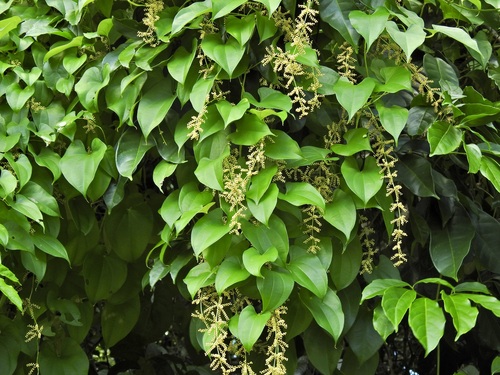
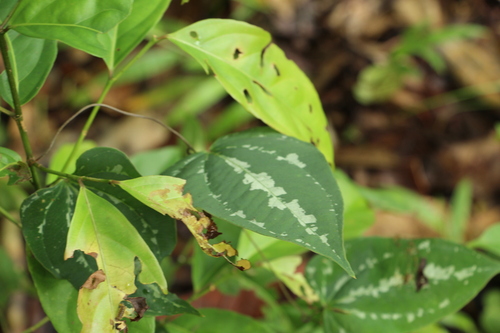
Dioscorea glandulosa
(Griseb.) Klotzsch ex Kunth
DioscoreaceaeRoots
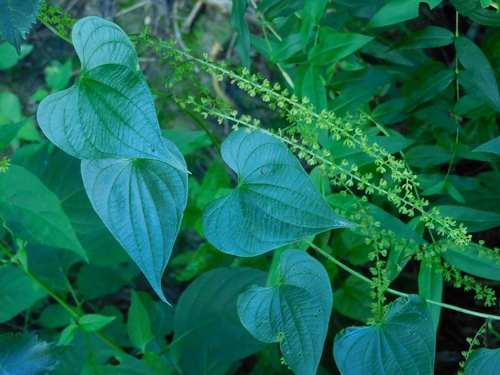
iNaturalist · cc-by-nc
(c) Ignacio Barrientos, some rights reserved (CC BY-NC), uploaded by Ignacio Barrientos
(c) Ignacio Barrientos, some rights reserved (CC BY-NC), uploaded by Ignacio Barrientos

iNaturalist · cc-by-nc
(c) Lucila Boasso, some rights reserved (CC BY-NC)
(c) Lucila Boasso, some rights reserved (CC BY-NC)

iNaturalist · cc-by-nc
(c) Lucila Boasso, some rights reserved (CC BY-NC)
(c) Lucila Boasso, some rights reserved (CC BY-NC)
What to Eat
Edible parts: Tubers, Root
The tubers are cooked and eaten, requiring long cooking times.
Where to Find It
A tropical plant. In Argentina it grows below 800 m above sea level.
Argentina, Bolivia, Brazil, Colombia, Paraguay, Peru, South America,
How to Identify
A yam. It is a climbing plant producing annual stems from an underground rootstock or tuber. The stems twine around other plants. The tubers are small and round.
Medicinal Uses
The tubers are traditionally cooked and eaten.
Other Information
It is a cultivated yam.
Notes
There are about 650 species of Dioscorea.
Names & Synonyms
Karante
Dioscorea glandulosa var. glandulosaDioscorea multispicata R. KnuthDioscorea paranensis R. KnuthDioscorea piperifolia var. glandulosa Griseb.Dioscorea piperifolia var. legitima Griseb.Dioscorea piperifolia var. triangularis Griseb.Dioscorea recurva RusbyDioscorea sororia KunthDioscorea triangularis (Griseb.) R. Knuth [Illegitimate]Dioscorea undecimnervis Vell.
References (5)
- Enum. pl. 5:352. 1850
- Carretero, A. L., 2005, Useful Plants and Traditional knowledge in the Rucumano-Boliviano Forest. M.Sc. thesis. University of Aarhus-Denmark. (As Dioscorea multispicata)
- Chu, E. P., Figueiredo-Ribeiro, R. C. L., 1991, Native and Exotic Species of Dioscorea Used as Food In Brazil. Economic Botany, Vol. 45, No. 4, pp. 467-479 (As Dioscorea triangularis)
- Fern, K., 2012, Tropical Species Database http://theferns.info/tropical/
- Kew Plants of the World Online