Dioscorea hastifolia
Nees
Spear-leaved dioscorea
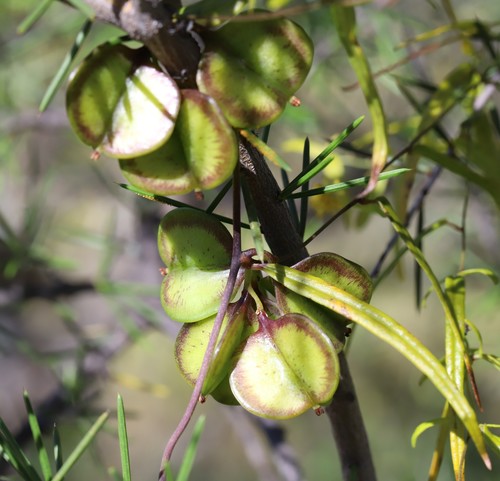
(c) overlander (Gerald Krygsman), some rights reserved (CC BY-NC), uploaded by overlander (Gerald Krygsman)
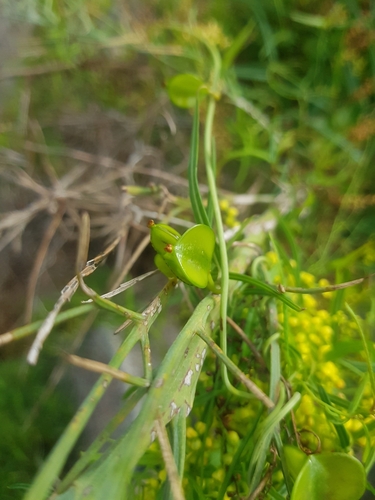
(c) Jamie Lee, some rights reserved (CC BY-NC)
What to Eat
The cylindrical yam tubers, 2-3 cm across, are eaten.
Where to Find It
Tubers, Root,
How to Identify
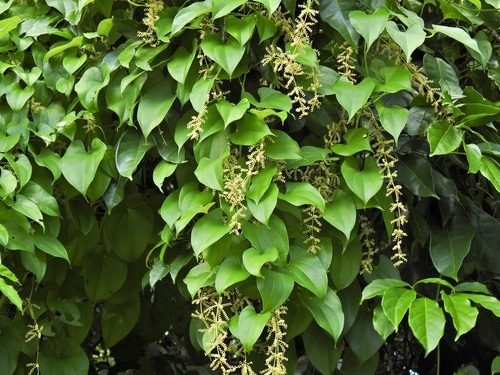
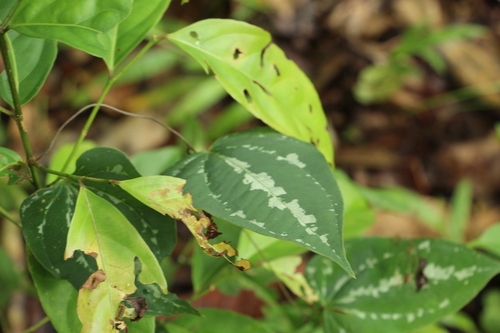
A scrambling or twining vine in the yam family with a tuberous root from which it regenerates after dying back seasonally. It can grow to 2 m high with variable leaves typically 2-3.5 cm long and 0.5-1.5 cm wide, bearing 3-5 prominent veins. Male and female flowers occur on separate plants, with females producing winged fruit about 2 cm long.
How to Grow
It is grown from shoots and the tips of the yam tubers. It can also be grown from seed.
Wikipedia
Source ↗Dioscorea hastifolia, the adjigo (ˈadʒɪɡəʊ) yam, also known as the warram, is a yam with long, white, edible tubers that is native to Southwest Australia. It is a climbing vine with hastate, spearheaded, leaves and bears green triangular fruit. The tubers are used by Aboriginal Australians as a source of carbohydrates, who managed the plant extensively in agriculture-like systems. After the yellow flowers have seeded the plant is dug up in winter and roasted.
Other Information
Dioscoreaceae
Notes
A yam. A scrambling or twining shrub. It has a slender vine and a tuberous root. Plants die back and re-grow from this tuberous root. The plant can grow to 2 m high. The leaves vary a lot in shape and size. They can be 8 cm long but are more often 2-3.5 cm long by 0.5-1.5 cm wide. The leaves have 3-5 prominent veins. Male and female flowers are on separate plants. The male flowers are in spikes 1-3 cm long. The female plants produce winged fruit. These are about 2 cm long. The yams are cylindrical and 2-3 cm across.
Names & Synonyms
Native yam, Southern yam, Warrain, Warrine
References (17)
- Bindon, P., 1996, Useful Bush Plants. Western Australian Museum. p 101
- Bonney, N., 2012, Edible Wild Native Plants for Southern Australia. p 110
- Cherikoff V. & Isaacs, J., The Bush Food Handbook. How to gather, grow, process and cook Australian Wild Foods. Ti Tree Press, Australia p 199
- Daw, B., Walley, T. & Keighery, G., 2001, Bush Tucker. Plants of the South-West. Department of Conservation and Land Management. Western Australia. p 16
- Elliot, W.R., & Jones, D.L., 1984, Encyclopedia of Australian Plants suitable for cultivation. Vol 3. Lothian. p 282
- Hedrick, U.P., 1919, (Ed.), Sturtevant's edible plants of the world. p 274
- Jardin, C., 1970, List of Foods Used In Africa, FAO Nutrition Information Document Series No 2.p 14
- Jones, D.L. & Gray, B., 1977, Australian Climbing Plants. Reed. p 61
- Lim, T. K., 2015, Edible Medicinal and Non Medicinal Plants. Volume 9, Modified Stems, Roots, Bulbs. Springer p 35
- Low, T., 1992, Bush Tucker. Australia’s Wild Food Harvest. Angus & Robertson. p 106
- Morley, B.D., & Toelken, H.R., (Eds), 1983, Flowering Plants in Australia. Rigby. p 342
- Paczkowska, G. & Chapman, A.R., 2000, The Western Australian Flora. A Descriptive Catalogue. Western Australian Herbarium. p 60
- Pascoe, B., 2018, Dark Emu. Aboriginal Australia and the birth of Agriculture. Magabala books, p 17
- RIRDC, 2010, New Root Vegetables fo the Native Food Industry, Australian Government RIRDC Publication 9/161
- Smith, K., 1998, Growing Uncommon Fruits and Vegetables. New Holland. p 104
- Smith, K & I., 1999, Grow your own bushfoods. New Holland. Australia. p 80
- Uphof, 1968,