Dioscorea hirtiflora
Benth.
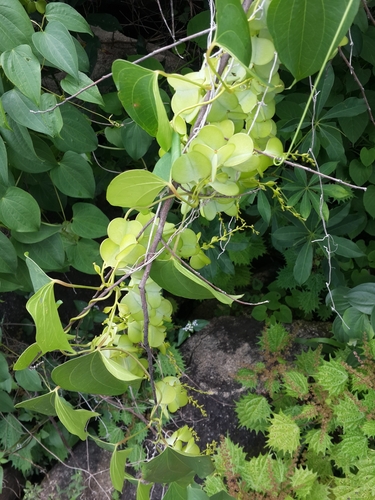
(c) Umar Musa, some rights reserved (CC BY-NC), uploaded by Umar Musa
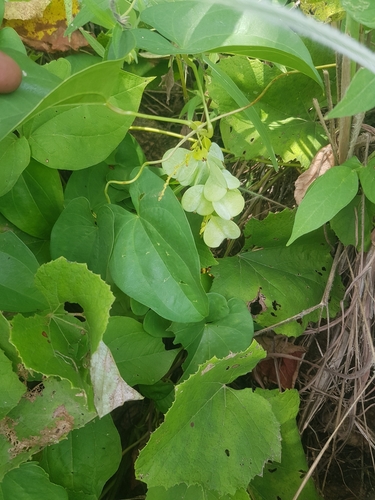
(c) Umar Musa, some rights reserved (CC BY-NC), uploaded by Umar Musa
(c) Umar Musa, some rights reserved (CC BY-NC), uploaded by Umar Musa
What to Eat
Edible parts: Tubers, Root, Bulbils, Caution
The tubers are eaten after the toxins are removed by extended soaking, then cooked. Bulbils are also edible portions.
Known Hazards
Where to Find It
A tropical plant. It grows in the savannah.
Africa, Angola, Burkina Faso, Cameroon, Central Africa, Congo, Congo R, East Africa, Guinea, Guinée, Guinea-Bissau, Malawi, Mozambique, Niger, Nigeria, Sahel, Senegal, Sierra Leone, Southern Africa, Tanzania, West Africa, Zambia, Zimbabwe,
How to Identify
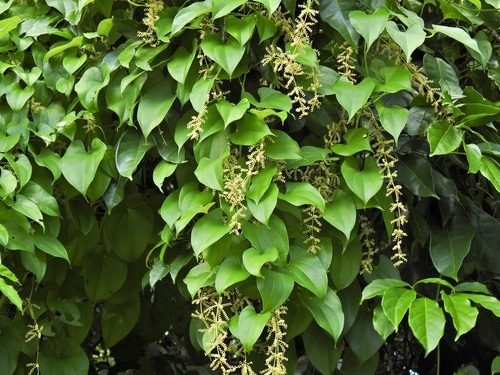
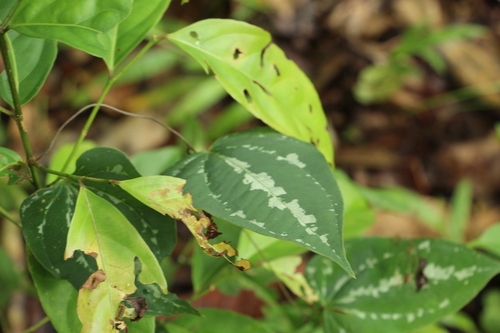
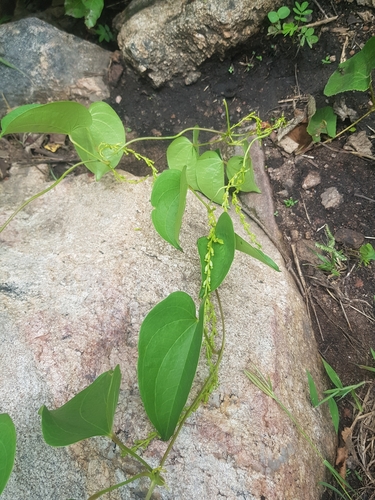
A yam. There are 1-6 tubers. They are up to 5 cm across. They are narrow and extend downwards into the soil. The stems twine right-handed. They do not have prickles. They can climb 6 m high. The leaves are usually opposite and the leaf blade in entire. The leaves are 6 cm across. The flowers are in loose arrangements. There are 3 subspecies.
Medicinal Uses
The mashed up tuber is applied to freshly washed areas of scabies. The leaf-sap is taken by mouth to treat hard pus-filled abscesses.
Other Information
A famine food. It is cultivated.
Notes
There are about 650 species of Dioscorea.
Names & Synonyms
Danda dion, Denda fara, Esssende, Inhame-di-mato, Kapol-forro, Mng'oko, Nhame-de-lobo
References (17)
- Billong Fils, P. E., et al, 2020, Ethnobotanical survey of wild edible plants used by Baka people in southeastern Cameroon. Journal or Ethnobiology and Ethnomedicine. 16:64 p 7
- Bongers, F. et al (Eds), Forest Climbing Plants of West Africa: Diversity, Ecology and Management. CABI
- Burkill, H. M., 1985, The useful plants of west tropical Africa, Vol. 1. Kew.
- Busson, 1965,
- Catarino, L., et al, 2016, Ecological data in support of an analysis of Guinea-Bissau's medicinal flora. Data in Brief 7 (2016):1078-1097
- Chapman, J. D. & Chapman, H. M., 2001, The Forest Flora of Taraba and Andamawa States, Nigeria. WWF & University of Canterbury. p 208
- Fowler, D. G., 2007, Zambian Plants: Their Vernacular Names and Uses. Kew. p 67
- Grivetti, L. E., 1980, Agricultural development: present and potential role of edible wild plants. Part 2: Sub-Saharan Africa, Report to the Department of State Agency for International Development. p 24, 32
- IRVINE,
- Jardin, C., 1970, List of Foods Used In Africa, FAO Nutrition Information Document Series No 2.p 14
- Kakeya, 1976,
- Lim, T. K., 2015, Edible Medicinal and Non Medicinal Plants. Volume 9, Modified Stems, Roots, Bulbs. Springer p 35
- Nkeoua, G. & Boundzanga, G. C., 1999, Donnees sur les produits forestieres non ligneux en Republique du Congo. FAO. p 25
- Peters, C. R., O'Brien, E. M., and Drummond, R.B., 1992, Edible Wild plants of Sub-saharan Africa. Kew. p 17
- Wilkin, P., 2001, Dioscoreaceae of South-Central Africa. Kew Bulletin, Vol. 56, No. 2 (2001), pp 361-404
- World Checklist of Useful Plant Species 2020. Royal Botanic Gardens, Kew
- Zeven, A. C. & de West, J. M. J., 1982, Dictionary of cultivated plants and their regions of diversity. Wageningen. p 125