Dioscorea hispida
Dennstaedt
Bitter yam, Asiatic bitter yam
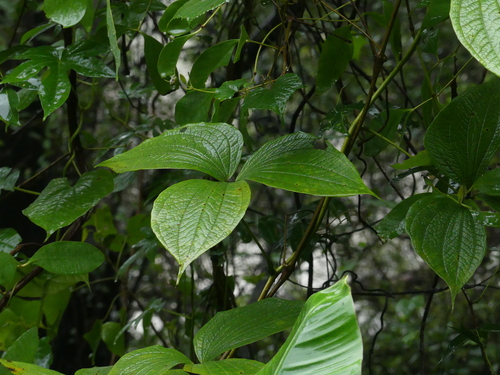
(c) Radha Veach, some rights reserved (CC BY-NC), uploaded by Radha Veach
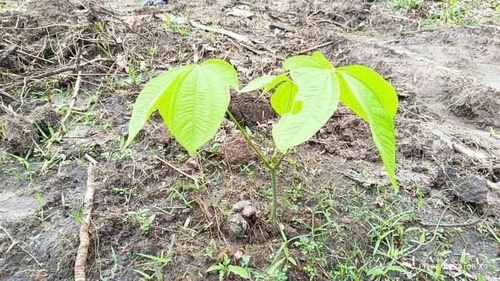
(c) lordworm_cryptopsy, some rights reserved (CC BY-NC)

(c) lordworm_cryptopsy, some rights reserved (CC BY-NC)
What to Eat
Edible parts: Tubers, Root, Bulbils
Several peoples use the tuber as food. The tuber is toxic when fresh due to the presence of saponins and calcium oxalate raphides, so it must be processed prior to consumption, typically by finely slicing into thin strips, placing in a sack or net, and leaving in a stream for a few days until the toxins have leached out. It is then dehydrated and cooked.
Where to Find It
A tropical plant. In the Philippines they occur in Mt Province and from Luzon to Basilan. Also common in central Luzon and northern Mindanao. Outside PNG it occurs in SE Asia and Indonesia. Plants grow from sea level to 1500 m altitude in Southern China. In Yunnan.
Asia, Bangladesh, Bhutan, Brazil, Cambodia, China, East Timor, FSM, Himalayas, India, Indochina, Indonesia, Laos, Malaysia, Nepal, Northeastern India, Pacific, Papua New Guinea, PNG, Philippines, Pohnpei, SE Asia, Sikkim, South America, Thailand, Timor-Leste, Vietnam,
How to Identify
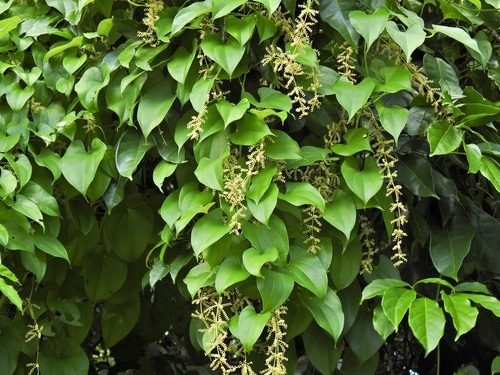
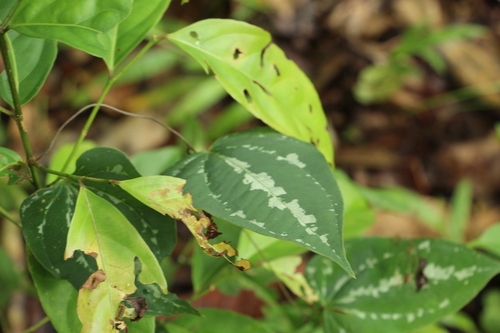
A yam. A climbing vine which can be quite long. It can be 10 m long. They twine to the left. There are thorns on the stem. It has compound leaves bearing 3 very large leaflets. The leaves can be 30 cm across. The leaflets are unequal on each side. The leaves are produced one after another along the stem. The young leaf stalks, stems and leaflets are hairy. The leaf stalk is as long as the leaflets (10-15 cm). There are small prickles on the under surface of the main vein. The flowers are small, pale yellow and borne on compound flower clusters. The fruit are 5 cm across and divided into 3 lobes. The tuber is covered with root hairs. It has lobes. Tubers are often 15-25 cm across.
Nutrition Score: 18/100
| Part | Moisture | kJ | kcal | Protein | Vit A | Vit C | Iron | Zinc |
|---|---|---|---|---|---|---|---|---|
| Tubers | 72.7 | — | — | 4.3 | — | — | — | — |
How to Grow
It can be grown from a tuber. The tuber can continue to increase in size over several years.
Medicinal Uses
Grated gadung tubers are utilized in Indonesia and China for the treatment of early-stage leprosy, warts, calluses, and fish eyes (Source: ). Additionally, the bulbs of the gadung plant are employed in treating wounds caused by syphilis. In Thailand, slices of gadung root are applied to alleviate stomach spasms, colic, and to extract pus from wounds. Furthermore, in the Philippines and China, it is used to provide relief from arthritis and rheumatism, as well as to cleanse wounds on animals. Dioscorea tubers, the main component of gadung, possess a thick mucilage consisting of water-soluble glycoproteins and polysaccharides. These glycoproteins and polysaccharides serve as water-soluble dietary fiber and function as hydrocolloids. They have demonstrated beneficial effects in reducing blood glucose levels and total cholesterol levels, particularly LDL cholesterol.
Wikipedia
Source ↗Dioscorea hispida, also known as the Indian three-leaved yam, (Tagalog: nami, Indonesia: gadung) is a species of yam in the genus Dioscorea, native to South and Southeast Asia. Known to be poisonous when fresh, careful processing is required to render it edible.
Other Information
A yam only occasionally used as an emergency food. It is occasionally cultivated.
Notes
It contains the alkaloid dioscorine which is poisonous so it needs to be treated before eating. There are about 650 species of Dioscorea.
Names & Synonyms
Bai shu liang, Baichandi, Bekoi, Bharlang, Bigap, Cu nan, Gadog, Gadong mabok, Gadong, Gadongan, Gadung, Gakn, Gang, Gloei, Halu genasu, Hasar sanga, Hati-muria alu, Hoseyar sanga, Hubi gak, Hung, Intoxicating Yam, Karot, Karukandu, Kata alu, Kalot, Kayos, Kduoch, Kedut, Khuech, Khulu sanga, Kloi, Kloy, Klut, Koi, Manovaj, Mete alu, Nami, Peiperendai, Podavakilangu, Pulidumpa, Sulur gadong, Tella-ginigeddalu, Thadangja, Ubi akas, Ubi arak, Ubi bekoi, Vaskand
References (63)
- Alegado, A. M. & De Guzman, R. B., 2014, Indigenous food crops of the Aetas tribe in the Philippines and their traditional methods of food preparation. in Promotion of Underutilized Indigenous Food Resources for Food Security and Nutrition in Asia and Pacific. FAO. Bangkok p 160
- Ambasta, S.P. (Ed.), 2000, The Useful Plants of India. CSIR India. p 175
- Anderson, E. F., 1993, Plants and people of the Golden Triangle. Dioscorides Press. p 209
- Antonio, M. A., et al, 2011. Survey and Characterization of Indigenous Food Plants in Ilocos Norte, Philippines, SEARCA Agricultural & Development Discussion Papr Series No. 2011-2
- Bandyopadhyay, S. et al, 2009, Wild edible plants of Koch Bihar district, West Bengal. Natural Products Radiance 8(1) 64-72
- Barrau, J., 1976, Subsistence Agriculture in Polynesia and Micronesia. Bernice P. Bishop Museu, Bulletin 223 Honolulu Hawaii. Kraus reprint. p 45
- Bastakoti, R., et al, 2008, Food Insecurity and dependency of Chepang Communities on Wild Edible Plants. Sustainable Forest Management and Poverty Alleviation: Roles of Traditional Forest-related Knowledge IUFRO World Series Volume 21
- Borrell, O.W., 1989, An Annotated Checklist of the Flora of Kairiru Island, New Guinea. Marcellin College, Victoria Australia. p 21
- Burkill, I.H., 1966, A Dictionary of the Economic Products of the Malay Peninsula. Ministry of Agriculture and Cooperatives, Kuala Lumpur, Malaysia. Vol 1 (A-H) p 831
- Castillo, C., 2013, The Archaeobotany of Khao Sam Kaeo and Phu Khao Thong: The Agriculture of Late Prehistoric Southern Thailand. Ph. D. thesis University College, London p 378
- Cengel, D. J. & Dany, C., (Eds), 2016, Integrating Forest Biodiversity Resource Management and Sustainable Community Livelihood Development in the Preah Vihear Protected Forest. International Tropical Timber Organization p 123
- Chatterjee, A.S. & Koma, Y.S., 1995, List of Vegetables and Edible Plants in Cambodia. JVC Trainers' training manual. Home Garden Series No. 1. JVC Cambodia p 4
- Chauhan, S. H., et al, 2018, Consumption patterns of wild edibles by the Vasavas: a case study from Gujarat, India. Journal of Ethnobiology and Ethnomedicine (2018) 14:5
- Coursey, D.G., 1979, Yams, in Simmonds N.W.,(ed), Crop Plant Evolution. Longmans. London. p 70
- Ding Zhizun, Gilbert, M. G., DIOSCOREACEAE, shu yu ke, Flora of China,
- Dutta, B., 2015, Food and medicinal values of certain species of Dioscorea with special reference to Assam. Journal of Pharmacognosy and Phytochemistry. 3(4): 15-18
- Eiadthong, W., et al, 2010, Management of the Emerald Triangle Protected Forests Complex. Botanical Consultant Technical Report. p 23
- French, B.R., 1986, Food Plants of Papua New Guinea, A Compendium. Asia Pacific Science Foundation p 13
- Gautam, R. S., et al, 2022, Ethnobotanical Review of Wild Edible Plants of Nepal. Journal of Natural History Museum Volume 32, 2021-22 p 112
- Hedrick, U.P., 1919, (Ed.), Sturtevant's edible plants of the world. p 273 (As Dioscorea daemona)
- http://palaeoworks.anu.edu.au/Nuno_PhD/04.pdf re Timor
- Ibrahim, N., 1994, Trace metals in tropical yam species: Dioscorea spp. Food Chemistry 51:5-6
- Jha, P. K., et al, 1996, Plant genetic resources of Nepal: A guide for plant breeders of agricultural, horticultural and forestry crops. Euphytica 87:189-210
- Johnson, N., 2002, Environmental Change in northern Thailand: Impact on Wild Edible Plant Availability. Ecology of Food and Nutrition, 41: 5, 373-399
- Kachenchart, B., et al, 2008, Phenology of Edible Plants at Sakaerat Forest. In Proceedings of the FORTROP II: Tropical Forestry Change in a Changing World. Bangkok, Thailand.
- Kay, D.E., 1973, Root Crops, Digest 2, Tropical Products Institute, London, p 190, 220
- Kumar, G.M., & Shiddamallayya, N., 2014, Documentation of Wild Plant Tubers as Food Resources in Hassan District, Karnataka, International Journal of Applied Biology and Pharmaceutical Technology. 5(2) p 91
- Kuvar, S. D. & Shinde, R. D., 2019, Wild Edible Plants used by Kokni Tribe of Nasik District, Maharashtra. Journal of Global Biosciences. Volume 8, Number 2, 2019, pp. 5936-5945
- Lembaga Biologi Nasional, 1977, Ubi-Ubian, Balai Pustaka, Jakarta. p 24
- Lacuna-Richman, C., 2006, The use of non-wood forest products by migrants in a new settlement: experiences of a Visayan community in Palawan, Philippines. Journal of Ethnobiology and Ethnomedicine. 2:36
- Lim, T. K., 2015, Edible Medicinal and Non Medicinal Plants. Volume 9, Modified Stems, Roots, Bulbs. Springer p 35
- Macmillan, H.F. (Revised Barlow, H.S., et al) 1991, Tropical Planting and Gardening. Sixth edition. Malayan Nature Society. Kuala Lumpur. p 339
- Maghirang, R. G., et al, 2018. Ethnobotanical Studies of Some Plants Commonly Used as Vegetables in Selected Provinces of the Philippines. Journal of Nature Studies. 17(2), 30-43.
- Marandi, R. R. & Britto, S. J., 2015, Medicinal Properties of Edible Weeds of Crop Fields and Wild plants Eaten by Oraon Tribals of Latehar District, Jharkhand. International Journal of Life Science and Pharma Research. Vo. 5. (2) April 2015 (As Dioscorea daemona)
- Massal, E and Barrau, J., 1973, Food Plants of the South Sea Islands. SPC Technical Paper No 94. Nounea, New Caledonia. p 12-15
- McMakin, P.D., 2000, Flowering Plants of Thailand. A Field Guide. White Lotus. p 48
- Menisa, A. A., et al, 2012, Survey and characterization of Indigenous Food Plants in Ilocos Norte, Philippines. SEARCA Discussion Paper series No. 2011-2
- Mishra, M., 2013, Utilization of wild tuberous plants in extreme environmental condition: A Case of Baiga Tribe of Central India. The Journal of Ethnobiology and Traditional Medicine. Photon 118 (2013) 366-372 (As Dioscorea daemona)
- Misra, R. C., et al, 2013, Genetic resources of wild tuberous food plants traditionally used in Similipal Biosphere Reserve, Odisha, India. Genetic Resources and Crop Evolution. Vol. 60 No. 2. Springer
- Mohd, N. G. et al, 2014, A Preliminary Flora Survey in Gunung Kajang, Pulau Tioman, Pahang Darul Makmur, Malaysia. Malays. Appl. Biol. 43(2): 17-23
- Monsalud, M.R., Tongacan, A.L., Lopez, F.R., & Lagrimas, M.Q., 1966, Edible Wild Plants in Philippine Forests. Philippine Journal of Science. p 460
- Nashriyah, N. et al, 2011, Ethnobotany and Distribution of Wild Edible Tubers in Pulau Redang and Nearby Islands of Terengganu, Malaysia. World Academy of Science, Engineering and Technology International Journal of Nutrition and Food Engineering Vol:5, No:12,
- Ochse, J.J. et al, 1931, Vegetables of the Dutch East Indies. Asher reprint. p 250
- Ogle, B. M., et al, 2003, Food, Feed or Medicine: The Multiple Functions of Edible Wild Plants in Vietnam. Economic Botany 57(1): 103-117
- Pandy, R. K. & Saini, S. K., 2007, Edible plants of tropical forests among tribal communities of Madhya Pradesh. Indian Journal of Traditional Knowledge. 6(1), pp 185-190 (As Dioscorea daemona)
- Peekel, P.G., 1984, (Translation E.E.Henty), Flora of the Bismarck Archipelago for Naturalists, Division of Botany, Lae, PNG. p 97, 96
- Phon, P., 2000, Plants used in Cambodia. © Pauline Dy Phon, Phnom Penh, Cambodia. p 236
- Purseglove, J.W., 1972, Tropical Crops. Monocotyledons. Longmans p 106
- Schluessel Hortus malab. 33. 1818
- Sheikh, N., et al, 2009, Status documentation of Dioscorea L. (Dioscoreaceae) in Meghalaya: an approach towards food security. Pleione 3(1): 74 - 82
- Singh, H.B., Arora R.K.,1978, Wild edible Plants of India. Indian Council of Agricultural Research, New Delhi. p13
- Singh, G. & Kumar, J., 2015, Diversity of Wild Edible Yams and its Traditional Knowledge Among Munda Tribe of District Khunti, Jharkhand, India. International Journal of Bioassays. 4.10: 4440-4442
- Somnasang, P., Moreno, G and Chusil K., 1998, Indigenous knowledge of wild hunting and gathering in north-east Thailand. Food and Nutrition Bulletin 19(4) p 359f
- Sujarwo, W., et al, 2016, Traditional knowledge of wild and semi-wild edible plants used in Bali (Indonesia) to maintain biological and cultural diversity. Plant Biosystems, 2016, Vol. 150, No. 5, 971-976
- Sukarya, D. G., (Ed.) 2013, 3,500 Plant Species of the Botanic Gardens of Indonesia. LIPI p 922
- Suwardi, A. B., 2018, Nutritional Evaluation of Some Wild Edible Tuberous Plants as Alternative Foods. Innovare Journal of Food Science, Vol. 6, Issue 2.
- Thorng, R., et al, 2015, Roles of Wild Food Plants in Ethnic Group Communities in Mondulkiri Province, Northeastern Cambodia. Journal of Mekong Societies Vol.11 No.2 May-August 2015 pp. 1-17
- Toppo, P. et al, 2016, Wild edible plants of Dhamtari district of Chhattisgarh, India. Van Sangyan Vol. 3, No. 4
- Trimanto, & Hapsari L., 2016, Botanical survey in thirteen montane forests of Bawean Island Nature Reserve, East Java Indonesia: Conservation status, bioprospecting and potential tourism. Biodiversitas 17: 832-846.
- Tutul, E et al, 2009, Angiospermic Flora of Runctia Sal Forest, Bangladesh. Bangladesh J. Plant Taxon. 16(1): 83-90. p 88
- Wiersema, J. H. & Leon, B., 2013, World Economic Plants. A Standard Reference CRC Press. 2nd Ed. p 248
- Wild edible plants of Himachal Pradesh
- World Checklist of Useful Plant Species 2020. Royal Botanic Gardens, Kew