Dioscorea luzonensis
Schauer

Wikimedia Commons - UPLB MNH Digital Archives

Wikimedia Commons - UPLB MNH Digital Archives
What to Eat
Edible parts: Tubers, Root
Tubers - cooked. Used like potatoes. The white or pinkish-white flesh is succulent. The tubers can be 1 metre long.
Where to Find It
A tropical plant. In the Philippines found in Ilocos, Norte, Bontoc and Lepanto, Mt Province, La Union, Bulacan, Zambales, Rizal, Laguna and Batangas.
Asia, Pacific, Philippines, SE Asia,
How to Identify
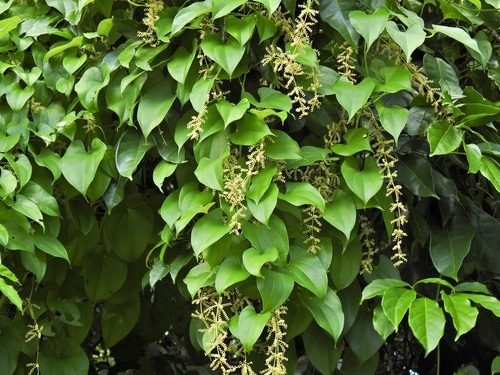
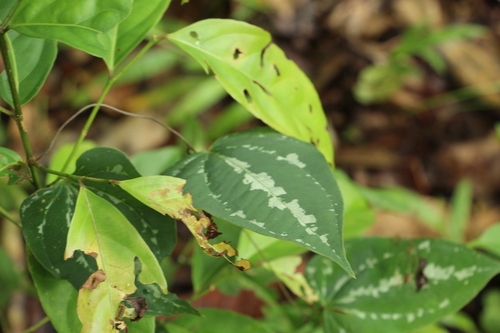
A yam with a twining vine with arrow shaped leaves. It twines to the right. The tubers are round and 5 cm across. The tubers can be 1 m deep in the soil. The flesh is white or pink. The stems do not have spines. The leaves are simple and usually alternate. The leaf stalk is as long as the blade. The leaf is heart shaped. It is 15 cm long and 12 cm across. The small flowers occur in spikes which grow in clusters from the axils of leaves. The male flowers curve upwards. There are 2-4 together. They are 7 cm long with about 60 flowers which do not have stalks. The female flower stalks are 22 cm long. The fruit are divided into thin half round lobes with thin winged seeds.
Nutrition Score: 42/100
| Part | Moisture | kJ | kcal | Protein | Vit A | Vit C | Iron | Zinc |
|---|---|---|---|---|---|---|---|---|
| Tuber | 74.7 | 405 | 97 | 2.5 | — | 18 | 0.7 | — |
Notes
There are about 650 species of Dioscorea.
Names & Synonyms
Kamangeg, Kamengeg, Mayat-bang, Pakit
References (8)
- Antonio, M. A., et al, 2011. Survey and Characterization of Indigenous Food Plants in Ilocos Norte, Philippines, SEARCA Agricultural & Development Discussion Papr Series No. 2011-2
- Brown, W.H., 1920, Wild Food Plants of the Philippines. Bureau of Forestry Bulletin No. 21 Manila. p 31
- Ferns, Useful Tropical Plants
- Maghirang, R. G., et al, 2018. Ethnobotanical Studies of Some Plants Commonly Used as Vegetables in Selected Provinces of the Philippines. Journal of Nature Studies. 17(2), 30-43.
- Menisa, A. A., et al, 2012, Survey and characterization of Indigenous Food Plants in Ilocos Norte, Philippines. SEARCA Discussion Paper series No. 2011-2
- Monsalud, M.R., Tongacan, A.L., Lopez, F.R., & Lagrimas, M.Q., 1966, Edible Wild Plants in Philippine Forests. Philippine Journal of Science. p 460
- PROSEA handbook Volume 9 Plants yielding non-seed carbohydrates. p 172
- World Checklist of Useful Plant Species 2020. Royal Botanic Gardens, Kew