Dioscorea minutiflora
Engl.
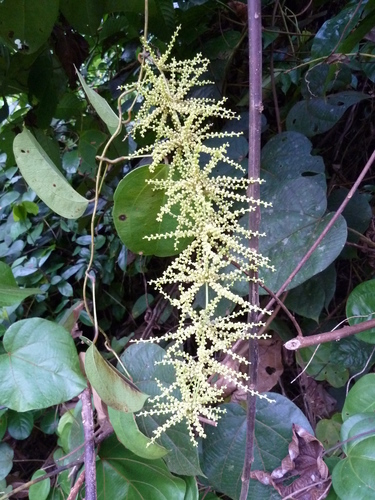
(c) Carel Jongkind, some rights reserved (CC BY-NC), uploaded by Carel Jongkind
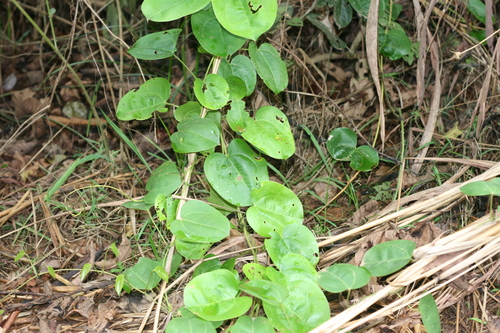
(c) Luc Strydom, some rights reserved (CC BY-NC)
What to Eat
Edible parts: Tubers, Root, Vegetable
Tuber - cooked. Seen mainly as a food for use in times of shortage, usually only the lower portion is eaten, and then only while still young. Prolonged soaking of the tuber is required before it can be eaten, not so much because of any traces of toxicity as because of the woodiness of the tissue.
Where to Find It
A tropical plant. It grows in secondary clearings in rainforest in Congo. It is in humid areas and well-drained soils. It suits humid locations. In Kenya it grows between 1,500-2,400 m altitude. It is in areas with more than 700 mm rainfall.
Africa, Benin, Burkina Faso, Cameroon, Central Africa, Central African Republic, CAR, Comoros, Congo DR, Congo R, Côte d'Ivoire, East Africa, Gabon, Ghana, Ivory Coast, Kenya, Liberia, Madagascar, Nigeria, Sao Tome and Principe, Senegal, Sierra Leone, Tanzania, Uganda, West Africa,
How to Identify
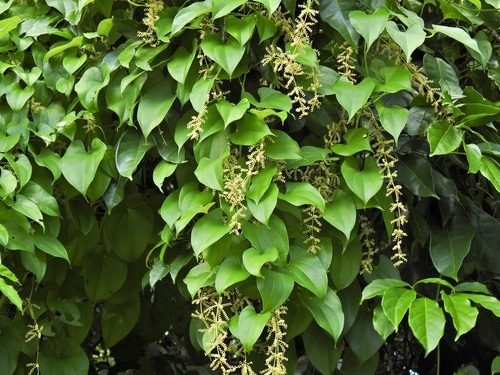
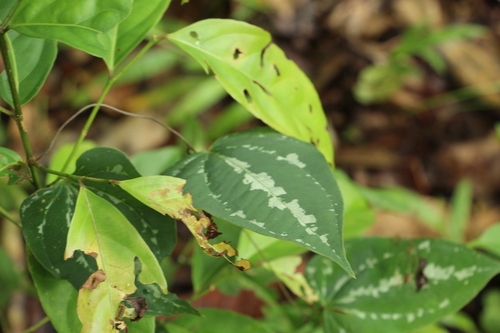
A yam. It is a vine plant. The tubers are below a woody crown. They can be at the end of finger like projections. The stems twine to the right. They are round. The leaves are opposite and entire. They can be papery and prickly. There are no bulbils along the stem. The tubers keep developing from year to year.
Nutrition Score: 36/100
| Part | Moisture | kJ | kcal | Protein | Vit A | Vit C | Iron | Zinc |
|---|---|---|---|---|---|---|---|---|
| Tuber | 68.4 | 493 | 118 | 3 | — | — | — | — |
How to Grow
It is grown from the base of the hard branched stem base. The stems need supports to climb over.
Medicinal Uses
The leaves are squeezed in water, which is then added to gin and taken as a treatment for jaundice. The leafy stems are pulped up to make a topical application for skin-affections.
Production
Tubers can be harvested after 2-3 years. Plants can be left to grow for 20 years.
Other Information
It is a cultivated plant.
Notes
There are about 650 species of Dioscorea.
Names & Synonyms
Aha bayere, Bihama, Buki, Ekihama, Endika, Hazara, Ikeke, Kaama, Koukou, Kpeinkoh-leh, Kuku, Lepheyo, Lewa, Magoraza, Opheyipheyi, Oviazo
References (28)
- Agea, J. G., et al 2011, Wild and Semi-wild Food Plants of Bunyoro-Kitara Kingdom of Uganda: etc. Environmental Research Journal 5(2) 74-86
- Billong Fils, P. E., et al, 2020, Ethnobotanical survey of wild edible plants used by Baka people in southeastern Cameroon. Journal or Ethnobiology and Ethnomedicine. 16:64 p 7
- Bongers, F. et al (Eds), Forest Climbing Plants of West Africa: Diversity, Ecology and Management. CABI
- Burkill, H. M., 1985, The useful plants of west tropical Africa, Vol. 1. Kew.
- Codjia, J. T. C., et al, 2003, Diversity and local valorisation of vegetal edible products in Benin. Cahiers Agricultures 12:1-12
- Godfrey, J. et al, 2013, Harvesting, preparationand preservation of commonly consumed wild and semi-wild food plants in Bunyoro-Kitara Kingdom, Uganda. Int. J. Med. Arom. Plants. Vol.3 No.2 pp 262-282
- Grivetti, L. E., 1980, Agricultural development: present and potential role of edible wild plants. Part 2: Sub-Saharan Africa, Report to the Department of State Agency for International Development. p 24
- Grubben, G. J. H. and Denton, O. A. (eds), 2004, Plant Resources of Tropical Africa 2. Vegetables. PROTA, Wageningen, Netherlands. p 561
- Hawthorne, W.& Marshall, C., 2013, Nimba Western Area Iron Ore Concentrator Mining Project Environmental and Social Impact Assessment. AcelorMittel Liberia. p 474
- Herb., E. A., 1981,
- http://aflora.africa.kyoto-u.ac.jp
- IRVINE,
- Jardin, C., 1970, List of Foods Used In Africa, FAO Nutrition Information Document Series No 2.p 14 (Also as Dioscorea acarophyta, D ekolo, D. engbo, Dioscorea armata)
- Lim, T. K., 2015, Edible Medicinal and Non Medicinal Plants. Volume 9, Modified Stems, Roots, Bulbs. Springer p 36
- Maundu, P. et al, 1999, Traditional Food Plants of Kenya. National Museum of Kenya. 288p
- MORTIMORE,
- Msuya, T. S., et al, 2010, Availability, Preference and Consumption of Indigenous Foods in the Eastern Arc Mountains, Tanzania, Ecology of Food and Nutrition, 49:3, 208-227
- Mutie, F. M., et al, 2023, Important Medicinal and Food Taxa (Orders and Families) in Kenya, Based on Three Quantitative Approaches. Plants 2023, 12, 1145
- Nkeoua, G. & Boundzanga, G. C., 1999, Donnees sur les produits forestieres non ligneux en Republique du Congo. FAO. p 25
- Peters, C. R., O'Brien, E. M., and Drummond, R.B., 1992, Edible Wild plants of Sub-saharan Africa. Kew. p 17
- Sato, H., 2001, The potential of edible wild yams and yam-like plants as a staple food resource in the African Tropical Rain Forest. African Study Monographs Suppl. 26:123-134
- Terashima, H., & Ichikawa, M., 2003, A comparative ethnobotany of the Mbuti and Efe hunter-gatherers in the Ituri Forest, Democratic Republic of Congo. African Study Monographs, 24 (1, 2): 1-168, March 2003
- Termote, C., et al, 2011, Eating from the wild: Turumbu, Mbole and Bali traditional knowledge of non-cultivated edible plants, District Tshopo, DRCongo, Gen Resourc Crop Evol. 58:585-618
- Tugume, P. & Nyakoojo, C., 2020, Traditional use of wild edible plants in the communities adjacent to Mabira Central Forest Reserve, Uganda. Ethnobotany Research & Applications 20:15 (2020)
- Wilkin, P. et al, 2007, A new edible yam (Dioscorea L.) species endemic to Mayotte, new data on D. comorensis R. Knuth and a key to the yams of the Comoro Archipelago. Adansonia ser. 3, 29(2): 215-228
- World Checklist of Useful Plant Species 2020. Royal Botanic Gardens, Kew
- Yasuoka, H., 2006, Long-Term Foraging Expeditions (Molongo) among the Baka Hunter-Gatherers in the Northwestern Congo Basin, with Special Reference to the "Wild Yam Question". Human Ecology, Vol. 34, No. 2, April 2006, pp 275 ff
- Yasuoka, H., 2009, Concentrated Distribution of Wild Yam Patches: Historical Ecology and the Subsistence of African Rainforest Hunter-Gatherers. Human Ecology 37:577-587