Dioscorea pentaphylla
L.
Five leaflet yam
(c) Paulmathi Vinod, some rights reserved (CC BY), uploaded by Paulmathi Vinod

(c) Satish Nikam, some rights reserved (CC BY-NC-SA)
(c) Kobita Dass Kolli, some rights reserved (CC BY-NC), uploaded by Kobita Dass Kolli
What to Eat
Edible parts: Tubers, Root, Leaves, Flowers, Bulbils
The underground and aerial tubers are eaten boiled or roasted. Bulbils are also cooked and eaten. The leaves and flowers are reported to be eaten in India.
Known Hazards
Where to Find It
A tropical plant. They grow from sea level up to 1600 m. It needs a well drained, well aerated soil. They are best adapted to an abundant rainfall during the growing season and an annual dry season. Soils need to be fertile. Five leaflet yam or Dioscorea pentaphylla L. occurs mainly in China; Malaysia; India; Indonesia; the Philippines; Papua New Guinea and into the Pacific Islands. It is common and widely distributed throughout the Philippines. In Yunnan.
American Samoa, Andamans, Asia, Australia, Bangladesh, Bhutan, Brazil, Cambodia, China (Yunnan), Cook Is., Fiji, Guam, Hawaii, Himalayas, India, Indochina, Indonesia, Japan, Laos, Malaysia, Marquesas, Micronesia, Myanmar, Nepal, New Caledonia, Niue, Northeastern India, Pacific, Palau, Papua New Guinea, PNG, Philippines, Samoa, SE Asia, Sikkim, Solomon Islands, South America, Sri Lanka, Taiwan, Thailand, Tibet, Tonga, Vanuatu, Vietnam, Wallis & Futuna, Yap,
How to Identify
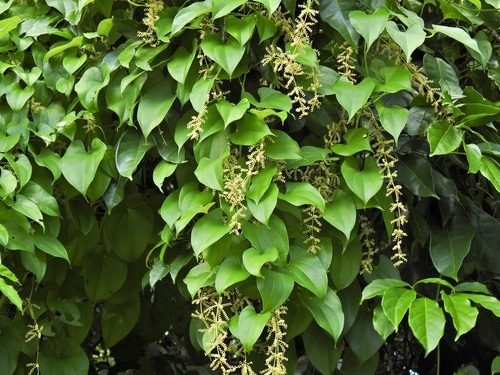
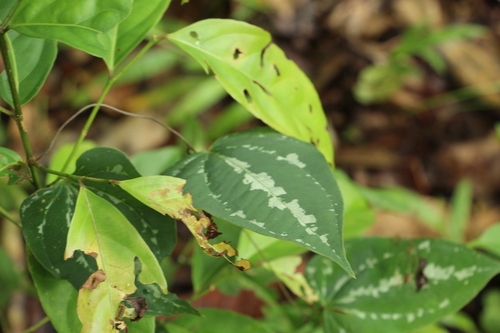
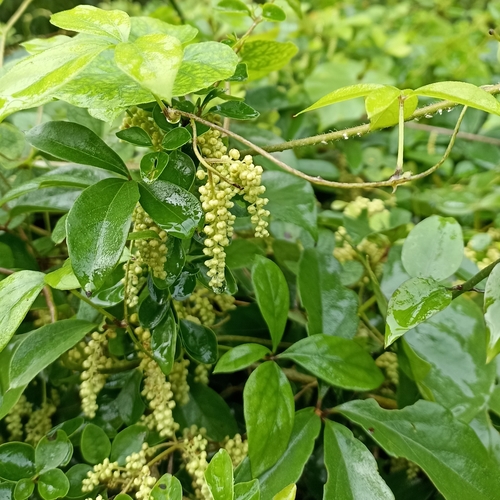
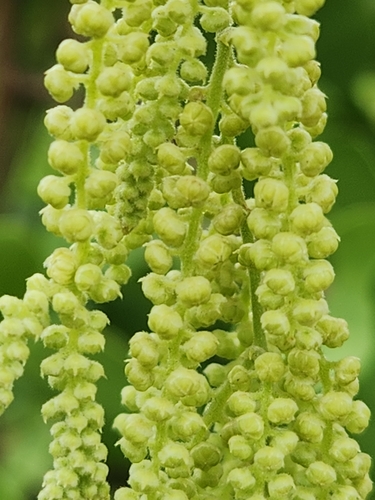
A yam with a climbing vine 2-5 m long. The stems have scattered small spines. There are small tubers found in the axils of the leaves as well as larger underground tubers. The leaves have 5 to 7 leaflets pointed at the tip and 8 to 15 cm long. Often the lower leaves have 5-7 leaflets and upper leaves have 3 leaflets. The leaflets are spread out like fingers on a hand. The leaves are finely hairy. The flowers are small, yellowish white with a slight smell and borne in large numbers of flower clusters in the axils of leaves. The male flower spikes are 10-18 cm long and mostly occur as two together in the axil of a leaf. The female spikes occur as 1-3 together and are as long as the male ones. The fruit are winged capsules 8-12 mm long by 6-9 mm wide. The tubers vary in colour and shape. Often they are round and covered with long hairs.
Nutrition Score: 32/100
| Part | Moisture | kJ | kcal | Protein | Vit A | Vit C | Iron | Zinc |
|---|---|---|---|---|---|---|---|---|
| Root | 80 | 266 | 64 | 2.3 | — | 2.8 | 0.44 | 0.4 |
How to Grow
They are grown from tubers or pieces of tubers. They can be grown from aerial tubers. The dormancy of the tuber can be short. They need stakes for support. Stakes of about 2 m are adequate although live stakes are often used. They often grow wild.
Propagation: Seed - not normally used to propagate this species. Cuttings of tubers. Small tubers can be cut into 2 - 4 sections, larger ones into 6 - 8 sections. Each section should have 2 - 3 dormant buds. The cut tuber is often left in the sun for several hours to promote wound healing and reduce the risk of fungal infection.
Medicinal Uses
No medicinal uses mentioned in data.
Wikipedia
Source ↗Dioscorea pentaphylla is a species of flowering plant in the yam family known by the common name fiveleaf yam. It is native to southern and eastern Asia (China, India, Indochina, Indonesia, Philippines, etc.) as well as New Guinea, Sri Lanka and northern Australia. It is widely cultivated as a food crop and naturalized in Cuba and on several island chains in the Pacific (including Hawaii). Dioscorea pentaphylla is a prickly vine that twines counterclockwise around objects and other plants. It may reach 10 meters in length. The alternately arranged leaves are compound, divided into 3 to 5 leaflets each up to 10 centimeters long. The plant produces horseshoe-shaped bulbils about a centimeter long. New plants can sprout from the bulbils. Flowers are borne in spikes. The vine grows from a tuber. Specimens may weigh 3 pounds and may be located over a meter underground. The tubers of the vine can be cooked and eaten.
Production
Tubers are harvested after the vines die back.
Other Information
This yam is not widely used in Papua New Guinea, but it can be found occasionally in many areas. It is sold in local markets. It is cultivated.
Notes
There are about 650 species of Dioscorea.
Names & Synonyms
Allai, Alshi, Aser, Babra, Baha, Bantarul, Bayan alu, Bhaegur, Bhusa, Bhyagur, Bhyakur, Boiato, C jing, Chai, Chatavali, Chavi, Chedhukandhi, Chuinyan, Damlong teuk, De de, Dui yi bao, Dukapendalamu, Dure dari, Fi’i arakai, Gazaria, Gholongi, Hill, Huoyimian, Huvdo, Huwi dawata, Jabet, Jangli-alu, Kaadu gumbala, Kaile, Kala kand, Kanta alu, Kataalu Katavala, Kattukilangu, Kattukkillangu, Katuala, Kokolo, Kophrehro, Koshauk-rik, Kusok, Kyway-u, Lavati Aniv, Lima-lima, Man awn, Man hing, Mandi, Mithe tarul, Nakwa kanda, Nealengu, Nuraigenasu, Nurunnaki-langu, Nyivanyi, Pachpotia alu, Padmati, Pakatiro, Pan-dang, Parauara, Pas, Paspotia alu, Pilita, Put-sa-u, Ram bahra, Ruipheng, Sapang, Ser, Shahada, Shanedvel, Stenz, Suar alu, Suarkand, Tabongo, Taigun, Takuli, Tha bolong, Thaphin, Tokatolu, Ubi pasir, Ubi sakai, Ubi sanda, Ulashi, Ulasi, Uli, Utau, Vor dom loung teuk, Vymu dumpa, Yi bao
References (103)
- Ambasta, S.P. (Ed.), 2000, The Useful Plants of India. CSIR India. p 175
- Anderson, E. F., 1993, Plants and people of the Golden Triangle. Dioscorides Press. p 209
- Arora, K., Indigenous Forest Management in the Andaman and Nicobar Islands, India.
- Aryal, K. P. et al, 2009, Uncultivated Plants and Livehood Support - A case study from the Chepang people of Nepal. Ethnobotany Research and Applications. 7:409-422
- Avinash, B. K., Kumar, R., et al, 2013, Ethnoboptany of Tharus of Dudhwa National Park, India. Mintage journal of Pharmaceutical & Medical Science 6-11
- Balkrishna, A., et al, 2022, Indigenous Uses of Plants among Forest-dependent Communities of Seijosa, Arunachal Pradesh. International Journal of Economic Plants 2022, 9(1):064-080
- Bandyopadhyay, S. et al, 2009, Wild edible plants of Koch Bihar district, West Bengal. Natural Products Radiance 8(1) 64-72
- Bandyopadhyay, S., et al, 2012, A Census of Wild Edible Plants from Howrah District, West Bengal, India. Proceedings of UGC sponsored National Seminar 2012
- Bastakoti, R., et al, 2008, Food Insecurity and dependency of Chepang Communities on Wild Edible Plants. Sustainable Forest Management and Poverty Alleviation: Roles of Traditional Forest-related Knowledge IUFRO World Series Volume 21
- BHARGAVA,
- Borrell, O.W., 1989, An Annotated Checklist of the Flora of Kairiru Island, New Guinea. Marcellin College, Victoria Australia. p 21
- Bourret, D., 1981, Bonnes-Plantes de Nouvelle-Caledonie et des Loyaute. ORSTOM. p 40
- Brown, W.H., 1920, Wild Food Plants of the Philippines. Bureau of Forestry Bulletin No. 21 Manila. p 36
- Burkill, I.H., 1966, A Dictionary of the Economic Products of the Malay Peninsula. Ministry of Agriculture and Cooperatives, Kuala Lumpur, Malaysia. Vol 1 (A-H) p 835
- Cao, Y., et al, 2020, Ethnobotanical study on wild edible plants used by three trans-boundary ethnic groups in Jiangcheng County, Pu’er, Southwest China. Journal of Ethnobiology and Ethnomedicine (2020) 16:66
- Castillo, C., 2013, The Archaeobotany of Khao Sam Kaeo and Phu Khao Thong: The Agriculture of Late Prehistoric Southern Thailand. Ph. D. thesis University College, London p 378
- Cengel, D. J. & Dany. C., (Eds), 2016, Integrating Forest Biodiversity Resource Management and Sustainable Community Livelihood Development in the Preah Vihear Protected Forest. International Tropical Timber Organization p 110
- Chatterjee, A.S. & Koma, Y.S., 1995, List of Vegetables and Edible Plants in Cambodia. JVC Trainers' training manual. Home Garden Series No. 1. JVC Cambodia
- Chauhan, S. H., et al, 2018, Consumption patterns of wild edibles by the Vasavas: a case study from Gujarat, India. Journal of Ethnobiology and Ethnomedicine (2018) 14:5
- Cheng, Z., et al, 2022, Ethnobotanical study on wild edible plants used by Dulong people in northwestern Yunnan, China. Journal of Ethnobiology and Ethnomedicine (2022) 18:3
- Chowdery, T., et al, 2014, Wild edible plants of Uttar Dinajpur District, West Bengal. Life Science Leaflets. 47:pp 20-36 http://lifesciencesleaflets.ning.com
- Coursey, D.G., 1979, Yams, in Simmonds N.W.,(ed), Crop Plant Evolution. Longmans. London. p 70
- Dangol, D. R. et al, 2017, Wild Edible Plants in Nepal. Proceedings of 2nd National Workshop on CUAOGR, 2017.
- Ding Zhizun, Gilbert, M. G., DIOSCOREACEAE, shu yu ke, Flora of China,
- Dutta, B., 2015, Food and medicinal values of certain species of Dioscorea with special reference to Assam. Journal of Pharmacognosy and Phytochemistry. 3(4): 15-18
- Facciola, S., 1998, Cornucopia 2: a Source Book of Edible Plants. Kampong Publications, p 91
- Franklin, J., Keppel, G., & Whistler, W., 2008, The vegetation and flora of Lakeba, Nayau and Aiwa Islands, Central Lau Group, Fiji. Micronesica 40(1/2): 169–225, 2008
- French, B.R., 1986, Food Plants of Papua New Guinea, A Compendium. Asia Pacific Science Foundation p 12
- French, B.R., 2010, Food Plants of Solomon Islands. A Compendium. Food Plants International Inc. p 23
- GAMMIE,
- Gautam, R. S., et al, 2022, Ethnobotanical Review of Wild Edible Plants of Nepal. Journal of Natural History Museum Volume 32, 2021-22 p 112
- Gillaumin, R., 1954, Les Plantes utiles des Nouvelles-Hebrides (fin et complement) In: Journal d'agriculture tropicale et de botanique appliquee Vol. 1, No. 10-12 pp 453-460
- GUPTA,
- GUPTA & KANODIA,
- HANDY,
- Hedrick, U.P., 1919, (Ed.), Sturtevant's edible plants of the world. p 274
- Henderson, C.P. and Hancock, I.R., 1988, A Guide to the Useful Plants of Solomon Islands. Res. Dept. Ministry of Agriculture and Lands, Honiara, Solomon Islands, p 24
- Hossain, U. & Rahman, A., 2018, Study and quantitative analysis of wild vegetable floral diversity available in Barisal district, Bangladesh. Asian J. Med. Biol. Res. 2018, 4 (4), 362-371
- Jha, P. K., et al, 1996, Plant genetic resources of Nepal: A guide for plant breeders of agricultural, horticultural and forestry crops. Euphytica 87:189-210
- Jose, D. T. & Sasidharan, N., 2016, Checklist of wild edible plants of Aralam Wildlife sanctuary, Kerala, India. South Indian Journal Of Biological Sciences 2016; 2(1); 141‐144
- Joshi, N., et al, 2007, Traditional neglected vegetables of Nepal: Their sustainable utilization for meeting human needs. Tropentag 2007. Conference on International Agricultural Research for Development.
- Kar, A., & Borthakur, S. K., 2008, Wild vegetables of Karbi - Anglong district, Assam, Natural Product Radiance, Vol. 7(5), pp 448-460
- Kiran, K. C., et al, 2019, Diversity and Seasonal Availability of Potential Wild Edible Plants from Vidarbha Region of Maharashtra State, India. Int.J.Curr.Microbiol.App.Sci (2019) 8(2): 1434-1446
- Kumar, G.M., & Shiddamallayya, N., 2014, Documentation of Wild Plant Tubers as Food Resources in Hassan District, Karnataka, International Journal of Applied Biology and Pharmaceutical Technology. 5(2) p 91
- Kuvar, S. D. & Shinde, R. D., 2019, Wild Edible Plants used by Kokni Tribe of Nasik District, Maharashtra. Journal of Global Biosciences. Volume 8, Number 2, 2019, pp. 5936-5945
- Lacuna-Richman, C., 2006, The use of non-wood forest products by migrants in a new settlement: experiences of a Visayan community in Palawan, Philippines. Journal of Ethnobiology and Ethnomedicine. 2:36
- Lebot, V. & Sam, C., Green desert or ‘all you can eat’? How diverse and edible was the flora of Vanuatu before human introductions?. Terra australis 52 p 410
- Lembaga Biologi Nasional, 1977, Ubi-Ubian, Balai Pustaka, Jakarta. p 38
- Li, S., et al, 2020, Monpa, memory, and change: an ethnobotanical study of plant use in Mêdog County, South-east Tibet, China. Journal of Ethnobiology and Ethnomedicine. (2020) 16:5 p 17
- Lim, T. K., 2015, Edible Medicinal and Non Medicinal Plants. Volume 9, Modified Stems, Roots, Bulbs. Springer p 37
- Low, T., 1991, Wild Food Plants of Australia. Australian Nature FieldGuide, Angus & Robertson. p 121
- Low, T., 1992, Bush Tucker. Australia’s Wild Food Harvest. Angus & Robertson. p 107
- Maghirang, R. G., et al, 2018. Ethnobotanical Studies of Some Plants Commonly Used as Vegetables in Selected Provinces of the Philippines. Journal of Nature Studies. 17(2), 30-43.
- Manandhar, N.P., 2002, Plants and People of Nepal. Timber Press. Portland, Oregon. p 203
- Marandi, R. R. & Britto, S. J., 2015, Medicinal Properties of Edible Weeds of Crop Fields and Wild plants Eaten by Oraon Tribals of Latehar District, Jharkhand. International Journal of Life Science and Pharma Research. Vo. 5. (2) April 2015
- Massal, E and Barrau, J., 1973, Food Plants of the South Sea Islands. SPC Technical Paper No 94. Nounea, New Caledonia. p 12-15
- Mareenoon, K. et al, 2008, Ethnobotany of Dioscorea L. (Dioscoreaceae), a Major Food Plant of the Sakai Tribe at Banthad Range, Peninsular Thailand. Ethnobotany Reaearch & Applications 6:385-394
- Medhi, P. and Borthakur, S. K., 2011, Genetic Resources of Root and Tuber Crops from North Cachar Hills of Assam. Journal of Root Crops, Vol. 37No.2 pp. 131-143
- Medhi, P., Sarma, A and Borthakur, S. K., 2014, Wild edible plants from the Dima Hasao district of Assam, India. Pleione 8(1): 133-148
- Meitei, L. R., et al, 2022, An ethnobotanical study on the wild edible plants used by forest dwellers in Yangoupokpi Lokchao Wildlife Sanctuary, Manipur, India. Ethnobotany Research and Application 23:15
- Misra, R. C., et al, 2013, Genetic resources of wild tuberous food plants traditionally used in Similipal Biosphere Reserve, Odisha, India. Genetic Resources and Crop Evolution. Vol. 60 No. 2. Springer
- Monsalud, M.R., Tongacan, A.L., Lopez, F.R., & Lagrimas, M.Q., 1966, Edible Wild Plants in Philippine Forests. Philippine Journal of Science. p 460
- Mukhia, P.K., et al, 2013, Wild plants as Non Wood Forest Products used by the rural community of Dagana, a southern foothill district of Bhutan, SAARC Journal, 27 pages
- Murtem, G. & Chaudhrey, P., 2016, An ethnobotanical note on wild edible plants of Upper Eastern Himalaya, India. Brazilian Journal of Biological Sciences, 2016, v. 3, no. 5, p. 63-81
- NEAL,
- Nilegaonkar, S., et al, 1985, Nutritional Evaluation of some wild food plants from the Pune and Nieghbouring districts, Maharashtra state: Part 1. J. Econ. Tax. Bot. Vol. 6 No. 3 pp 629-635
- Ochse, J.J. et al, 1931, Vegetables of the Dutch East Indies. Asher reprint. p 255
- Parham, B. E. V., 1972, Plants of Samoa. New Zealand Department of Scientific and Industrial Research. Information Series. No. 85 p 136
- Patiri, B. & Borah, A., 2007, Wild Edible Plants of Assam. Geethaki Publishers. p 146
- Peekel, P.G., 1984, (Translation E.E.Henty), Flora of the Bismarck Archipelago for Naturalists, Division of Botany, Lae, PNG. p 95, 94
- Pfoze, N. L., et al, 2012, Survey and assessment of floral diversity on wild edible plants from Senapati district of Manipur, Northeast India. Journal or Biodiversity and Environmental Sciences. 1(6):50-52
- Phangchopi, U., et al, 2015, Diversity of wild edible plants in Marat Longri Wildlife Sanctuary, Assam. Indian Journal of Natural Products and Resources Vol. 6(4), December 2015 pp. 305-313
- Phon, P., 2000, Plants used in Cambodia. © Pauline Dy Phon, Phnom Penh, Cambodia. p 237
- Prabha, Y. P., et al, 2010, Documentation of Wild Edible Plants of Melghat Forest, Dist. Amravati, Maharashtra State, India. Ethnobotanical Leaflets 14: 751-58, 2010.
- Purseglove, J.W., 1972, Tropical Crops. Monocotyledons. Longmans p 107
- Rahangdale, D.R. & Rahangdale, S.S., 2014, Potential Wild Edible Plant Resources from Maharashtra Future Prospects for their Conservation and Improvement. Life Science Leaflets. http://lifesciencesleaflets.ning.com
- Rajapaksha, U., 1998, Traditional Food Plants in Sri Lanka. HARTI, Sri Lanka. p 190
- Ramachandran,V. S., & Udhayavani, C., 2013, Knowledge and uses of wild edible plants by Paniyas and Kurumbas of Western Nilgiris, Tamil Nadu. Indian Journal of Natural Products and Resources. 4(4) December 2013, pp 412-418
- Rao, M. L. S., et al, 2014, Indigenous Plant Foods which are commonly consumed by the tribal communities in Dumbriguda Area of Visakhapatnam District, Andhra Pradesh, India. Biolife. Vol 2, Issue 3
- Sarma, H., et al, 2010, Updated Estimates of Wild Edible and Threatened Plants of Assam: A Meta-analysis. International Journal of Botany 6(4): 414-423
- Savita, et al, 2006, Studies on wild edible plants of ethnic people in east Sikkim. Asian J. of Bio Sci. (2006) Vol. 1 No. 2 : 117-125
- Setiya, A. V., et al, 2016, Exploration and documentation of some wild edible plants used by the aboriginals from Gadchiroli District (M.S.) India. International Advanced Research Journal in Science, Engineering and Technology. 3(7)
- Sheikh, N., et al, 2009, Status documentation of Dioscorea L. (Dioscoreaceae) in Meghalaya: an approach towards food security. Pleione 3(1): 74 - 82
- Singh, A. G., Panthi, M. P., & Tewari, D. D., 2012, Wild Plants Used as Vegetable in Rupandehi District of Nepal and their Ethnomedicinal Importance. J. Nat. Hist. Mus. Vol. 26, 2012, 111-125
- Singh, B., et al, 2012, Wild edible plants used by Garo tribes of Nokrek Biosphere Reserve in Meghalaya, India. Indian Journal of Traditional Knowledge. 11(1) pp 166-171
- Singh, H.B., Arora R.K.,1978, Wild edible Plants of India. Indian Council of Agricultural Research, New Delhi. p13
- Sp. pl. 2:1032. 1753
- Stone, B. C., 1970, The Flora of Guam. A Manual for the Identification of the Vascular Plants of the Island. Micronesica. Journal of the University of Guam. p 129
- Taram, M., et al, 2018, Wild Food Plant Resources of Komkar Adi Tribe of Upper Siang District in Arunachal Pradesh, India. Bulletin of Arunachal Forest Research, Vol. 33(2), 27-35
- Teron, R. & Borthakur, S. K., 2016, Edible Medicines: An Exploration of Medicinal Plants in Dietary Practices of Karbi Tribal Population of Assam, Northeast India. In Mondal, N. & Sen, J.(Ed.) Nutrition and Health among tribal populations of India. p 151
- Thorng, R., et al, 2015, Roles of Wild Food Plants in Ethnic Group Communities in Mondulkiri Province, Northeastern Cambodia. Journal of Mekong Societies Vol.11 No.2 May-August 2015 pp. 1-17
- Tindall, H.D., 1983, Vegetables in the Tropics, Macmillan p 216
- Turreira Garcia, N., et al, 2017, Ethnobotanical knowledgeof the Kuy and Khmer people in Prey Lang, Cambodia. Cambodian Journal of Natural History 2017 (1): 76-101
- Tutul, E et al, 2009, Angiospermic Flora of Runctia Sal Forest, Bangladesh. Bangladesh J. Plant Taxon. 16(1): 83-90. p 88
- Uprety, Y., et al, 2016, Traditional use and management of NTFPs in Kangchenjunga Landscape: implications for conservation and livelihoods. Journal of Ethnobiology and Ethnomedicine (2016) 12:19
- USDA, ARS, National Genetic Resources Program. Germplasm Resources Information Network - (GRIN). [Online Database] National Germplasm Resources Laboratory, Beltsville, Maryland. Available: www.ars-grin.gov/cgi-bin/npgs/html/econ.pl (10 April 2000)
- Walter, A. & Lebot, V., 2007, Gardens of Oceania. ACIAR Monograph No. 122 p. 93
- WATT,
- World Checklist of Useful Plant Species 2020. Royal Botanic Gardens, Kew
- Xu, You-Kai, et al, 2004, Wild Vegetable Resources and Market Survey in Xishuangbanna, Southwest China. Economic Botany. 58(4): 647-667.
- Yuncker, T. G., 1943, The Flora of Niue Island. Bernice P. Bishop Museum Bulletin 178 p 35
- Yuncker, T.G., 1959, Plants of Tonga, Bernice P. Bishop Museum, Hawaii, Bulletin 220. p 83
- Zeven, A. C. & de West, J. M. J., 1982, Dictionary of cultivated plants and their regions of diversity. Wageningen. p 52