Dioscorea polygonoides
Humb. & Bonpl. ex Willd.
Biter jessie

(c) Claire O'Neill, some rights reserved (CC BY-NC), uploaded by Claire O'Neill

(c) Claire O'Neill, some rights reserved (CC BY-NC), uploaded by Claire O'Neill

(c) Biodiversity Heritage Library, some rights reserved (CC BY)
What to Eat
Edible parts: Tubers, Root
The tubers are cooked and eaten, or roasted and ground into a powder to use as a coffee substitute.
Where to Find It
A tropical plant. It grows in rainforest clearings. It is often on limestone soils. It grows between 150-900 m in Jamaica.
Antilles, Argentina, Belize, Brazil, Caribbean, Central America, Dominican Republic, Guiana, Guianas, Guyana, Haiti, Jamaica, Mexico, North America, Puerto Rico, South America, Suriname, Venezuela, West Indies,
How to Identify
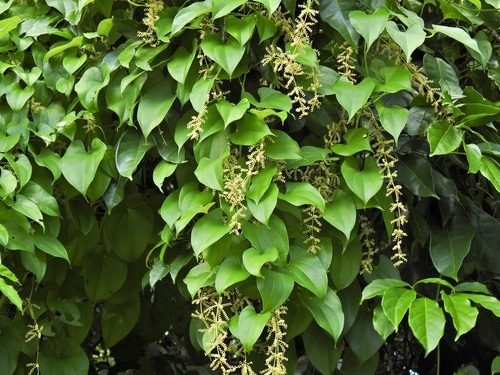
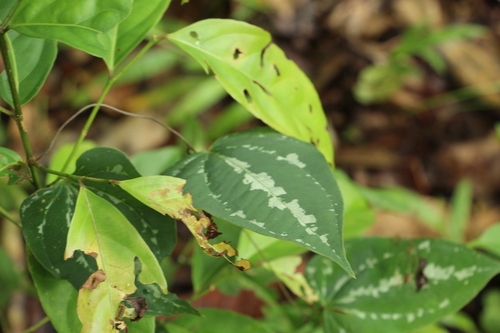
A yam. It is a climbing plant that keeps growing from year to year by producing slender twining stems from a large tuberous rootstock. The vine can be 8 m long. The stems are almost cylinder shaped. The leaves are alternate and oval with 7-11 veins. The leaves are 8-21 cm long by 5-17 cm wide. They taper to the tip and are heart shaped at the base. The upper surface is shiny and the lower surface is dull. The leaf stalks are 5-8 cm long. The bulbils on the stem are angular and 5 cm wide. The flowers hang down in the axils of the leaves. They can be branched and 50 cm long. The flowers are in groups without stalks. The capsule has 3 wings and is about 3 cm long.
How to Grow
A plant of the moist tropical lowlands. A dioecious species, both male and female forms need to be grown if seed is required.
Notes
There are about 650 species of Dioscorea.
Names & Synonyms
Cara, Cara-do-mato, Cheen chaak, Macal kuch ak, Makal k'uuch ak'
References (7)
- Chu, E. P., Figueiredo-Ribeiro, R. C. L., 1991, Native and Exotic Species of Dioscorea Used as Food In Brazil. Economic Botany, Vol. 45, No. 4, pp. 467-479
- Fern, K., 2012, Tropical Species Database http://theferns.info/tropical/
- FMNH Botany Collections Database - Mesoamerican Ethnobotany emuweb.field museum.org
- Kinupp, V. F., 2007, Plantas alimenticias nao-convencionais da regiao metropolitana de Porto Alegre, RS, Brazil p 77
- McNuff, M. A. et al, 2005, Proximate Analysis and Some Antinutritional Factor Constituents in Selected Varieties of Jamaican Yams (Disocorea and Rajana spp.) Plant Foods for Human Nutrition 60:93-98
- Plants of Haiti Smithsonian Institute http://botany.si.edu/antilles/West Indies
- Sp. pl. 4(2):795. 1806