Dioscorea quartiniana
A. Rich.

(c) feno, some rights reserved (CC BY-NC), uploaded by feno
(c) Landy Rita, some rights reserved (CC BY-NC), uploaded by Landy Rita

(c) feno, some rights reserved (CC BY-NC), uploaded by feno
What to Eat
Edible parts: Tubers, Caution, Root
Tubers - cooked. The tubers are peeled and soaked in water for several days; then they are washed, sliced and dried in the sun; the dried slices are pounded into flour and used for uji or ugali. The dried flour can be stored.
Known Hazards
Where to Find It
A tropical plant. It occurs throughout most of Subsaharan Africa. It grows in forest and grassland. It grows from sea level to 2,000 m altitude.
Africa, Angola, Asia, Botswana, Burkina Faso, Central Africa, Comoros, Congo, East Africa, Eswatini, Ethiopia, Ghana, Guinea, Guinée, Guinea-Bissau, India, Madagascar, Malawi, Mozambique, Namibia, Rwanda, Senegal, Sierra Leone, South Africa, Southern Africa, Swaziland, Tanzania, West Africa, Zambia, Zimbabwe,
How to Identify
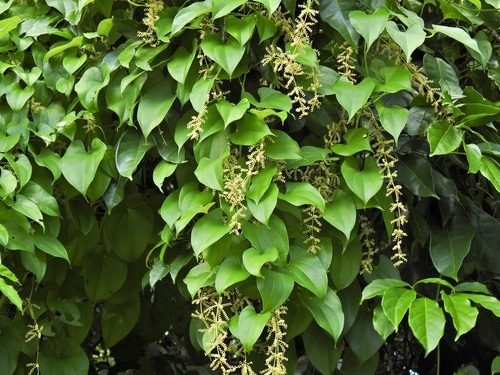
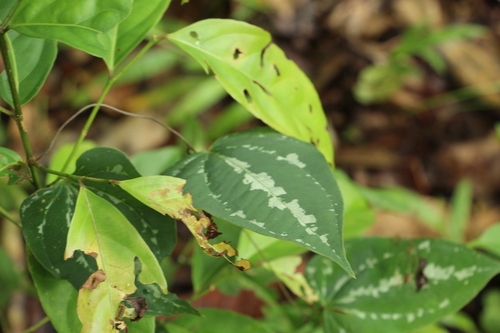
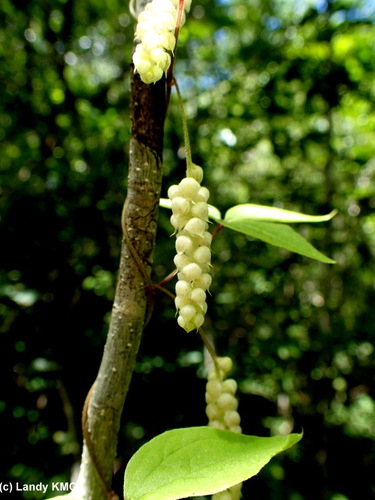
A yam. It is a strong slender twiner or climber. It can be 6 m long. The vine twines to the left. It does not have spines. There are a cluster of tubers that are oval or long. The stems are wiry. The leaves are alternate. The leaves have 5 (3-7) leaflets. The leaflets are often arched backwards. The leaves taper to the base and have a threadlike tip. The leaves are 5 cm long by 2 cm wide. Leaf shape can vary. There can be lumpy bulbils along the stems. The female flowers do not have stalks. They are in single slender spikes in the axils of leaves.
How to Grow
A plant of low to moderate elevations in the moist tropics. In Tanzania it grows in areas where the mean annual rainfall is in the range 800 - 1,900mm. Often found in the deep shade of other vegetation. Tolerates a wide range of soil types. A very variable species.
Wikipedia
Source ↗Dioscorea quartiniana is a climbing tuber geophyte in the family Dioscoreaceae. It is native to Benin, Botswana, Burundi, Chad, Congo, Côte d'Ivoire (Ivory Coast), Eritrea, Ethiopia, Gambia, Ghana, Kenya, Madagascar, Malawi, Mozambique, Namibia, Nigeria, Rwanda, Sierra Leone, South Africa, Sudan, Tanzania, Uganda, Zambia, and Zimbabwe. This species occurs in forests, grasslands, and rocky areas.
Production
The tubers are collected after the end of the rainy season. The dried flour can be stored.
Other Information
A famine food. Tubers are sold in local markets. It is cultivated.
Notes
There are about 650 species of Dioscorea.
Names & Synonyms
Baiyang sanga, Gumbo, Itugu, Ituguligwa, Kilumbu, Kuba, Lunyawolwendlovu, Ndiga, Sikubabe, Tugu, Unyawo-lwendlovu
References (19)
- Asfaw, Z., Conservation and use of traditional vegetables in Ethiopia. FAO
- Burkill, H. M., 1985, The useful plants of west tropical Africa, Vol. 1. Kew.
- Fowler, D. G., 2007, Zambian Plants: Their Vernacular Names and Uses. Kew. p 66
- Gemedo-Dalle, T., et al, 2005, Plant Biodiversity and Ethnobotany of Borana Pastoralists in Southern Oromia, Ethiopia. Economic Botany 59(1) pp. 43-65
- http://nhm2.uio.no/botanisk/nbf/temp/Sebsebe
- Jardin, C., 1970, List of Foods Used In Africa, FAO Nutrition Information Document Series No 2.p 14
- Long, C., 2005, Swaziland's Flora - siSwati names and Uses http://www.sntc.org.sz/flora/
- Lulekal, E., et al, 2011, Wild edible plants in Ethiopia: a review on their potential to combat food insecurity. Afrika Focus - Vol. 24, No 2. pp 71-121
- Msuya, T. S., et al, 2010, Availability, Preference and Consumption of Indigenous Foods in the Eastern Arc Mountains, Tanzania, Ecology of Food and Nutrition, 49:3, 208-227
- Ruffo, C. K., Birnie, A. & Tengnas, B., 2002, Edible Wild Plants of Tanzania. RELMA p 276
- Ruiters-Welcome, A. K., 2019, Food plants of southern Africa. Ph.D. thesis. Univ. of Johannesburg p 51
- Singh, G. & Kumar, J., 2015, Diversity of Wild Edible Yams and its Traditional Knowledge Among Munda Tribe of District Khunti, Jharkhand, India. International Journal of Bioassays. 4.10: 4440-4442
- Swaziland's Flora Database http://www.sntc.org.sz/flora
- Welcome, A. K. & Van Wyk, B.-E., 2019, An inventory and analysis of the food plants of southern Africa. South African Journal of Botany 122 (2019) 136–179
- White, F., Dowsett-Lemaire, F. and Chapman, J. D., 2001, Evergreen Forest Flora of Malawi. Kew. p 97
- Wilkin, P., 2001, Dioscoreaceae of South-Central Africa. Kew Bulletin, Vol. 56, No. 2 (2001), pp 361-404
- Wilkin, P. et al, 2007, A new edible yam (Dioscorea L.) species endemic to Mayotte, new data on D. comorensis R. Knuth and a key to the yams of the Comoro Archipelago. Adansonia ser. 3, 29(2): 215-228
- World Checklist of Useful Plant Species 2020. Royal Botanic Gardens, Kew
- Zeven, A. C. & de West, J. M. J., 1982, Dictionary of cultivated plants and their regions of diversity. Wageningen. p 52