Dioscorea sagittifolia
Pax.
DioscoreaceaeRoots

wikimedia · cc-by-sa
Wikimedia Commons - UPLB MNH Digital Archives
Wikimedia Commons - UPLB MNH Digital Archives

wikimedia · cc-by-sa
Wikimedia Commons - UPLB MNH Digital Archives
Wikimedia Commons - UPLB MNH Digital Archives
What to Eat
Edible parts: Tubers, Root
The tubers and roots are eaten.
Where to Find It
A tropical plant. It grows in the Sahel. It can grow in arid places.
Africa, Burkina Faso, Central Africa, Congo DR, Congo, East Africa, Gabon, Ghana, Liberia, Madagascar, Sahel, Senegal, Sierra Leone, Sudan, West Africa, Zambia,
Countries: Angola, Burkina Faso, Burundi, Benin, Botswana, Congo (DRC), Central African Republic, Congo (Republic), Cote d'Ivoire, Cameroon, Cape Verde, Djibouti, Algeria, Egypt, Eritrea, Ethiopia, Gabon, Ghana, Gambia, Guinea, Equatorial Guinea, Guinea-Bissau, Kenya, Comoros, Liberia, Lesotho, Libya, Morocco, Madagascar, Mali, Mauritania, Mauritius, Malawi, Mozambique, Namibia, Niger, Nigeria, Rwanda, Seychelles, Sudan, Sierra Leone, Senegal, Somalia, South Sudan, Sao Tome & Principe, Eswatini, Chad, Togo, Tunisia, Tanzania, Uganda, South Africa, Zambia, Zimbabwe
How to Identify
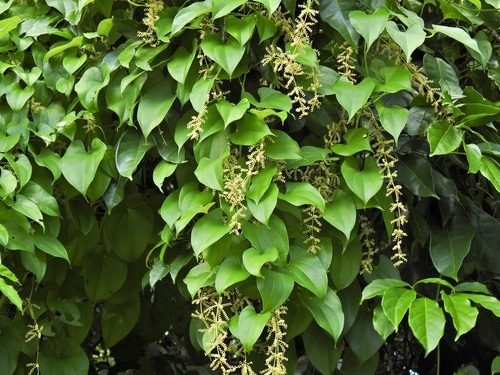
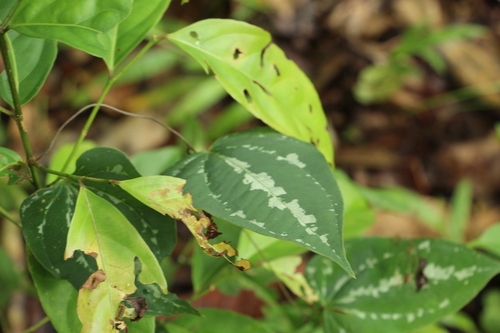
A yam. The vines are 8 m long. They twine to the right-hand. The tuber is deep rooted. The leaves are alternate. The leaves are triangle or sword shaped. They taper tot eh tip. They are 10-13 cm long by 6-8 cm wide.
Notes
There are about 650 species of Dioscorea.
Names & Synonyms
Aduaka, An-won, G-niambi, Yozi
References (3)
- Jardin, C., 1970, List of Foods Used In Africa, FAO Nutrition Information Document Series No 2.p 14
- Tanno, T., 1981, Plant Utilization of the Mbuti Pygmies: With Special reference to their Material Culture and Use of Wild Vegetable Foods. Kyoto University Research. African Study Monographs 1:1-54
- World Checklist of Useful Plant Species 2020. Royal Botanic Gardens, Kew