Dioscorea schimperiana
Hochst. ex Kunth

(c) Dr. Alexey Yakovlev, some rights reserved (CC BY), uploaded by Dr. Alexey Yakovlev

(c) Dr. Alexey Yakovlev, some rights reserved (CC BY), uploaded by Dr. Alexey Yakovlev

(c) Dr. Alexey Yakovlev, some rights reserved (CC BY), uploaded by Dr. Alexey Yakovlev
What to Eat
Edible parts: Tubers, Root, Bulbils
Tubers - cooked. Bulbils - cooked.
Where to Find It
A tropical plant. It grows in subsaharan Africa. It grows near river banks and can be amongst rocks or on termite mounds. It grows between 800-1,800 m altitude.
Africa, Burkina Faso, Cameroon, Central Africa, Congo DR, East Africa, Ethiopia, Kenya, Malawi, Mozambique, Nigeria, Rwanda, Southern Africa, Sudan, Tanzania, Uganda, West Africa, Zambia, Zimbabwe,
How to Identify
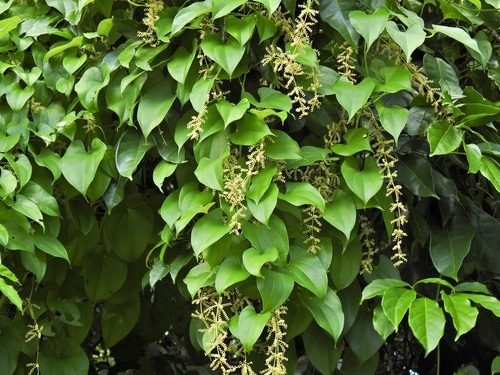
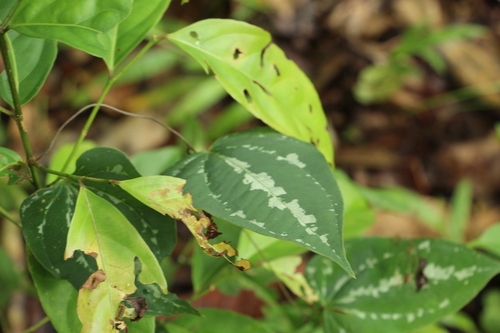
A yam. The vine can be 8 m long. It has a single tuber. This is 3 cm wide and 60 cm long. It grows downwards into the soil. The stem twines to the right. It is stout and does not have prickles. The leaves are usually opposite. They are 10-20 cm long and heart shaped. The flowers hang down in spikes in the axils of leaves. It can have bulbils. They are 1 cm across. The fruit are 4 winged capsules. They become papery when dry.
Nutrition Score: 23/100
| Part | Moisture | kJ | kcal | Protein | Vit A | Vit C | Iron | Zinc |
|---|---|---|---|---|---|---|---|---|
| Tubers | 77 | 323 | 77 | 1.2 | — | — | — | — |
Other Information
It is a famine food.
Notes
There are about 650 species of Dioscorea.
Names & Synonyms
Ankorumba, Buliga-kubwa, Intendene, Itugu, Ituguligwa, Kansa, Kilumbu, Mutendeni, Nyamunwu, Yagniat
References (20)
- Asfaw, Z., Conservation and use of traditional vegetables in Ethiopia. FAO
- Asfaw, Z. and Tadesse, M., 2001, Prospects for Sustainable Use and Development of Wild Food Plants in Ethiopia. Economic Botany, Vol. 55, No. 1, pp. 47-62
- Burkill, H. M., 1985, The useful plants of west tropical Africa, Vol. 1. Kew.
- Ferns, Useful Tropical Plants
- Gallagher, D. E., 2010, Farming beyond the escarpment: Society, Environment, and Mobility in Precolonial Southeastern Burkina Faso. PhD University of Michigan.
- Herb., E. A., 1981,
- KABUYE,
- Kakeya, 1976,
- Lim, T. K., 2015, Edible Medicinal and Non Medicinal Plants. Volume 9, Modified Stems, Roots, Bulbs. Springer p 38
- Lulekal, E., et al, 2011, Wild edible plants in Ethiopia: a review on their potential to combat food insecurity. Afrika Focus - Vol. 24, No 2. pp 71-121
- Malaisse, F., 1997, Se nourrir en floret claire africaine. Approche ecologique et nutritionnelle. CTA., p 61, 83
- Mutie, F. M., et al, 2023, Important Medicinal and Food Taxa (Orders and Families) in Kenya, Based on Three Quantitative Approaches. Plants 2023, 12, 1145
- Nishida, 1974,
- Peters, C. R., O'Brien, E. M., and Drummond, R.B., 1992, Edible Wild plants of Sub-saharan Africa. Kew. p 17
- Ruffo, C. K., Birnie, A. & Tengnas, B., 2002, Edible Wild Plants of Tanzania. RELMA p 278
- White, F., Dowsett-Lemaire, F. and Chapman, J. D., 2001, Evergreen Forest Flora of Malawi. Kew. p 97
- Wild, 1975,
- Wilkin, P., 2001, Dioscoreaceae of South-Central Africa. Kew Bulletin, Vol. 56, No. 2 (2001), pp 361-404
- World Checklist of Useful Plant Species 2020. Royal Botanic Gardens, Kew
- www.zimbabweflora.co.zw 2011