Dioscorea tokoro
Makino ex Miyabe
Shan bei xie

(c) licensed media from TrekNature DwCA without owner, some rights reserved (CC BY-NC-SA)
(c) WATANABE Hitoshi 渡辺仁, some rights reserved (CC BY)
What to Eat
Edible parts: Root, Tuber
The tubers are eaten cooked. They should be soaked or boiled in lye before use, as they are said to be poisonous raw.
Known Hazards
Where to Find It
It is a temperate plant. It grows in mixed forest from sea level to 1000 m altitude in China. In Sichuan.
Asia, China, Japan, Korea,
How to Identify
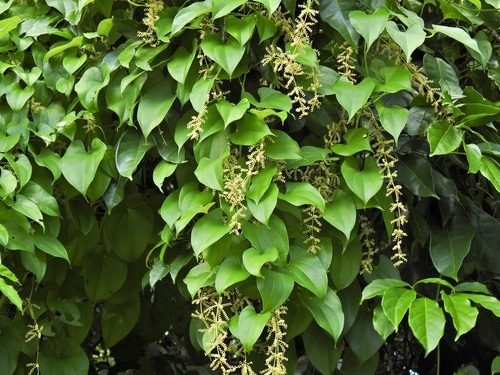
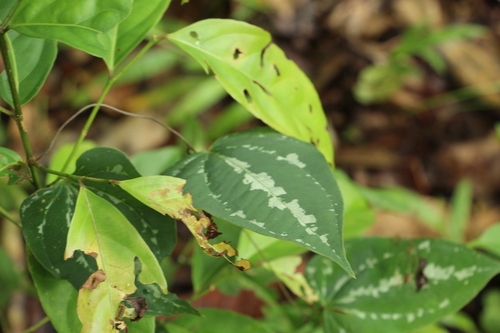
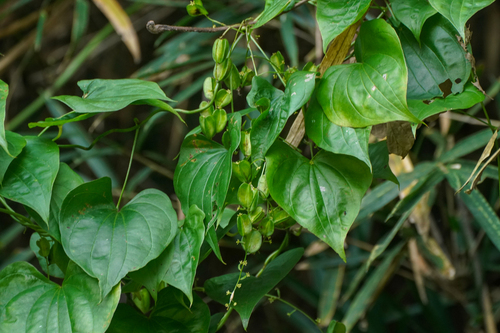
A yam with a rhizome which lies horizontal and is much branched. Stems twine to the left. The leaves are alternate and simple. The leaf stalks are 5-12 cm long. The leaves are triangle or heart shaped and 5-14 cm long by 5-11 cm wide.
How to Grow
We have very little information on this species and do not know if it will be hardy in Britain, though judging by its native range it could succeed outdoors in many parts of this country. The following notes are based on the general needs of the genus. Easily grown in a fertile well-drained soil in a sunny position or light shade. Prefers a rich light soil. Plants produce tubercles (small tubers that are formed in the leaf axils of the stems), and can be propagated by this means. A climbing plant that supports itself by twining around the branches of other plants. Dioecious. Male and female plants must be grown if seed is required.
Propagation: Sow seed in March to April in a sunny position in a warm greenhouse, barely covered. Germination takes 1–3 weeks at 20°C. Prick out seedlings once large enough to handle and grow on in the greenhouse for their first year, then plant out in late spring as new growth begins. Basal stem cuttings can be taken in summer. Divide in the dormant season only — never when in growth. The plant often produces several shoots; the top 5–10cm of root below each shoot can be potted up as a new plant, while the lower portion of the root can possibly be eaten. Tubercles forming in the leaf axils are harvested in late summer to early autumn when approximately pea-sized and detaching freely. Pot up immediately into individual containers in a greenhouse or cold frame and plant out in early summer when actively growing.
Medicinal Uses
The roots are antirheumatic, antiseptic, antitussive, and contraceptive, and are also used for desensitization. A decoction of the root is taken in the treatment of arthritis, rheumatism, and prostatitis, and it acts as a resolvent for blood clots. Like most or all members of this genus, the roots contain diosgenin, which is widely used in modern medicine to manufacture progesterone and other steroid drugs employed as contraceptives and in treating disorders of the genital organs, as well as conditions such as asthma and arthritis.
Other Uses
None known.
Wikipedia
Dioscorea tokoro is a perennial climbing vine that flowers from September to October. The species is dioecious, requiring both male and female plants for seed production. It grows in light sandy, medium loamy, and heavy clay soils with good drainage, tolerating mildly acidic to mildly alkaline pH. The plant requires full sun and prefers moist soil conditions.
Notes
There are about 650 species of Dioscorea.
Names & Synonyms
References (3)
- Ding Zhizun, Gilbert, Michael G., DIOSCOREACEAE, shu yu ke, Flora of China,
- Plants for a Future database, The Field, Penpol, Lostwithiel, Cornwall, PL22 0NG, UK. http://www.scs.leeds.ac.uk/pfaf/
- Tokyo Bot. Mag. 3:112. 1889