Dioscorea trifida
L. f.
Sweet yam, Cush-cush yam

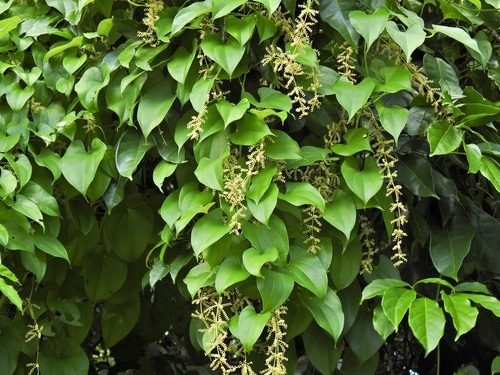
(c) User:Mvh57, some rights reserved (CC BY-SA)
(c) Hervé GALLIFFET, some rights reserved (CC BY-NC)
(c) Hervé GALLIFFET, some rights reserved (CC BY-NC)
What to Eat
Edible parts: Tubers, Vegetable, Root
The roots are boiled or baked and some forms have an excellent flavour — the cooked flesh is smooth, moist, attractively coloured, and unusually rich-tasting. Roots are approximately 15–20cm long and 6–8cm in diameter. The tuber contains about 38% waxy starch that lacks amylose, giving it potential as a binder and thickener in food processing.
Where to Find It
It is a tropical plant. It is indigenous to Central America. It suits a cooler climate than other yams. It grows in areas with temperatures between 25-30°C. The rainfall is 1,500-2,000 mm per year. It cannot tolerate frost.
Africa, Amazon, Antilles, Benin, Brazil, Burundi, Caribbean*, Central Africa, Central America, Colombia, Congo, Costa Rica, Cuba, Dominican Republic, East Africa, Ecuador, French Guiana, Guadeloupe, Guianas, Guyana, Haiti, Honduras, Jamaica, Martinique, New Caledonia, Nicaragua, North America, Pacific, Panama, Peru, Puerto Rico, South America, Sri Lanka, St. Lucia, St. Vincent and Grenadines, Suriname, Tonga, Trinidad, USA, Vanuatu, Venezuela, West Africa, West Indies,
How to Identify
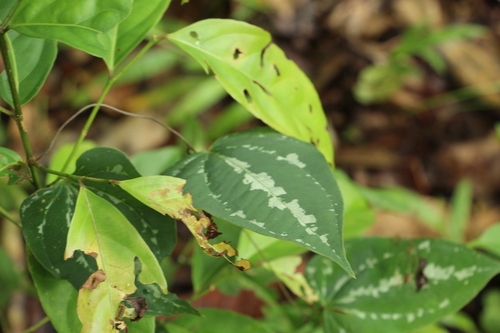
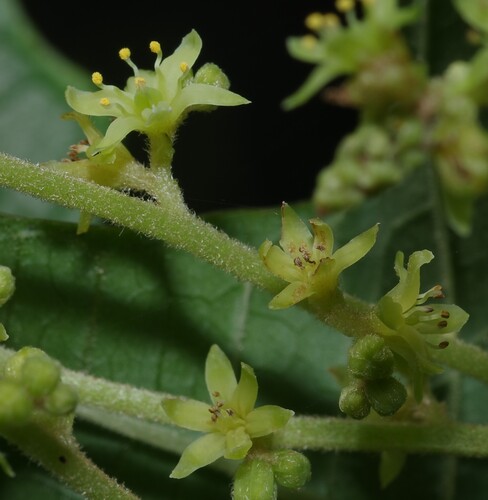
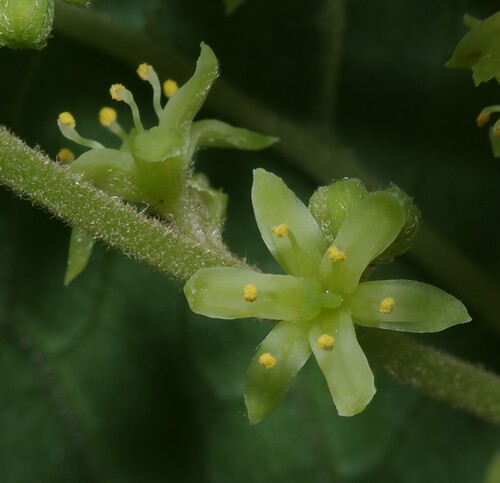
A yam vine. The stem is square in cross section and does not have spines. The leaves are 25 cm long. They are opposite. The leaf is divided like fingers on a hand into 3 or more segments. The male flower is on a long stalk and the female flower stalk is short. It easily produces seed. The underground tuber is irregular in shape. It can be 70 cm long. Varieties can range in colour from white to purple and black.
Nutrition Score: 32/100
| Part | Moisture | kJ | kcal | Protein | Vit A | Vit C | Iron | Zinc |
|---|---|---|---|---|---|---|---|---|
| Tuber | 80.7 | 284 | 68 | 2.5 | — | — | 0.5 | 0.4 |
How to Grow
A plant of the moist tropics and subtropics. It grows best in areas where annual daytime temperatures are within the range 18 - 26°c, but can tolerate 10 - 36°c. It can be killed by temperatures of 7°c or lower. It prefers a mean annual rainfall in the range 1,200 - 2,600mm, but tolerates 1,000 - 4,000mm. This species grows better at lower temperatures than most tropical yams. Prefers a sunny position, tolerating some shade. For best yields, most yams require a deep, well-drained, sandy loam that is not liable to water-logging. This species will succeed in a wide range of soils so long as there is plenty of organic matter and they are well drained. Prefers a pH in the range 6 - 6.7, tolerating 5.3 - 8. Daylengths of more than 12 hours are preferred during the early growing season since this encourages vegetative growth; daylengths of less than 12 hours towards the end of the growing season will encourage tuber formation and development. Crops can be obtained in 9 - 11 months from planting, yields of 15 - 20 tonnes per hectare have been achieved. Plants produce groups of 5 - 50 tubers from enlarged stolons or runners. This is perhaps the only cultivated yam species that has retained its full reproductive potential through seed formation. There are some named varieties. A dioecious species, both male and female plants need to be grown if seed is required.
Propagation: Seed is sown in containers and planted out at the beginning of the growing season. Tuber cuttings are also used: small tubers are cut into 2–4 sections and larger ones into 6–8 sections, each with 2–3 dormant buds. Cut tubers are often left in the sun for several hours to encourage wound healing and reduce the risk of fungal infection.
Medicinal Uses
None known.
Other Uses
Vines of other Dioscorea species are grown as ornamentals. Grown in food forest systems.
Wikipedia
Source ↗Dioscorea trifida is a species of flowering plant in the family Dioscoreaceae. It is a species of yam (genus Dioscorea). It is native to the Caribbean and Central and South America. Its many common names include Indian yam, cush-cush, and yampee. It is called mapuey in Venezuela, inhame in Brazil, tabena and ñame in Colombia, sacha papa in Peru, and ñampi in Costa Rica.
Production
Plants take 9-10 months to mature. Tubers will store in cool, dry, well-ventilated places for a while. Yields of 15-20 tonnes per hectare have been achieved.
Other Information
It is a commercially cultivated vegetable. Tubers are sold in local markets.
Notes
There are about 650 species of Dioscorea.
Names & Synonyms
Aja e, Cara amazonico, Cara branco, Cara doce, Chambo, Chilma, Couche couche, Drun nuen, Indian yam, Indienne, Inhame roxo, Japecanga, Kenke, Maona, Mapuey, Name blanco, Name, Nampi, Papa chambo, Sachapapa, Tsanbu, Yampi yam
References (41)
- Bennett, B. C., 1990, Useful Plants of Amazonian Ecuador. US Agency for International Development. Fifth Progress Report. New York Botanical Gardens. p 40
- Bortolotto, I. M., et al, 2018, Lista preliminar das plantas alimenticias nativas de Mato Grosso do Sul, Brasil. Iheringia, Serie Botanica, Porto Alegre, 73 (supl.):101-116
- Brazil: Biodiversity for Food and Nutrition. http://www.b4fn.org/countries/brazil/
- Brouk, B., 1975, Plants Consumed by Man. Academic Press, London. p 144
- Campbell, D. et al, 2021, Wild Food Harvest in Jamaica. Frontiers in Sustainable Food Systems. Vol. 5 Article 663863
- Castaneda, H., & Stepp, J. R., 2007, Ecosystems as Sources of Useful Plants for the Guaymi People of Costa Rica. Ethnobotany Journal. 5:249-257
- Chu, E. P., Figueiredo-Ribeiro, R. C. L., 1991, Native and Exotic Species of Dioscorea Used as Food In Brazil. Economic Botany, Vol. 45, No. 4, pp. 467-479 (Also as Dioscorea brasiliensis and Dioscorea goyazensis)
- Coe, F. G., and Anderson, G. J., 1996, Ethnobotany of the Garifuna of Eastern Nicaragua. Economic Botany 50(1) pp 71-107
- Coe, F. G. and Anderson, G. J., 1999, Ethnobotany of the Sumu (Ulwa) of Southeastern Nicaragua and Comparisons with Miskitu Plant Lore. Economic Botany Vol. 53. No. 4. pp. 363-386
- Coursey, D.G., 1979, Yams, in Simmonds N.W.,(ed), Crop Plant Evolution. Longmans. London. p 70
- D'Ambrosio, U., & Puri, R. K., 2016, Foodways in transition: food plants, diet and local perceptions of change in a Costa Rican Ngäbe community. Journal of Ethnobiology and Ethnomedicine (2016) 12:3 p 24
- Ekman Herbarium records Haiti
- Facciola, S., 1998, Cornucopia 2: a Source Book of Edible Plants. Kampong Publications, p 91
- Gragson, T. L., 1997, The Use of Underground Plant Organs and Its Relation to Habitat Selection among the Pume Indians of Venezuela. Economic Botany, Vol. 51, No. 4, pp. 377-384
- Hedrick, U.P., 1919, (Ed.), Sturtevant's edible plants of the world. p 275 (Also as Dioscorea triloba)
- Hermandez Bermejo, J.E., and Leon, J. (Eds.), 1994, Neglected Crops. 1492 from a different perspective. FAO Plant Production and Protection Series No 26. FAO, Rome. p20
- Hunter, D., et al, 2019, The potential of neglected and underutilized species for improving diets and nutrition. Planta (2019) 250:709-729
- Jardin, C., 1970, List of Foods Used In Africa, FAO Nutrition Information Document Series No 2.p 15
- Kay, D.E., 1973, Root Crops, Digest 2, Tropical Products Institute, London, p 190, 210
- Kays, S. J., and Dias, J. C. S., 1995, Common Names of Commercially Cultivated Vegetables of the World in 15 languages. Economic Botany, Vol. 49, No. 2, pp. 115-152
- Langlois, H. C., 2004, Ethnobotanical analysis of different successional stages as sources of wild edible plants for the Guaymi people in Costa Rica. M. Sc. thesis University of Florida.
- Penafield Anchundia, D. D., 2017, Traditional food consumption and its nutritional contribution in Guasaganda, Central Ecuador. PhD Ghent University p 71
- Macmillan, H.F. (Revised Barlow, H.S., et al) 1991, Tropical Planting and Gardening. Sixth edition. Malayan Nature Society. Kuala Lumpur. p 339
- Omawale, 1973, Guyana's edible plants. Guyana University, Georgetown p 113
- Onwueme, I.C., 1978, The Tropical Tuber Crops. Wiley, p 11
- Purseglove, J.W., 1972, Tropical Crops. Monocotyledons. Longmans p 108
- Roa, J. A. G. & Boada, D. S. G., 2018, Fundación para el Fortalecimiento de la Fruticultura y Plantas Alimenticias no Convencionales en Colombia.
- Schneider, E., 2001, Vegetables from Amaranth to Zucchini: The essential reference. HarperCollins. p 712
- Smith, N., Mori, S.A., et al, 2004, Flowering Plants of the Neotropics. Princeton. p 437 (Drawing)
- Sp. Pl. 2: 1032. 1753
- Tindall, H.D., 1983, Vegetables in the Tropics, Macmillan p 219
- Tomchinsky, B., et al, 2021, Food Composition Data: Edible Plants from the Amazon. in M. C. M. Jacob, U. P. Albuquerque (eds.), Local Food Plants of Brazil, Ethnobiology, Springer p 275
- Torre, de la, L., et al, 2008, Enciclopedia de las Plantas Útiles del Ecuador. Herbario QCA. Pontificia Universidad Católica del Ecuador. p 309
- Uphof,
- USDA, ARS, National Genetic Resources Program. Germplasm Resources Information Network - (GRIN). [Online Database] National Germplasm Resources Laboratory, Beltsville, Maryland. Available: www.ars-grin.gov/cgi-bin/npgs/html/econ.pl (10 April 2000)
- Vael, L., 2015, Ethnobotanical study of the plant use in the natural landscape of two mestizo communities in the Ucayali region of the Peruvian Amazon. Universiteit Gent.
- van Wyk, B., 2005, Food Plants of the World. An illustrated guide. Timber press. p 178
- Villachica, H., (Ed.), 1996, Frutales Y hortalizas promisorios de la Amazonia. FAO, Lima. p 331
- Walter, A. & Lebot, V., 2007, Gardens of Oceania. ACIAR Monograph No. 122 p. 95
- Wiersema, J. H. & Leon, B., 2013, World Economic Plants. A Standard Reference CRC Press. 2nd Ed. p 249
- World Checklist of Useful Plant Species 2020. Royal Botanic Gardens, Kew