Eremurus spectabilis
M. Bieb.
Desert candle, Foxtail lily
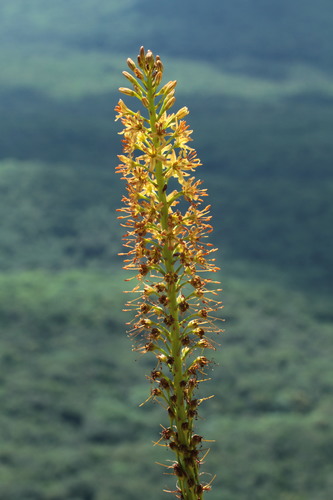
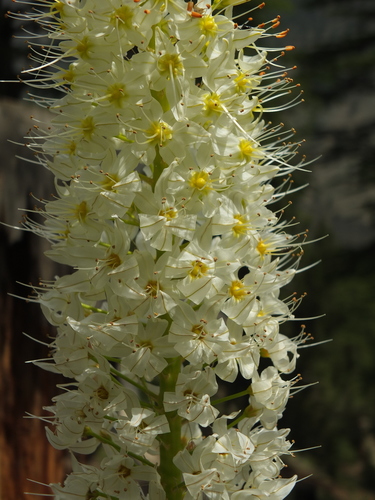
(c) Богданович Светлана, some rights reserved (CC BY-NC), uploaded by Богданович Светлана
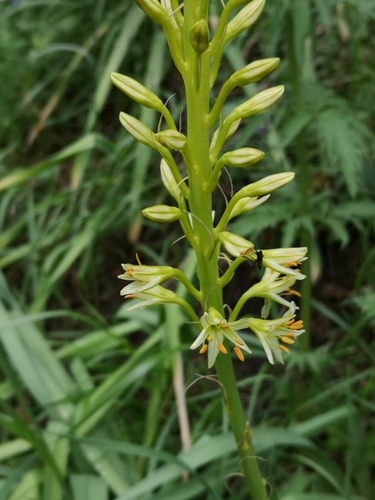
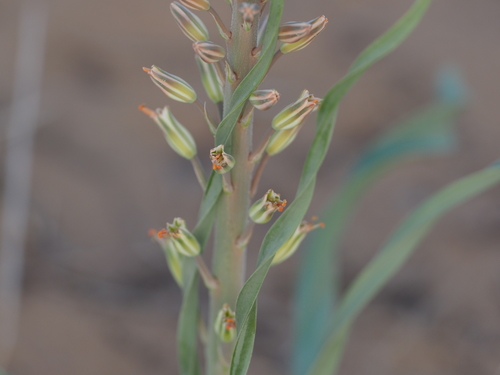
(c) Todd Boland, some rights reserved (CC BY)

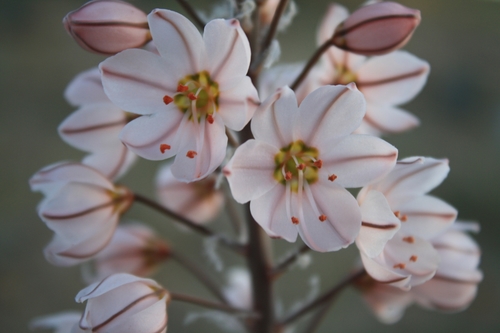
(c) Oron Peri, some rights reserved (CC BY-NC-ND), uploaded by Oron Peri
What to Eat
Edible parts: Leaves, Gum
Young shoots can be eaten cooked and are considered a delicacy in Siberia, with a flavour described as intermediate between purslane and spinach — by no means disagreeable.
Where to Find It
It is a temperate plant. It grows in full sun. It needs fertile, well-drained loamy soil. It can tolerate frost. It needs to grow in the sun and can tolerate drought. It can grow in hardiness zones 5-9.
Armenia, Asia, Azerbaijan, Caucasus, Europe, Georgia, India, Iran, Iraq, Lebanon, Mediterranean, Middle East, Pakistan, Siberia, Turkey, Türkiye, Ukraine,
How to Identify
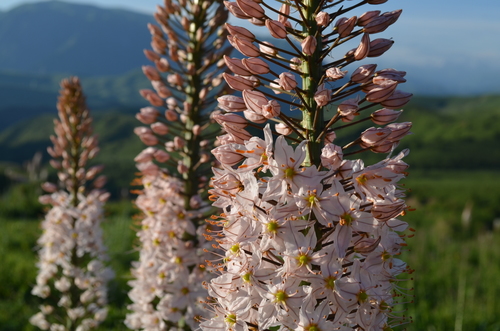
A bulb plant. It keeps growing from year to year. It grows 1 m tall. The flower spikes are tall and slender.
Nutrition Score: 28/100
| Part | Moisture | kJ | kcal | Protein | Vit A | Vit C | Iron | Zinc |
|---|---|---|---|---|---|---|---|---|
| Leaves | 92 | 107 | 26 | 0.1 | — | 129 | 2.4 | 0.4 |
How to Grow
Prefers a very well drained, very rich, light sandy loam in a warm sunny sheltered position. A covering of sharp sand helps the plant to survive wet winters. Plants can also be mulched overwinter with organic matter in the autumn in order to give them extra protection, but this mulch must be removed in the spring otherwise it might encourage the new growth to rot. Some protection should be given to the young shoots in spring in areas subject to late frosts. Keep plants dry in summer after they have flowered. A very ornamental plant and a good bee plant. Plants resent root disturbance and so should be placed in their final positions as soon as possible. This species, in part at least, is also known as E. caucasicus Stephen. Tubers should be planted 15cm deep. The edible young shoots are sold in local markets in Siberia. Plants require some cold stratification in winter in order to flower well in the following summer. Slugs are very attracted to this plant so some protection must be given. Foxtail Lily is generally self-fertile. The flowers are typically harvested in late spring to early summer when they are in full bloom. Foxtail Lily flowers from late spring to early summer. Foxtail Lily grows relatively slowly and can take a few years to establish before producing flowers. However, once established, it can reach heights of 3 to 5 feet and produce a striking display of flowers.
Propagation: Seed is best sown as soon as it is ripe in autumn in a cold frame. Stored seed should be sown in a greenhouse as soon as it is obtained. Germination is slow and can take 1–12 months at 15°C. Prick out seedlings into individual pots once large enough to handle and grow them through their first winter under glass. Plant out in late spring after the last expected frosts, taking care not to plant too deeply — the crown should remain slightly exposed. Division can be done after the plant dies down in late summer, but great care is needed as plants strongly resent root disturbance. Divide only when truly necessary, no more than once every 6 years, avoiding damage to the brittle roots. Potting up divisions and growing them on under glass until established is recommended.
Medicinal Uses
None known.
Other Uses
The roots contain around 30% gum, an arabinic acid derivative, which makes a good-quality glue. The dried and powdered bulb is used for sizing cloth and in bookbinding. Foxtail Lily can be grown as an ornamental in garden borders and its yellow flowers, which bloom from May to June in the Northern Hemisphere, attract pollinators such as bees with their nectar and pollen.
Wikipedia
Source ↗Eremurus spectabilis, is a species of flowering plant in the family Asphodelaceae. It is widely distributed from the eastern Mediterranean to the Caucasus.
Production
Plants take 3-5 years to reach flowering size.
Other Information
The shoots are sold in local markets.
Notes
There are about 50 Eremurus species. It is used in medicine. It has also been put in the family Xanthorrhoeaceae.
Names & Synonyms
Aslêrk, Ciris, Gulik, Gullik, Guling, Shresh, Sitirk, Xwzhe, Yelig
References (20)
- Baktır, I., Yılmaz, G., Göktürk, R.S. and Karagüzel, O. (2013). EDIBLE FLOWERING GEOPHYTES OF TURKEY. Acta Hortic. 1002, 297-300
- Cakir, E. A., 2017, Traditional knowledge of wild edible plants of Iğdır Province (East Anatolia, Turkey). Acta Soc Bot Pol. 2017;86(4):3568.
- Cent. pl. Ross. merid. 2: t. 61. 1832
- Dogan, A. & Tuzlaci, E., 2015, Wild Edible Plants of Pertek (Tunceli-Turkey). Marmara Pharmaceutical Journal 19: 126-135
- Dogan, Y., 2012, Traditionally used wild edible greens in the Aegean Region of Turkey. Acta Societatis Botanicorum Poloniae 81(4): 329-342
- Dogan, Y. et al, 2013, Wild Edible Plants sold in the Local Markets of Izmir, Turkey. Pak. J. Bot. 45(S1): 177-184
- Facciola, S., 1998, Cornucopia 2: a Source Book of Edible Plants. Kampong Publications, p 143
- Guzelsoy, N. A., et al, 2017, Nutritional Properties of some Wild Edible Plant Species in Turkey. ANADOLU, J. of AARI 27(2) 2017, 39-45
- Hedrick, U.P., 1919, (Ed.), Sturtevant's edible plants of the world. p 291
- Ibadullayeva, S., et al, 2011, Protection of some rare and endangered vegetable plants in the flora of the Nakhichevan AR. International Journal of Biodiversity and Conservation Vol. 3(6), pp. 224-229
- Marinelli, J. (Ed), 2004, Plant. DK. p 233
- Mukemre, M., et al, 2016, Survey of wild food plants for human consumption in villages of Catak, (Van-Turkey), Indian Journal of Traditional Knowledge. Vol. 15(2) pp. 183-191
- Nanagulyan, S., et al, 2020, Wild plants and fungi sold in the markets of Yerevan (Armenia). Journal of Ethnobiology and Ethnomedicine 16:26
- Pieroni, A., et al, 2017, The spring has arrived: traditional wild vegetables gathered by Yarsanis (Ahl-e Haqq) and Sunni Muslims in Western Hawraman, SE Kurdistan (Iraq). Acta Soc Bot Pol 86(1):3519
- Plants for a Future database, The Field, Penpol, Lostwithiel, Cornwall, PL22 0NG, UK. http://www.scs.leeds.ac.uk/pfaf/
- Polat, R., et al, 2015, Survey of wild food plants for human consumption in Elazig (Turkey). Indian Journal of Traditional Knowledge. Vol. 1(1): 69-75
- Polat, R., et al, 2017, Survey of wild food plants for human consumption in Bingol, (Turkey). Indian Journal of Traditional Knowledge. Vol. 16(3) July 2017, pp. 378-384
- Rivera, D. et al, 2006, Gathered Mediterranean Food Plants - Ethnobotanical Investigations and Historical Development, in Heinrich M, Müller WE, Galli C (eds): Local Mediterranean Food Plants and Nutraceuticals. Forum Nutr. Basel, Karger, 2006, vol 59, pp 18–74
- Singh, H.B., Arora R.K.,1978, Wild edible Plants of India. Indian Council of Agricultural Research, New Delhi. p 25
- Rivera, D. et al, 2006, Gathered Mediterranean Food Plants - Ethnobotanical Investigations and Historical Development, in Heinrich M, Müller WE, Galli C (eds): Local Mediterranean Food Plants and Nutraceuticals. Forum Nutr. Basel, Karger, 2006, vol 59, pp 18–74