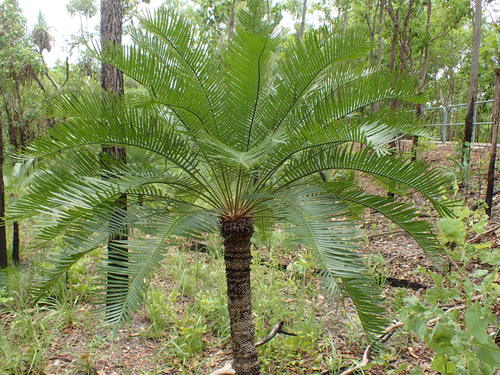
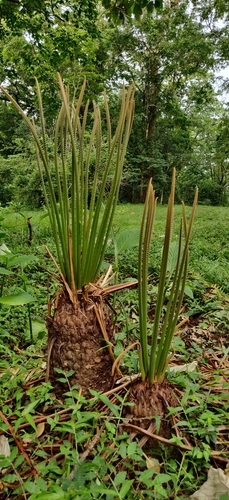
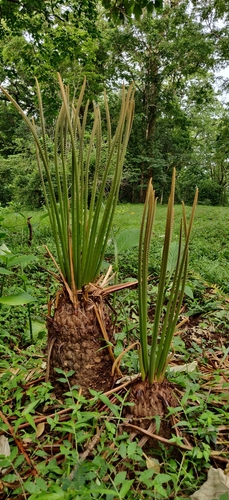
Zamia spp
Various
Zamia cycads. Pine cone cycad

zroper

brownheadednuthatch

Karen McCabe
What to Eat
Edible parts: Root, Stem
A number of species are edible. For example: Zamia loddigesii - An edible starch can be obtained from the stems. This can be ground into a powder and used in making bread etc. It needs to be thoroughly cooked in order to destroy a poisonous principle. Zamia integrifolia -The stems and roots are a rich source of starch. To make flour, the roots are first chopped into pieces. They are then pounded with a mortar and pestle. The pulp is then washed with water and the starch is allowed to settle to the bottom. Then the water is drained and the remaining paste is left to ferment for several days. At the end of the fermentation process, the starch is set in the sun to dry. When dry, the powdery, cornmeal-like flour is baked into bread. The plant parts contain central nervous system toxins, which must be removed before consumption. There is a poisonous principle in the stems that is destroyed by thorough cooking. and Zamia erosa - The large fleshy root is hidden in crevices of the jagged rocks, but is dug out by local people and used in the manufacture of starch. This is ground into a powder and used to make bread etc. It needs to be thoroughly cooked in order to destroy a poisonous principle.
Known Hazards
Where to Find It
Native to Mexico, the West Indies, and Central and South America as far south as Bolivia. The range of one species (Z. integrifolia), extends into the contiguous United States, i.e. Georgia and Florida.
Coming Soon
How to Identify
Zamia spp is a PERENNIAL growing to 1 m (3ft 3in) by 1 m (3ft 3in) at a slow rate. See above for USDA hardiness. It is hardy to UK zone 10. It is noted for attracting wildlife. Suitable for: light (sandy), medium (loamy) and heavy (clay) soils. Suitable pH: mildly acid, neutral and basic (mildly alkaline) soils. It can grow in full shade (deep woodland) semi-shade (light woodland) or no shade. It prefers dry moist or wet soil.
How to Grow
Hypothetical Crop Industrial Crop: Starch Management: Standard. Climate: warm temperate to tropical. Humidity: arid to humid. A range of deciduous shrubs with aerial or subterranean circular stems, often superficially resembling palms growing in a number of habitats, with some growing as understory plants in moist tropical rainforests and others from more open habitats with unreliable rainfall, considerably more sun, and less humidity, but most are best suited to tropical and subtropical regions that are free from frost. Carbon Farming Solutions - Cultivation: hypothetical. Management: standard (Describes the non-destructive management systems that are used in cultivation).
Propagation: Seed - remove the fleshy coating and surface sow on damp sand. Germination is best at around 23 - 29°c, but can take several months or even years. Pot up young seedlings into a rich, moist medium, as soon as they are large enough to handle and grow on at high temperatures without any check to growth until 2 - 3 leaves have been produced at one time, otherwise they may enter dormancy. Division.
Other Uses
Carbon Farming Solutions - Industrial Crop: starch (Crops grown for non-food uses. Industrial crops provide resources in three main categories: materials, chemicals, and energy. Traditional materials include lumber and thatch, paper and cardboard, and textiles). A number of cycads unrelated to commercial crops offer a chance to produce industrial starch without any of the drawbacks of working with existing food crop families. Genera to investigate include: Cycas, Dioon, Encephalartos, Macrozamia, Microcycas, and Zamia.