Aloe cooperi
Baker
Cooper's aloe, Icena

(c) Kate Braun, some rights reserved (CC BY-NC), uploaded by Kate Braun

(c) riana60, some rights reserved (CC BY-NC), uploaded by riana60

(c) Kate Braun, some rights reserved (CC BY-NC), uploaded by Kate Braun
What to Eat
Young shoots and flowers are often cooked and eaten as vegetables by the Zulu people, they also believe that smoke from burning leaves in the cattle kraal will prevent the effects on cattle of eating improper food. The plant's juice has been fed to horses to rid them of ticks. The plant attracts nectar feeding birds, this made it a popular garden plant in South Africa.
Known Hazards
Where to Find It
Southern Africa - Mozambique, Swaziland, S. Africa.
Grassland, in moist to marshy habitats and also in well-drained, dry, rocky areas at elevations from sea level up to 2.000 metres.
How to Identify
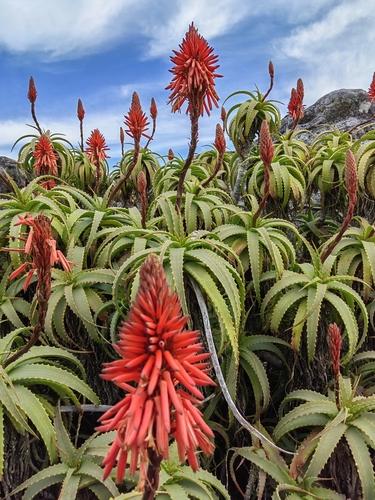
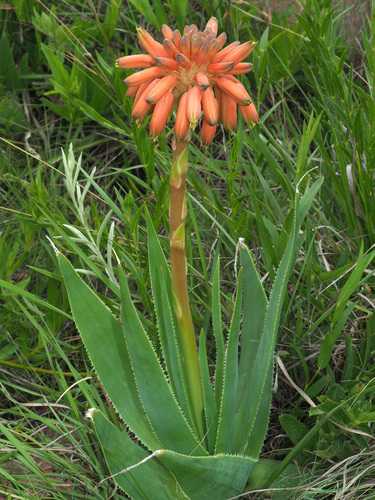
Aloe cooperi is a succulent, perennial plant that can be unstemmed or with a short stem up to 15cm tall. It forms one or a small clump of rosettes of erect, grass-like leaves that are 60 - 80cm long. The plant is usually evergreen in warm climates, but in colder conditions can die down to ground level. The plant is harvested from the wild for local use as a food and medicine. It is planted as an ornamental in South Africa.
How to Grow
Xanthorrhoeaceae
Propagation: Seed - we have no specific information on this species - in general Aloes are sown in a sandy, well-drained potting soil in a warm, shady position in standard seed trays. Germination takes about three weeks. Cover the seed with a thin layer of sand (1 - 2mm), keep moist. The seedlings can be planted out in individual bags or containers as soon as they are large enough to handle. Division of suckers.
Medicinal Uses
A decoction of the flowers is taken to ease childbirth. The distinctive constituents in Aloe leaves are phenolic compounds, including chromone, anthraquinone or anthrone derivatives. Some of the compounds are found in many species, whereas others occur in only a few.
Wikipedia
Source ↗Aloe cooperi, also known as Cooper's aloe and as iPutumane in Zulu, is a succulent species that is endemic to Southern Africa. It has significant cultural and economic value to the Zulu people of South Africa.
Production
A herb. The leaves are in two ranks. They are rather soft. They taper from the base to the tip. They are 1 m long and 3-5 cm wide. There are soft teeth along the edge. The flowering stalk is 1 m high. They are orange of pink.
Names & Synonyms
Inhlaba, Lisheleshele, Lisheshelu
References (8)
- HELY- HUTCHINSON
- Long, C., 2005, Swaziland's Flora - siSwati names and Uses http://www.sntc.org.sz/flora/
- Ogle, B. M. & Grivetti, L. E., 1984, Legacy of the Chameleon: Edible Wild Plants in the Kingdom of Swaziland, Southern Africa. A Cultural, Nutritional Study. Part 4 - Nutritional Analysis and Conclusions. Ecology of Food and Nutrition. Vol 17, pp 431-64
- Peters, C. R., O'Brien, E. M., and Drummond, R.B., 1992, Edible Wild plants of Sub-saharan Africa. Kew. p 9
- Ruiters-Welcome, A. K., 2019, Food plants of southern Africa. Ph.D. thesis. Univ. of Johannesburg p 30
- Swaziland's Flora Database http://www.sntc.org.sz/flora
- Welcome, A. K. & Van Wyk, B.-E., 2019, An inventory and analysis of the food plants of southern Africa. South African Journal of Botany 122 (2019) 136–179
- World Checklist of Useful Plant Species 2020. Royal Botanic Gardens, Kew