Aloe ferox
Mill.
Bitter aloe, Red aloe, Candelabra aloe, Cape aloe
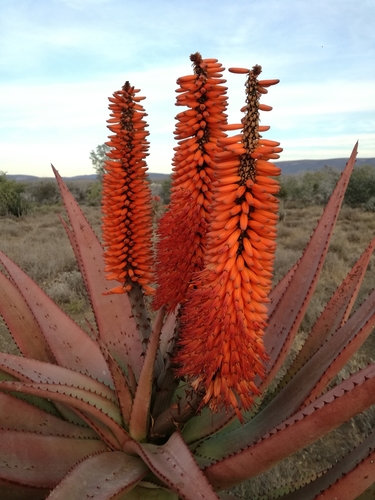
(c) Adriaan Grobler, some rights reserved (CC BY-NC), uploaded by Adriaan Grobler
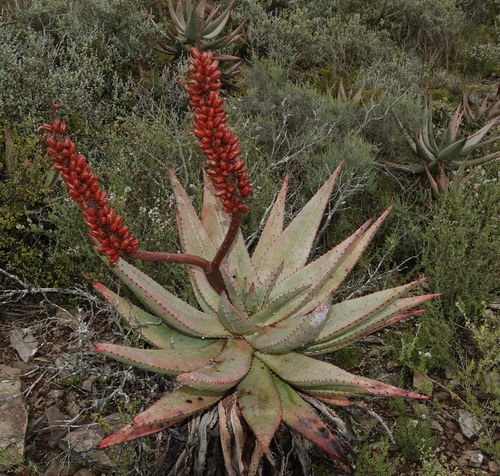
(c) desertnaturalist, some rights reserved (CC BY), uploaded by desertnaturalist

(c) Nicola van Berkel, some rights reserved (CC BY-SA), uploaded by Nicola van Berkel
What to Eat
Edible parts: Leaves, Nectar, Stem, Fruit
The gel from the leaves is used in South Africa to make a jam said to taste like watermelon jam, and is increasingly valued as a refreshing and nutritive ingredient in food and drinks. Dry leaves are harvested, crushed, and used to brew a herbal tea by decoction. The flowers are sucked for their sweet nectar.
Known Hazards
Where to Find It
It occurs in hills and open spaces. It grows in areas with a rainfall of 200 mm to 750 mm. The temperatures vary between 46°C and -5°C. It can grow in arid places. In Brisbane Botanical Gardens. It suits hardiness zones 9-11.
Africa, Asia, Australia, East Africa, Ecuador, Indonesia, Malawi, SE Asia, Slovenia, South Africa*, Southern Africa, South America,
How to Identify
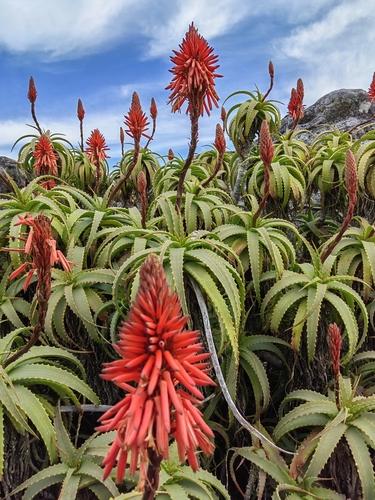
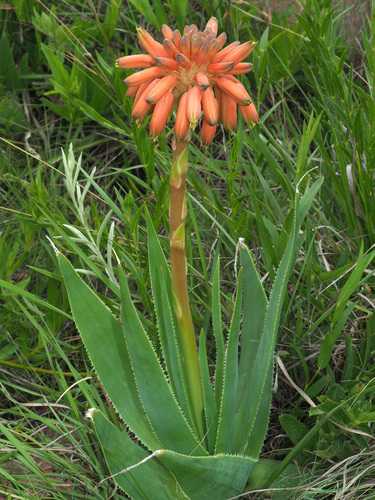
It can be a tall succulent plant. It can grow from 2-5 m tall. It normally has a single stem with the remains of the old dry leaves on it. The crown has the fleshy sword shaped leaves. These leaves are 15 cm wide at the base and taper to the tip. They are green but often tinged with red. They vary between being smooth to being very spiny. The edges have reddish teeth. Only one flower stalk develops. This can branch and have 5-8 erect closely packed flowering branches. These are normally bright red. The flowers are rich in nectar which is edible.
How to Grow
Aloe ferox is indigenous to the arid subtropical areas of South Africa, but it is now widely grown throughout the tropics and subtropics. It grows in a wide range of climatic conditions. It is especially abundant where mean temperatures range from 27 - 31c and annual rainfall ranges from 50 - 300mm. Plants can withstand light frost, with occasional short-lived temperatures as low as -4c, although the flowers may be damaged at -2c. Requires a sunny position and a very well-drained soil. Thrives on rich soils, but is also tolerant of poor ones. Aloe species follow the Crassulacean acid metabolism (CAM). CAM plants are able to fix CO2 at night and to photosynthesize with closed stomata during the day, thus minimizing water loss. This, plus their succulent leaves and stems and the presence of a thick cuticle, makes them well adapted to dry conditions. Severe drought, though, stops exudate production. Although the root system is shallow, the plant can grow under very dry conditions. A slow-growing plant. Cape aloe has a stem surrounded with a persistent layer of dead leaves that insulate it in the case of bush fires. Harvesting of Aloe ferox leaves for medicinal purposes could thus result in significant mortality due to fires. Aloe species are not self-fertile and often require cross-pollination with other plants for successful seed production. Aloe leaves can be harvested year-round, but mature leaves are generally harvested in late spring to summer when the plant is most vigorous for specific products like aloe vera gel. Aloe species typically flower in late winter to early spring, depending on the species and local climate conditions. Growth rates can vary among species, but generally, aloe plants are considered moderate to slow growers, with many species taking several years to reach maturity.
Propagation: Sow seed in a well-drained medium in shallow trays and cover lightly with sand to prevent seeds blowing away. Once germination begins, keep moist but avoid overwatering, as seedlings can rot. Transplant into small pots or bags once seedlings reach approximately 4cm in height, which takes around six months. Plants can also be propagated by planting the tops of old plants. Regeneration from root and embryo tissue is also successful.
Medicinal Uses
In southern Africa, the thickened red leaf exudate — known as 'Cape aloe' — is used as a purgative in both human and veterinary medicine. Fresh exudate is applied for ophthalmia and syphilis, and the plant is used in treating arthritis. The gel from the core of the leaves is used similarly to Aloe vera gel, treating burns, wounds, abrasions, and irritations, and is applied as a poultice on contusions or as a general refrigerant. The gel is also used as a hair wash to promote hair growth and to treat dandruff. The characteristic constituents of Aloe leaves are phenolic compounds including chromone, anthraquinone, and anthrone derivatives, some of which are found across many species while others occur in only a few.
Other Uses
The leaf gel is used as a hair wash to promote hair growth and combat dandruff, and as a cosmetic to improve the complexion and smooth the skin. Aloe gel is widely incorporated into creams and liquids such as sun lotion, shaving cream, lip balm, and healing ointments as a hydrating and skin-protecting agent. The leaf ash is used as an insect repellent. In South Africa, Aloe ferox is planted as a live fence. The plant can also serve as a drought-resistant ground cover, helping to prevent soil erosion and improve soil health, and may provide habitat for beneficial insects. The flowers are rich in nectar and attract pollinators including bees and hummingbirds.
Wikipedia
Source ↗Aloe ferox, commonly known as bitter aloe, is a species of flowering plant in the family Asphodelaceae. This woody aloe is indigenous to southern Africa. It is one of several Aloe species used to make bitter aloes, a purgative medication, and also yields a non-bitter gel that can be used in cosmetics.
Production
There can be about 1 cc of nectar per flower.
Notes
The leaves and juice are used medicinally and as a drug. There are about 350-400 Aloe species. Also put in the family Aloaceae. Also put in the family Asphodelaceae.
Names & Synonyms
Aloe merah, Divja aloja, Khala
References (21)
- Bodkin, F., 1991, Encyclopedia Botanica. Cornstalk publishing, p 68
- Cundall, P., (ed.), 2004, Gardening Australia: flora: the gardener's bible. ABC Books. p 135
- Dharani, N., 2002, Field Guide to common Trees & Shrubs of East Africa. Struik. p 196
- Etherington, K., & Imwold, D., (Eds), 2001, Botanica's Trees & Shrubs. The illustrated A-Z of over 8500 trees and shrubs. Random House, Australia. p 90
- Facciola, S., 1998, Cornucopia 2: a Source Book of Edible Plants. Kampong Publications, p 142
- Fox, F. W. & Young, M. E. N., 1982, Food from the Veld. Delta Books. p 256 (As Aloe candelabrum)
- Gard. dict. ed. 8: Aloe no. 22. 1768
- INFOODSUpdatedFGU-list.xls
- Llamas, K.A., 2003, Tropical Flowering Plants. Timber Press. p 126
- Marinelli, J. (Ed), 2004, Plant. DK. p 332
- Palgrave, K.C., 1996, Trees of Southern Africa. Struik Publishers. p 80
- Palmer, E and Pitman, N., 1972, Trees of Southern Africa. Vol. 1. A.A. Balkema, Cape Town p 383
- Peters, C. R., O'Brien, E. M., and Drummond, R.B., 1992, Edible Wild plants of Sub-saharan Africa. Kew. p 9
- Royal Botanic Gardens, Kew (1999). Survey of Economic Plants for Arid and Semi-Arid Lands (SEPASAL) database. Published on the Internet; http://www.rbgkew.org.uk/ceb/sepasal/internet [Accessed 24th March 2011]
- Ruiters-Welcome, A. K., 2019, Food plants of southern Africa. Ph.D. thesis. Univ. of Johannesburg p 31
- Sukarya, D. G., (Ed.) 2013, 3,500 Plant Species of the Botanic Gardens of Indonesia. LIPI p 1001
- van Wyk, B., 2000, A Photographic Guide to Wild Flowers of South Africa. Struik Nature. p 67
- van Wyk, B-E., 2011, The potential of South African plants in the development of new food and beverage products. South African Journal of Botany 77 (2011) 857–868
- Van Wick, B. & Van Wick, P., 2009, Filed Guide to Trees of Southern Africa, Struik Nature. p 44
- Welcome, A. K. & Van Wyk, B.-E., 2019, An inventory and analysis of the food plants of southern Africa. South African Journal of Botany 122 (2019) 136–179
- World Checklist of Useful Plant Species 2020. Royal Botanic Gardens, Kew