Aloe greatheadii
Schonland
Greathead’s aloe

no rights reserved

(c) David Hoare, some rights reserved (CC BY-NC-SA), uploaded by David Hoare

no rights reserved
What to Eat
Edible parts: Flowers, Caution
Flower buds - cooked. Considered a delicacy, though they need to be cooked in 3 changes of water. The buds are often flavoured with the dried leaves of cowpeas (Vigna unguiculata) and pumpkins (Cucurbita spp).
Known Hazards
Where to Find It
It is a subtropical plant. It can grow in arid places. It grows on termite mounds. It suits hardiness zones 8-11. Coffs.
Africa, Australia, Botswana, Central Africa, Congo, East Africa, Eswatini, Europe, Italy, Mediterranean, Mozambique, South Africa, Southern Africa, Swaziland, Zambia, Zimbabwe,
How to Identify
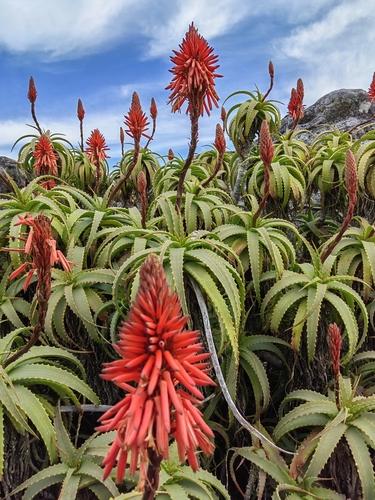
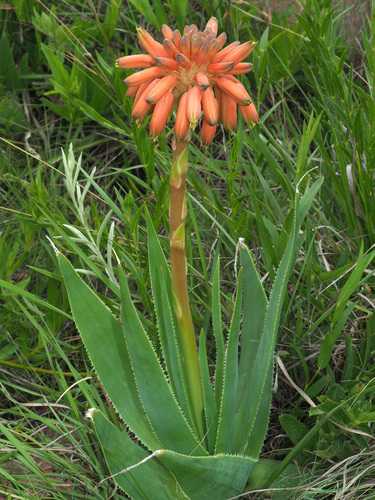
An evergreen succulent plant. The leaves can be 40 cm long. The leaves have a reddish-brown to deep green upper surface. There are reddish teeth along the edge. There can be 2 or 3 flower stalks from one ring of leaves. The flower stalk can be 1.4 m long. The flower heads are 20 cm long. The fresh buds are pink. The flowers have white stripes. Plants sucker and grow in groups.
Nutrition Score: 40/100
| Part | Moisture | kJ | kcal | Protein | Vit A | Vit C | Iron | Zinc |
|---|---|---|---|---|---|---|---|---|
| Flowers | 83.4 | 316 | 76 | 10 | — | — | — | — |
How to Grow
It can be grown by division or by seeds.
Propagation: Seed - we have no specific information on this species - in general Aloes are sown in a sandy, well-drained potting soil in a warm, shady position in standard seed trays. Germination takes about three weeks. Cover the seed with a thin layer of sand (1 - 2mm), keep moist. The seedlings can be planted out in individual bags or containers as soon as they are large enough to handle.
Medicinal Uses
This plant gel is used traditionally as a remedy for many medicinal properties by local people like: Skin complaints, inflammation, respiratory system, muscular-skeletal system, circulation and endocrine system diseases.
Other Uses
Large concentrated populations of the plant are an indication of overgrazing. Seedlings are planted in land reclamation trials; they need partial shade for survival. Trails have shown that this species can be used successfully as a soil binder in disturbed areas such as mine dumps.
Notes
There are about 350-400 Aloe species. Also put in the family Aloaceae. Also put in the family Asphodelaceae.
Names & Synonyms
Liposo
References (11)
- Bodkin, F., 1991, Encyclopedia Botanica. Cornstalk publishing, p 69
- Cundall, P., (ed.), 2004, Gardening Australia: flora: the gardener's bible. ABC Books. p 135
- Facciola, S., 1998, Cornucopia 2: a Source Book of Edible Plants. Kampong Publications, p 142
- Kunkel,
- Malaisse, F., 1997, Se nourrir en floret claire africaine. Approche ecologique et nutritionnelle. CTA., p 57
- Malaisse, F., 2010, How to live and survive in Zambezian open forest (Miombo Ecoregion). Les Presses Agronomiques de Gembloux.
- Morley, B. & Everard, B., 1970, Wild Flowers of the World. Ebury press. Plate 68
- Rec. Albany Mus. 1:121. 1904
- Royal Botanic Gardens, Kew (1999). Survey of Economic Plants for Arid and Semi-Arid Lands (SEPASAL) database. Published on the Internet; http://www.rbgkew.org.uk/ceb/sepasal/internet [Accessed 24th March 2011]
- Tredgold, M.H., 1986, Food Plants of Zimbabwe. Mambo Press. p 79
- World Checklist of Useful Plant Species 2020. Royal Botanic Gardens, Kew