Aloe vera
(L.) Burm.f.
Barbados aloe
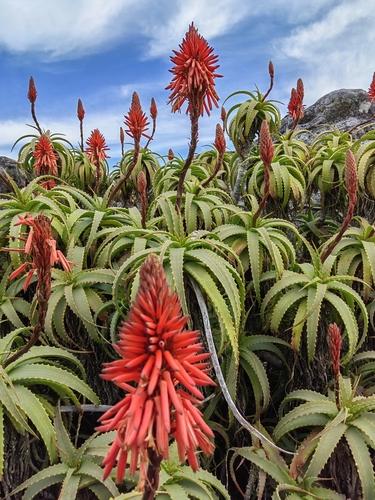
(c) Luis, some rights reserved (CC BY-NC), uploaded by Luis

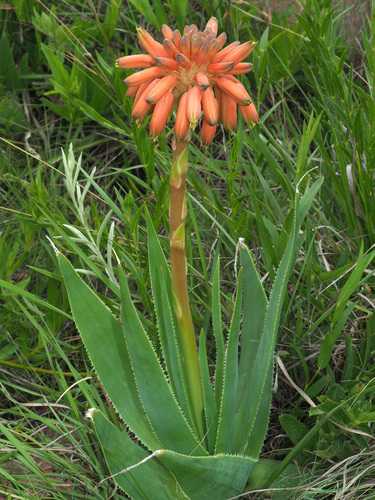
(c) Photo by David J. Stang, some rights reserved (CC BY-SA)

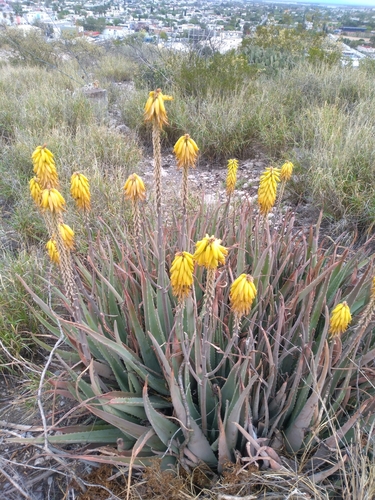
(c) jrebman, some rights reserved (CC BY-NC), uploaded by jrebman
What to Eat
Edible parts: Leaf bud, Seeds, Gel, Flowers
Leaves can be cooked but are very bitter and are best considered an emergency food used only when other options are exhausted. The gel within the leaves is sometimes used as an ingredient in commercial jellies. Seeds are also edible and similarly treated as an emergency food. Seed production is very unlikely in Britain.
Known Hazards
Where to Find It
A tropical and subtropical plant. It grows naturally on seaside sands and amongst rocks in the Mediterranean. In Nepal it grows to about 1400 m altitude. It needs a temperature above 10°C. It suits hardiness zones 9-12. In Yunnan.
Africa, Andorra, Anguilla, Antigua and Barbuda, Asia, Australia, Central America, China, Dominican Republic, EST AFRICA, Ecuador, Egypt, Europe, Fiji, France, Germany, Grenada, Guatemala, Haiti, Hawaii, Himalayas, India, Indochina, Indonesia, Jordan, Kenya, Lithuania, Malaysia, Marshall Islands, Mediterranean, Mexico, Micronesia, Middle East, Myanmar, Nepal, North Africa*, North America, Pacific, Panama, Rotuma, Samoa, Saudi Arabia, SE Asia, Slovenia, South Africa, Southern Africa, South America, St Helena, St. Vincent and Grenadines, Tasmania, Trinidad, Turkey, Türkiye, Tuvalu, United Arab Emirates, UAE, USA, Venezuela, West Indies, Yemen,
How to Identify
A perennial succulent plant 80 cm high. It spreads to 1 m wide. It develops suckers. The leaves form a rosette or ring just above the ground. They are fleshy and long. They are curved outwards or rounded underneath. They taper to a blunt point. They are smooth and pale green. There are white blotches on the leaves and prickles along the edges. The flowers are yellow or orange. They are 25-30 mm long. They hang down. The fruit is a capsule with angular seeds.
How to Grow
Plants can be grown from seed. The seed usually germinates in 1 - 6 months at 16°C. They need to be grown in a sunny nursery for 2 years. Plants can be grown by division or offsets.
Propagation: Sow seed in spring in a warm greenhouse; germination typically takes 1–6 months at 16°C. Prick seedlings into individual pots of very well-drained soil once large enough to handle, and grow on in a sunny part of the greenhouse for at least the first two winters. If planting outdoors, do so in early summer to allow establishment before winter, with some cold protection provided. Offsets are produced quite freely and can be divided at any time of year provided it is warm enough to encourage fresh root growth. Pot up divisions and grow on in the greenhouse until established.
Medicinal Uses
Aloe vera has a long, well-documented history of medicinal use and remains widely employed in modern herbal practice, often appearing in proprietary preparations. It has two principal types of medicinal use. The clear gel inside the leaves is an effective treatment for wounds, burns, and other skin disorders, forming a protective layer over affected areas, speeding healing, and reducing infection risk — partly through the action of aloectin B, which stimulates the immune system. The gel is obtained by cutting leaves lengthwise and rubbing the inner pulp onto the skin, providing immediate soothing relief. The second use comes from the bitter yellow sap at the leaf base. When leaves are cut transversally at the base, the exuded liquid is dried to produce bitter aloes, which contains anthraquinones that act as a digestive stimulant and strong laxative. Anthraquinone content is greatly reduced in pot-grown plants. Aloe vera is emmenagogue, emollient, laxative, purgative, stimulant, stomachic, tonic, vermifuge, and vulnerary, and extracts show antibacterial activity. Internally, bitter aloes is used for chronic constipation, poor appetite, and digestive problems. It should not be given to pregnant women or people with haemorrhoids or irritable bowel syndrome. The plant is strongly purgative and dosage must be carefully managed. It is also used to test for blood in faeces, and has a folk history of use in cancer treatment. The German Commission E Monographs approve Aloe vera for constipation. In Chinese medicine it is used for fungal diseases; in Indian medicine for stomach tumours, constipation, colic, skin diseases, amenorrhoea, worm infestation, and infections. Key chemical constituents include — Amino acids: isoleucine, leucine, lysine, methionine, phenylalanine, threonine, valine. Anthraquinones: aloe-emodin, aloetic acid, aloin, anthracene, anthranol, barbaloin, chryscophanoic acid, emodin, ester of cinnamic acid, ethereal oil, isobarbaloin, resistannol. Enzymes: alkaline phosphatase, amylase, catalase, lipase, oxidase. Minerals: calcium, chromium, copper, magnesium, manganese, sodium, zinc. Prostanoids: gamma-linolenic acid. Saccharides: aldopentose, cellulose, glucose, L-rhamnose, mannose. Vitamins: alpha-tocopherol, beta-carotene, choline, folic acid, B1, B2, B6, C, and E. Other constituents: beta-sitosterol, cholesterol, gibberellin, lignins, salicylic acid, steroids, uric acid, triglycerides.
Other Uses
Leaf extracts are used in skin-care cosmetic products. Plants grown indoors help remove toxins from the atmosphere and are notable for continuing to release oxygen and absorb carbon dioxide in the dark, making them well suited for growing in bedrooms. Aloe vera also functions as a drought-resistant ground cover for xeriscaping, helping prevent soil erosion and supporting soil health. Its nectar-rich tubular flowers attract pollinators including bees and hummingbirds, the flowers may provide food for wildlife, and the dense foliage offers some shelter for small animals. The plant does not produce significant leaf litter or overwintering sites for invertebrates, and its scent is not known to confuse pests, though its sap may have some deterrent effect.
Wikipedia
Source ↗Aloe vera () is a succulent plant species of the genus Aloe. It is widely distributed, and is considered an invasive species in many world regions. An evergreen perennial, it originates from the Arabian Peninsula, but also grows wild in tropical, semi-tropical, and arid climates around the world. It is cultivated for commercial products, mainly as a topical treatment used over centuries. The species is considered attractive for decorative purposes, and is often used indoors as a potted plant. The leaves of Aloe vera contain significant amounts of the polysaccharide gel acemannan, which can be used for topical purposes. The leaves also contain aloin, which is a toxic compound. Aloe vera products are typically made from the gel. Aloe vera acemannan may be used in skin lotions, cosmetics, ointments and gels for minor burns, skin abrasions, insect bites, and windburn. Oral ingestion of aloe vera extracts may cause acute abdominal pain and cramps, and hepatitis if consumed chronically. It should not be used during pregnancy. Some people have allergic reactions to aloe when used on skin.
Notes
There are about 350-400 Aloe species. It is used as a medicine. Also put in the family Aloaceae. Also put in the family Asphodelaceae.
Names & Synonyms
Alo, Burn aloe, Curucao aloe, Gaikwar, Ghiu kumari, Ghyukumari, Kalabanda, Kuthalay, Lidah buaya, Lu hui, Prava aloja, Saber, Savila, True aloe
References (28)
- Blamey, M and Grey-Wilson, C., 2005, Wild flowers of the Mediterranean. A & C Black London. p 469
- Bodkin, F., 1991, Encyclopedia Botanica. Cornstalk publishing, p 70
- Bremness, L., 1994, Herbs. Collins Eyewitness Handbooks. Harper Collins. p 141
- Brown, D., 2002, The Royal Horticultural Society encyclopedia of Herbs and their uses. DK Books. p 115
- Burkill, I.H., 1966, A Dictionary of the Economic Products of the Malay Peninsula. Ministry of Agriculture and Cooperatives, Kuala Lumpur, Malaysia. Vol 1 (A-H) p 109
- Burnie, G & Fenton-Smith, J., 1999, A Grower's Guide to Herbs. Murdoch Books. p 8
- Brickell, C. (Ed.), 1999, The Royal Horticultural Society A-Z Encyclopedia of Garden Plants. Convent Garden Books. p 101
- Chen Xinqi, Liang Songyun, Xu Jiemei, Tamura M.N., Liliaceae. Flora of China. p 90
- Cundall, P., (ed.), 2004, Gardening Australia: flora: the gardener's bible. ABC Books. p 137
- Facciola, S., 1998, Cornucopia 2: a Source Book of Edible Plants. Kampong Publications, p 142
- Fl. indica 83. 1768 1 Mar-6 Apr
- Hani Medicine of Xishuangbanna, 1999, p 475
- Hepper, E.N., 1993, Illustrated Encyclopedia of Bible Plants, IVP, England. p 59, 152, 153
- Ill. bot. Himal. Mts. 390. 1840, nom. nud. (As Aloe indica)
- INFOODSUpdatedFGU-list.xls
- Lazarides, M. & Hince, B., 1993, Handbook of Economic Plants of Australia, CSIRO. p 15
- Llamas, K.A., 2003, Tropical Flowering Plants. Timber Press. p 127
- Mutie, F. M., et al, 2023, Important Medicinal and Food Taxa (Orders and Families) in Kenya, Based on Three Quantitative Approaches. Plants 2023, 12, 1145
- Oran, S. A. S., 2015, Selected Wild Aromatic Plants in Jordan. International Journal of Medicinal Plants. Photon 108 (2015) 686-699
- Plants for a Future database, The Field, Penpol, Lostwithiel, Cornwall, PL22 0NG, UK. http://www.scs.leeds.ac.uk/pfaf/
- Plants of Haiti Smithsonian Institute http://botany.si.edu/antilles/West Indies
- Sasi, R. et al, 2011, Wild edible plant Diversity of Kotagiri Hills - a Part of Nilgiri Biosphere Reserve, Southern India. Journal of Research in Biology. Vol. 1 No. 2, pp 80-87
- Sotelo, A., et al, 2007, Content of Nutrient and Antinutrient in Edible Flowers of Wild Plants in Mexico. Plant Foods for Human Nutrition 62: 133-138
- Staples, G.W. and Herbst, D.R., 2005, A tropical Garden Flora. Bishop Museum Press, Honolulu, Hawaii. p 592
- Sukarya, D. G., (Ed.) 2013, 3,500 Plant Species of the Botanic Gardens of Indonesia. LIPI p 1005
- Thaman, R. R, 2016, The flora of Tuvalu. Atoll Research Bulletin No. 611. Smithsonian Institute p 34
- WATT (Also as Aloe indica)
- World Checklist of Useful Plant Species 2020. Royal Botanic Gardens, Kew