Phyllanthus parvifolius
Buch.-Ham. ex D. Don
PhyllanthaceaeFruit

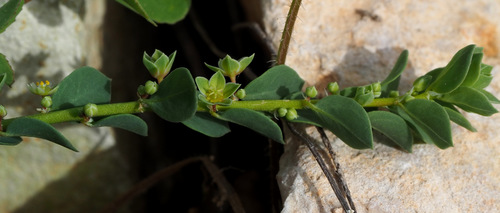
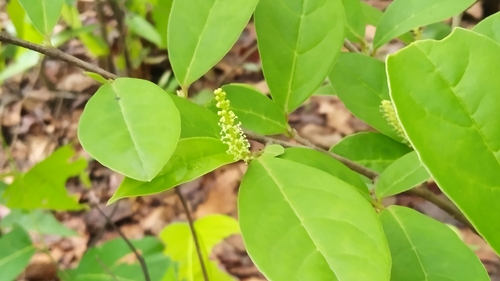
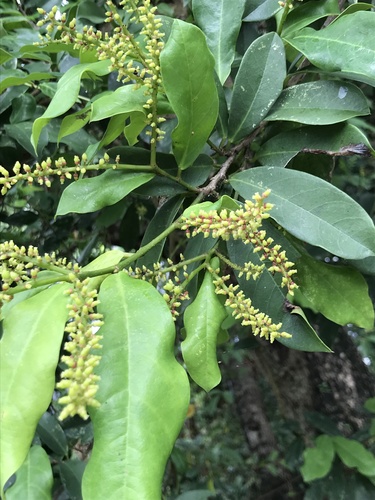
iNaturalist · cc-by
(c) Sagnik Dutta Roy, some rights reserved (CC BY), uploaded by Sagnik Dutta Roy
(c) Sagnik Dutta Roy, some rights reserved (CC BY), uploaded by Sagnik Dutta Roy
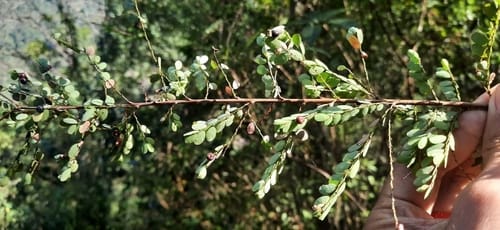
iNaturalist · cc-by-nc
(c) Phuentsho, some rights reserved (CC BY-NC)
(c) Phuentsho, some rights reserved (CC BY-NC)
What to Eat
Edible parts: Fruit
The fruit are eaten raw and also mixed with curry.
Where to Find It
A tropical plant. It grows near water and on limestone rocks. In Pakistan it grows up to 2,400 m altitude.
Asia, Bhutan, Himalayas, India, Indochina, Laos, Myanmar, Nepal, Northeastern India, Pakistan, SE Asia,
Countries: United Arab Emirates, Afghanistan, Armenia, Azerbaijan, Bangladesh, Bahrain, Brunei, Bhutan, China, Georgia, Indonesia, Israel, India, Iraq, Iran, Jordan, Japan, Kyrgyzstan, Cambodia, North Korea, South Korea, Kuwait, Kazakhstan, Laos, Lebanon, Sri Lanka, Myanmar, Mongolia, Maldives, Malaysia, Nepal, Oman, Philippines, Pakistan, Qatar, Saudi Arabia, Singapore, Syria, Thailand, Tajikistan, Timor-Leste, Turkmenistan, Turkey, Taiwan, Uzbekistan, Vietnam, Yemen
How to Identify
A small shrub. It grows 1 m high. The shoots are slender. The leaves are 3-9 mm long by 2-6 mm wide. The fruit are flattened and have 3 lobes. They are 3 mm long by 4 mm wide.
Notes
There are about 750 Phyllanthus species. They are mostly in the tropics.
Names & Synonyms
Ja-la-mat-kha, Memang-ambri
Diasperus parvifolius (Buch.-Ham. ex D. Don) KuntzePhyllanthus juniperinus Wall. ex Mull.Arg.
References (3)
- Flora of Pakistan. www.eFloras.org
- Maikhuri, R, K, and Gangwar, A. K., 1993, Ethnobiological Notes on the Khasi and Garo Tribes of Meghalaya, Northeast India, Economic Botany, Vol. 47, No. 4, pp. 345-357
- Prodr. Fl. Nep. 63. 1825