Rotala indica
(Willdenow) Koehne
Tooth-cup, Joint potherb
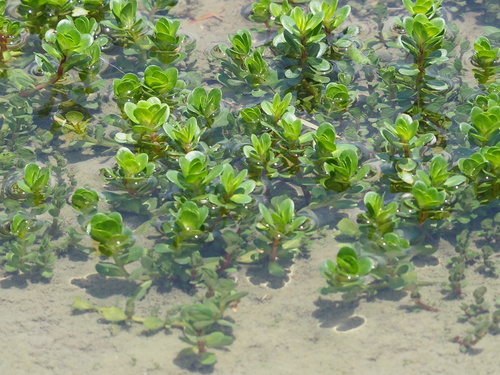
no rights reserved, uploaded by 葉子
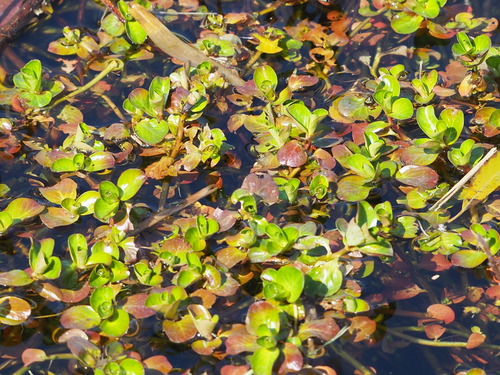
no rights reserved, uploaded by 葉子
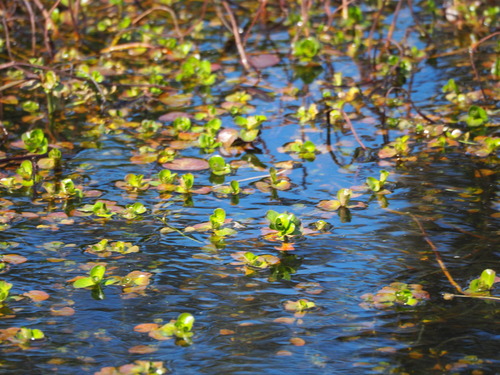
no rights reserved, uploaded by 葉子
What to Eat
Edible parts: Shoots, Leaves
The young shoots and leaves are eaten as a potherb.
Where to Find It
It grows in temperate and tropical places. It is common in central and southern China. It is usually associated with rice cultivation. It grows in wetlands. In Pakistan it grows between 300-1,800 m altitude.
Afghanistan, Africa, Asia, Bhutan, Cambodia, Central Africa, Central Asia, China, Congo, Europe, Himalayas, India, Indochina, Indonesia, Iran, Italy, Japan, Korea, Laos, Malaysia, Mediterranean, Middle East, Myanmar, Nepal, North America, Pakistan, Philippines, Portugal, Russia, SE Asia, Sri Lanka, Taiwan, Tajikistan, Thailand, USA, Vietnam,
How to Identify
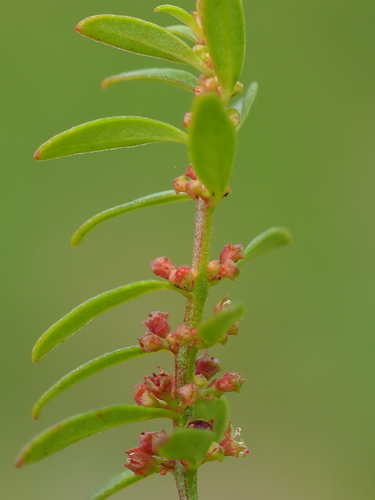
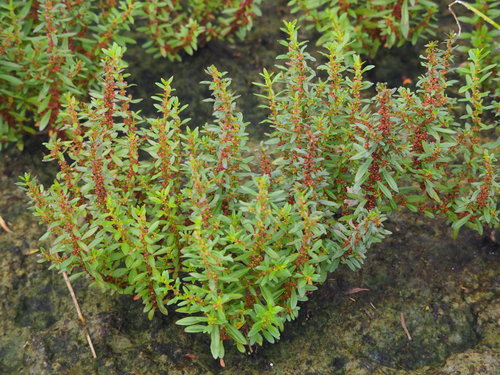
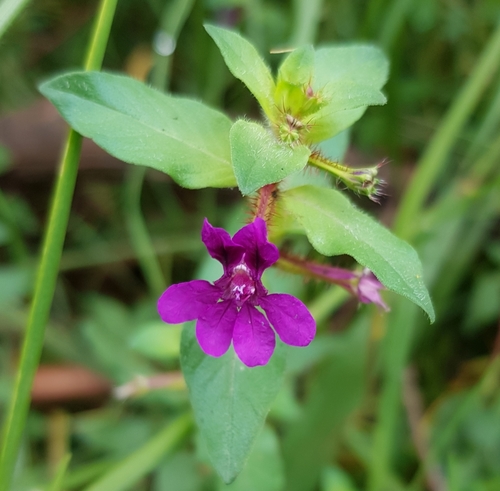
An annual herb. It can grow on land or in water. It is about 40 cm high. The stems are creeping and branched at the base. It can be weakly 4 angled. The leaves are divided and broadly oval. They are 5-17 mm long by 3-8 mm wide. The flowers are small and 1-2 mm long. They are in spikes 6-12 mm long in the axils of leaves. The fruit is an oblong capsule 1.5 mm long. It has lines along it. The seeds do not have wings.
Wikipedia
Source ↗Rotala indica is a species of flowering plant in the loosestrife family known by the common name Indian toothcup. It is native to Southeast Asia. This aquatic plant is best known as a popular aquarium plant and as a weed of rice fields. It is known as an introduced species and a weed in rice-growing regions in Congo, Italy, and Portugal, and California and Louisiana in the United States. The stems of the plant grow up to 30 or 40 cm long. Leaves are decussate, arranged oppositely in perpendicular pairs along the stems. The leaves are oval with thick, whitish, cartilaginous margins and measure up to 2 cm long. Flowers occur in leaf axils singly or in short, spikelike inflorescences. Each has four triangular sepals and four tiny pink petals.
Notes
There are 45 Rotala species. They grow in water.
Names & Synonyms
En ni a bo
References (5)
- Hu, Shiu-ying, 2005, Food Plants of China. The Chinese University Press. p 573
- Luo, B., et al, 2019, Wild edible plants collected by Hani from terraced rice paddy agroecosystem in Honghe Prefecture, Yunnan, China. Journal of Ethnobiology and Ethnomedicine 15:56
- READ,
- Swapna, M. M. et al, 2011, A review on the medicinal and edible aspects of aquatic and wetland plants of India. J. Med. Plants Res. 5 (33) pp. 7163-7176
- Zhang, Y., et al, 2014, Diversity of wetland plants used traditionally in China: a literature review. Journal of Ethnobiology and Ethnomedicine. 10:72