Sauropus androgynus
(L.) Merr.
Sweet leaf
no rights reserved

(c) surunivrse, some rights reserved (CC BY-NC)

(c) surunivrse, some rights reserved (CC BY-NC)
What to Eat
Edible parts: Leaves, Fruit, Flowers, Vegetable
Young leaves make a good addition to salads raw, while older leaves are better cooked — added to soups or cooked with rice. Young shoots about 7cm long, harvested as the leaves unfurl, have a flavour similar to asparagus and a sweet taste reminiscent of fresh garden peas. The leaves are a good source of protein, approximately 6–10%, and are very nutritious overall. Ripe fruits can be made into sweetmeats. A green dye obtained from the leaves is used for food colouring.
Where to Find It
A tropical plant. It occurs commonly in SE Asia. It can grow in partial shade or full sun. It suits the hot humid lowlands. It will grow in heavy clay soils and will grow in acid soils. In Java it grows up to 1,600 m above sea level. At MARDI. In Yunnan.
Andamans, Asia, Australia, Bangladesh, Cambodia, China, Ecuador, East Timor, Fiji, FSM, Hawaii, India, Indochina, Indonesia, Japan, Laos, Malaysia, Maldives, Myanmar, Northeastern India, Pacific, Papua New Guinea, PNG, Philippines, Pohnpei, SE Asia, Singapore, Solomon Islands, Sri Lanka, Taiwan, Thailand, Timor-Leste, Tuvalu, USA, Vietnam,
How to Identify
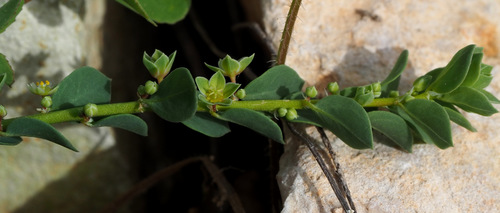
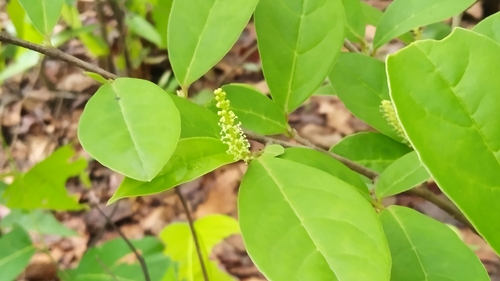
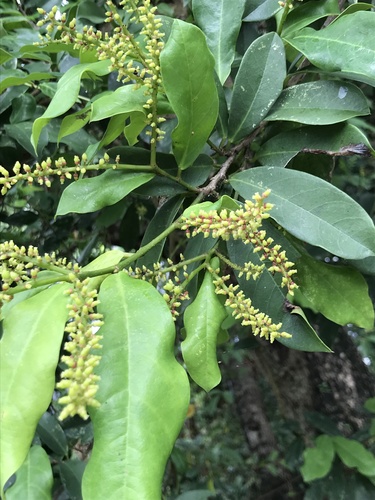
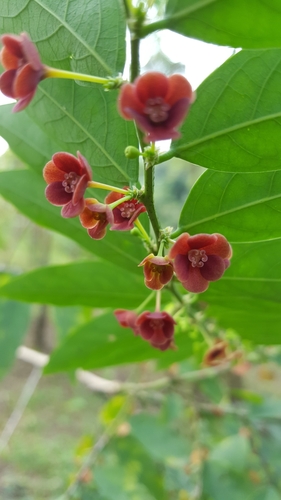
A low growing shrub with small red flowers. It continues to grow from year to year. It grows 0.8-2 m tall. It can grow 6 m tall. It tends to grow upright then falls over due to its weight. It branches little. Compound leaves on the sides of the stems bear flowers along their underside. Male and female flowers are on the same plant. The flowers are in drooping clusters. The fruit are purple. The fruit are about 1 cm across and open and drop their seed at maturity. See Breynia androgyna.
Nutrition Score: 58/100
| Part | Moisture | kJ | kcal | Protein | Vit A | Vit C | Iron | Zinc |
|---|---|---|---|---|---|---|---|---|
| Leaves | 81 | 244 | 58 | 4.8 | 133 | 85 | 2.7 | — |
How to Grow
It is grown from cuttings. Cuttings grow easily. Pruning encourages more upright shoots. It can also be grown from seed. Seed only remain viable for a few months. It is often grown as a hedge. Cuttings for this are placed 10 cm apart. Adding shade (shade cloth) and fertiliser can be used to force the leaf tips to grow rapidly. Normally bushes are planted about 60 cm apart.
Propagation: Seed is produced abundantly and germinates readily. Cuttings also strike readily; somewhat woody shoots 20–30cm long are used.
Medicinal Uses
The leaves are used medicinally to treat coughs and soothe the lungs, as a general tonic, and as a febrifuge to relieve internal fever.
Other Uses
Plants can be grown as a hedge provided they are trimmed regularly to keep them in check. They are commonly used as a living fence or to provide shade for vegetable crops.
Wikipedia
Sauropus androgynus is a fast-growing evergreen shrub reaching 3 meters tall and wide. Hardy to UK zone 10, it adapts to light sandy, medium loamy, and heavy clay soils, preferring well-drained conditions but tolerating heavy clay and poor nutrition. It grows across mildly acidic to mildly alkaline pH ranges and tolerates both semi-shade and full sun, adapting to dry or moist soil conditions.
Production
Young leaves can be harvested 4 months after planting. The top 15 cm of young leaf tips are picked. It gives a high yield of leaves. Production continues year round. Shrubs last a long time.
Other Information
It is a commercially cultivated vegetable. It is a popular vegetable often sold in local markets.
Notes
Demo. There are about 50 Sauropus species. It is high in Vitamin A and Vitamin B. It is also high in alpha-tocopherol or Vitamin E - 79.6 mg per 100 g. They have also been put in the family Euphorbiaceae. It possibly has anti-cancer properties.
Names & Synonyms
Babing, Boa kaalhulun, Bo ngot, Cekur manis, Chakur mani, Changkok manis, Chekkurmensis, Chekup manis, Chekurmanis, Chermela hutan, Chinese malunggay, Daun katuk, Dieng-soh-pit, Gam oying, Hanvoti, Kakul, Kantong, Katu, Katuk, Katukan, Malunggay hapon, Ma-shaw, Mella dum kola, Midum-an, Mithapotro, Nasi-nasi, Ngop, Ngub, Pak-wan, Pakwan, Pakwanban, Pamao, Pa wan, Pawing, Phak waan baan, Phak waan, Phak wan ban, Poshi, Qi du, Rau ngot, Rau nyot, Ruridama no ki, Sengtungrung, Shou gong mu, Shu tian cai, Simani, So-kun-mu, Star gooseberry, Sweet shoot, Tarok manis, Taruak manih, Thavasai murungai
References (74)
- Ali, R. M., et al, (Eds.), 2010, ASEAN Herbal and Medicinal Plants. Forestry research Institute Malaysia. p 103
- Ambasta S.P. (Ed.), 2000, The Useful Plants of India. CSIR India. p 553
- Andarwulan, N., et al, 2010, Flavonoid content and antioxidant activity of vegetables from Indonesia. Food Chemistry 121: 1231-1235
- Anderson, E. F., 1993, Plants and people of the Golden Triangle. Dioscorides Press. p 220
- Arora, R. K., 2014, Diversity in Underutilized Plant Species - An Asia-Pacific Perspective. Bioversity International. p 45 (Also as Sauropus albicans p 50)
- Ashton, M. S., et al 1997, A Field Guide to the Common Trees and Shrubs of Sri Lanka. WHT Publications Ltd. pdf p 211
- Bull. Bur. Forest. Philipp. Islands 1:30. 1903
- Burkill, I.H., 1966, A Dictionary of the Economic Products of the Malay Peninsula. Ministry of Agriculture and Cooperatives, Kuala Lumpur, Malaysia. Vol 2 (I-Z) p 2002
- Cao, Y., et al, 2020, Ethnobotanical study on wild edible plants used by three trans-boundary ethnic groups in Jiangcheng County, Pu’er, Southwest China. Journal of Ethnobiology and Ethnomedicine (2020) 16:66
- Cengel, D. J. & Dany, C., (Eds), 2016, Integrating Forest Biodiversity Resource Management and Sustainable Community Livelihood Development in the Preah Vihear Protected Forest. International Tropical Timber Organization p 123
- Chin, H. F., 1999, Malaysian Vegetables in Colour. Tropical Press. p 12
- Ching, L. S. & Mohamed, S., 2001, Alpha-Tocopherol Content in 62 Edible Tropical Plants. J. Agric. Food Chem. 2001, 49, 3101−3105
- Dobriyal, M. J. R. & Dobriyal, R., 2014, Non Wood Forest Produce an Option for Ethnic Food and Nutritional Security in India. Int. J. of Usuf. Mngt. 15(1):17-37
- Ethnobotany of Karbis. Chapter 4 in p 100
- Facciola, S., 1998, Cornucopia 2: a Source Book of Edible Plants. Kampong Publications, p 101
- French, B.R., 2010, Food Plants of Solomon Islands. A Compendium. Food Plants International Inc. p 99
- Flora of China. www.eFloras.org
- Foo, J.T.S.(ed), 1996, A Guide to Common Vegetables. Singapore Science Foundation. p 72
- Food Composition Tables for use in East Asia FAO http://www.fao.org/infoods/directory No. 700
- Ghorbani, A., et al, 2012, A comparison of the wild food plant use knowledge of ethnic minorities in Naban River Watershed Nature Reserve, Yunnan, SW China. Journal of Ethnobiology and Ethnomedicine; 8:17
- Hu, Shiu-ying, 2005, Food Plants of China. The Chinese University Press. p 512
- Jacquat, C., 1990, Plants from the Markets of Thailand. D.K. Book House p 77
- Japanese International Research Centre for Agricultural Science www.jircas.affrc.go.jp/project/value_addition/Vegetables
- Jiwajinda, S., et al, 2002, Suppressive Effects of Edible Thai Plants on Superoxide and Nitric Oxide Generation. Asian Pacific Journal of Cancer Prevention, Vol 3, 2002
- Kachenchart, B., et al, 2008, Phenology of Edible Plants at Sakaerat Forest. In Proceedings of the FORTROP II: Tropical Forestry Change in a Changing World. Bangkok, Thailand.
- Kar, A., et al, 2013, Wild Edible Plant Resources used by the Mizos of Mizoram, India. Kathmandu University Journal of Science, Engineering and Technology. Vol. 9, No. 1, July, 2013, 106-126
- Kays, S. J., and Dias, J. C. S., 1995, Common Names of Commercially Cultivated Vegetables of the World in 15 languages. Economic Botany, Vol. 49, No. 2, pp. 115-152
- Khumgratok, S., Edible Plants in Cultural Forests of Northeastern Thailand. Mahasarakham University Thailand.
- Kiple, K.F. & Ornelas, K.C., (eds), 2000, The Cambridge World History of Food. CUP p 1864
- Lembogi Biologi Nasional, 1980, Sayur-sayuran. Balai Pustaka, Jakarta. p 52
- Luczaj, L., et al, 2021, Wild food plants and fungi sold in the markets of Luang Prabang, Lao PDR. Journal of Ethnobiology and Ethnomedicine (2021) 17:6
- Lugod, G.C. and de Padua L.S., 1979, Wild Food Plants in the Philippines. Vol. 1. Univ. of Philippines Los Banos. p 35
- Maghirang, R. G., et al, 2018. Ethnobotanical Studies of Some Plants Commonly Used as Vegetables in Selected Provinces of the Philippines. Journal of Nature Studies. 17(2), 30-43.
- Maisuthisakul, P., 2012, Phenolic Constituents and Antioxidant Properties of some Thai Plants. Chp. 9 in Book Phytochemicals - A Global Perspective of Their Role in Nutrition and Health
- Martin, F.W., & Ruberte, R.M., 1979, Edible Leaves of the Tropics. Antillian College Press, Mayaguez, Puerto Rico. p 35, 192
- Martin, M.A., 1971, Introduction L'Ethnobotanique du Cambodge. Centre National de la Recherche Scientifique. Paris.
- McMakin, P.D., 2000, Flowering Plants of Thailand. A Field Guide. White Lotus. p 106
- Murakami, A. et al, 2014, Screening for the In Vitro Anti-tumor-promoting Activities of Edible Plants from Malaysia. Bioscience, Biotechnology, and Biochemistry, 64:1, 9-16.
- Norrington, L., & Campbell, C., 2001, Tropical Food Gardens. Bloomings Books. p 53
- NTBG herbarium "edible"
- Ochse, J.J. et al, 1931, Vegetables of the Dutch East Indies. Asher reprint. p 290
- Ogle, B. M., et al, 2003, Food, Feed or Medicine: The Multiple Functions of Edible Wild Plants in Vietnam. Economic Botany 57(1): 103-117
- Oomen, H.A.P.C., & Grubben, G.J.H., 1978, Tropical Leaf Vegetables in Human Nutrition, Communication 69, Department of Agricultural research, RTI Amsterdam, p 36, 56, 66, 97, 114
- Pasha, M. K. & Uddin, S. B., 2019, Minor Edible Fruits of Bangladesh. Bangladesh J. Plant Taxon. 26(2): 299–313
- Pawera, L., et al, 2020, Wild Food Plants and Trends in Their Use: From Knowledge and Perceptions to Drivers of Change in West Sumatra, Indonesia, Foods. 2020, 9, 1240
- Phon, P., 2000, Plants used in Cambodia. © Pauline Dy Phon, Phnom Penh, Cambodia. p 549
- Phangchopi, U., et al, 2015, Diversity of wild edible plants in Marat Longri Wildlife Sanctuary, Assam. Indian Journal of Natural Products and Resources Vol. 6(4), December 2015 pp. 305-313
- Pradheep, K., et al, 2016, Wild edible plants used by Konyak tribe in Mon district of Nagaland: Survey and inventorisation. Indian Journal of Natural Products and Resources. Vol 7(1) pp 74-81
- Recher, P, 2001, Fruit Spirit Botanical Gardens Plant Index. www.nrg.com.au/~recher/ seedlist.html p 3
- Rodriguez-Amaya, D. B., 1999, Carotenoides y Prepracion de Alimentos. University Estadual de Campinas, Brasil, Ph.D. thesis. p 21
- Sharma, B.B., 2005, Growing fruits and vegetables. Publications Division. Ministry of Information and broadcasting. India. p 195
- Solomon, C., 2001, Encyclopedia of Asian Food. New Holland. p 317
- Solomon, C., 2001, Encyclopedia of Asian Food. New Holland. p 317 (As Sauropus albicans)
- Somnasang, P., Moreno, G and Chusil K., 1998, Indigenous knowledge of wild hunting and gathering in north-east Thailand. Food and Nutrition Bulletin 19(4) p 359f
- Srichaiwong, P., et al, 2014, A Study of the Biodiversity of Natural Food Production to Support Community Upstream of Chi Basin, Thailand. Asian Social Science 10 (2):
- Staples, G.W. and Herbst, D.R., 2005, A tropical Garden Flora. Bishop Museum Press, Honolulu, Hawaii. p 296
- Sujanapal, P., & Sankaran, K. V., 2016, Common Plants of Maldives. FAO & Kerala FRI, p 232
- Sukarya, D. G., (Ed.) 2013, 3,500 Plant Species of the Botanic Gardens of Indonesia. LIPI p 709
- Sukenti, K., et al, 2016, Ethnobotanical study on local cuisine of the Sasak tribe in Lombok Island, Indonesia. Journal of Ethnic Foods. 3 (2016) 189-200 p 198
- Suksri, S., et al, 2005, Ethnobotany in Bung Khong Long Non-Hunting Area, Northeast Thailand. Kasetsart J., (Nat. Sci) 39: 519-533
- Taram, M., et al, 2018, Wild Food Plant Resources of Komkar Adi Tribe of Upper Siang District in Arunachal Pradesh, India. Bulletin of Arunachal Forest Research, Vol. 33(2), 27-35
- Teron, R. & Borthakur, S. K., 2016, Edible Medicines: An Exploration of Medicinal Plants in Dietary Practices of Karbi Tribal Population of Assam, Northeast India. In Mondal, N. & Sen, J.(Ed.) Nutrition and Health among tribal populations of India. p 152
- Terra, G.J.A., 1973, Tropical Vegetables. Communication 54e Royal Tropical Institute, Amsterdam, p 71, 72
- Thaman, R. R, 2016, The flora of Tuvalu. Atoll Research Bulletin No. 611. Smithsonian Institute p 87
- Thitiprasert, W., et al, 2007, Country report on the State of Plant Genetic Resources for Food and Agriculture in Thailand (1997-2004). FAO p 95
- Tindall, H.D., & Williams, J.T., 1977, Tropical Vegetables and their Genetic Resources, International Board for Plant Genetic Resources, Rome, p 108
- USDA, ARS, National Genetic Resources Program. Germplasm Resources Information Network - (GRIN). [Online Database] National Germplasm Resources Laboratory, Beltsville, Maryland. Available: www.ars-grin.gov/cgi-bin/npgs/html/econ.pl (10 April 2000)
- Van Sam, H. et al, 2008, Uses and Conservation of Plant Species in a National Park. A case study of Ben En, Vietnam. Economic Botany 62:574-593
- Van Welzen P. C., 2003, Revision of the Malesian and Thai species of Sauropus (Euphorbiaceae: Phyllanthoideae). Blumea Journal of Plant Taxonomy and Plant Geography. 48: 319-391
- Wiersema, J. H. & Leon, B., 2013, World Economic Plants. A Standard Reference CRC Press. 2nd Ed. p 616
- Wiriadinata, H., 1995, Ethnobotany of Economic Plants in the Baliem Valley, Jayawijaya, Irian Jaya, Indonesian Institute of Science, Bogor, Indonesia
- Woodward, P., 2000, Asian Herbs and Vegetables. Hyland House. p 120
- Xu, You-Kai, et al, 2004, Wild Vegetable Resources and Market Survey in Xishuangbanna, Southwest China. Economic Botany. 58(4): 647-667.
- Zeven, A. C. & de West, J. M. J., 1982, Dictionary of cultivated plants and their regions of diversity. Wageningen. p 53