Solanum repandum
Forst.f.
Sou, Pacific tomato

Wikimedia Commons - T. F. Cheeseman

Wikimedia Commons - T. F. Cheeseman
What to Eat
Edible parts: Fruit
The cooked fruit is eaten in soups and with yams.
Known Hazards
Where to Find It
A tropical plant. In Fiji it grows from sea level to 900 m altitude.
Cook Islands, Fiji, Hawaii, Marquesas, Niue, Pacific, Papua New Guinea, PNG, Samoa, Solomon Islands, Tonga, USA, Vanuatu,
How to Identify
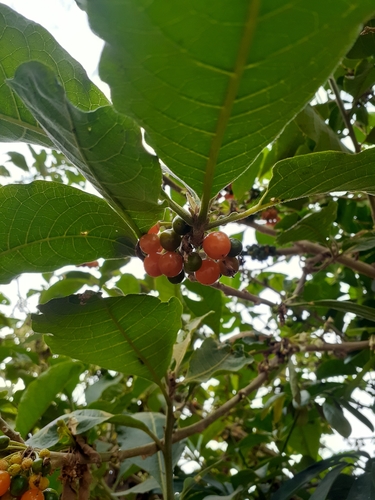
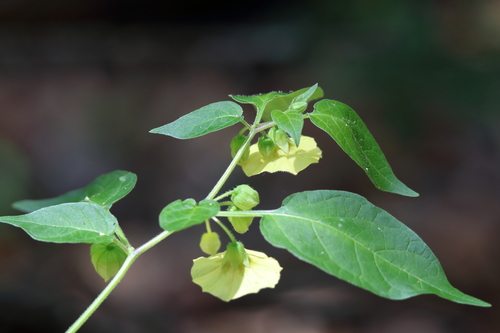
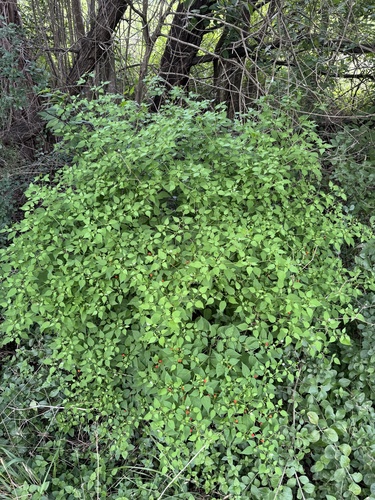
A shrub. It grows 0.6-3 m high. The leaves are oval and 20 cm long. The flowers are white and hairy. The fruit is yellow-green. The fruit are softly hairy but become smooth. They have 3-4 sections. It is similar to Naranjilla.
How to Grow
Plants can be grown from seed.
Propagation: Seed - sow in trays in a nursery. Prick out the seedlings into individual pots when they are large enough to handle and grow them on fast. Plant them out when 10cm or more tall. Cuttings of half-ripe wood. Very easy, the cuttings root within a couple of weeks.
Medicinal Uses
The following uses were listed under S. ferox. Since this species is either a form of S. Ferox, or a very closely related species, it is assumed that the medicinal uses listed below apply to this species as well. The leaves can be used as poultices on swellings. A decoction of the roots is used to treat syphilis, and to ease body pains and discomfort after meals. The roots are used externally to make baths for treating fevers and as a poultice on itches, cuts, wounds and bruises. The seeds are used to ease toothaches - they are burned and the fumes inhaled. The plant (part not specified) is used in Bangladesh and India to treat coughs, asthma, fever, vomiting, sore throat, gonorrhoea and female sexual disorders.
Other Uses
The seeds yield a yellow coloured oil, containing palmitic acid, stearic acid, oleic acid and linoleic acid. This report does not specify if the oil has any uses, or even if it is in sufficient quantity to be utilized.
Wikipedia
Source ↗Solanum repandum is a species of evergreen shrub native to various island groups across the Pacific Ocean (Bismarck Archipelago, Cook Islands, Fiji, Mariana islands, Marquesas, Niue, Pitcairn Islands, Samoa, Society Islands, Vanuatu), and occasionally grown for its edible fruit. Only partially domesticated and very rare in cultivation outside of its native range, it is also known as kokoua or huou. Solanum repandum will apparently hybridize with a number of close relatives, including the South American naranjilla, pseudolulo, and Solanum candidum, along with the Solanum lasiocarpum, from India. Solanum repandum is, in fact, so similar in growth habit and in its fruit that it has been possibly considered a subspecies of either Solanum quitoense (naranjilla) or Solanum lasiocarpum. The three species are native to different geographical areas, and tolerate slightly different climatic conditions, but their overall habit of growth is nearly identical, as is the use for the fruit in local cuisines. Each of them features a unique ring of emerald green juice surrounding the seeds in fruit that otherwise ripen to yellow or orange. The immature fruit is covered is bristles, which detach easily upon full ripening. Like many of its relatives, S. repandum is a close relative of other nightshades cultivated for their edible fruit, including the tomato (S. lycopersicum), the naranjilla (S. quitoense) and the eggplant (S. melongena). It will readily hybridize with Solanum candidum, Solanum quitoense (naranjilla), Solanum lasiocarpum (Indian nightshade), and Solanum sessiliflorum (cocona), though in some cases those hybrids are sterile. Scientifically, S. repandum is of additional scientific interest, as is S. candidum, as they appear to be the closest relatives and a possible link species between the Asian and South American members of the same botanical clade.
Production
Plants produce fruit in 1-2 years from seed.
Other Information
It is a cultivated plant.
Notes
There are about 1400 Solanum species. There are 3 Solanum repandum species with different authorities.
Names & Synonyms
Borosou, Huou, Kokoua, Lukumoka, Mboro sou, Sousou, Sou vitu, Taulo'u, Vuani
References (11)
- Hedrick, U.P., 1919, (Ed.), Sturtevant's edible plants of the world. p 619
- Lebot, V. & Sam, C., Green desert or ‘all you can eat’? How diverse and edible was the flora of Vanuatu before human introductions?. Terra australis 52 p 409
- McClatchey, W. C., 2012, Wild food plants of Remote Oceania. Acta Societatis Botanicorum Poloniae. 81(4):371-380
- NYBG Herbarium "edible"
- Parham, H. B. R, 1940, Supplement to the Journal of the Polynesian Society No. 16. Fiji Plants: Their Name and Uses.
- Parham, B. E. V., 1972, Plants of Samoa. New Zealand Department of Scientific and Industrial Research. Information Series. No. 85 p 122
- Samuels, J., 2015, Biodiversity of Food Species of the Solanaceae Family: A Preliminary Taxonomic Inventory of Subfamily Solanoideae. Resources 2015, 4. 277-322
- Smith, A.C., 1991, Flora Vitiensis Nova, Lawaii, Kuai, Hawaii, Volume 5 p 14
- Whistler, W. A., in Cox. P. A. et al (Ed.), 1991, Islands, Plants and Polynesians. Dioscorides Press Portland, Oregon. p 56
- Wiersema, J. H. & Leon, B., 2013, World Economic Plants. A Standard Reference CRC Press. 2nd Ed. p 647
- http://cookislands.bishopmuseum.org