Solanum tuberosum
L.
Potato
(c) dmitry tretjakov, some rights reserved (CC BY-NC), uploaded by dmitry tretjakov

(c) Landahlauts, some rights reserved (CC BY-NC-SA)

(c) Rachel Lyn Edler, some rights reserved (CC BY-NC), uploaded by Rachel Lyn Edler
What to Eat
Edible parts: Tubers, Root, (Leaves), Vegetable, Caution
The tuber is cooked. This species has the largest tubers of all Andean cultivated species, with a good protein content (12% dry weight, compared to 8–10% for the cultivated potato), and is rich in starch and vitamin C. Nutritional composition per 100g fresh weight: 80 calories; water 79%; protein 2.4g; fat 0.1g; carbohydrate 18g; fibre 0.5g; ash 1.3g; calcium 10mg; phosphorus 51mg; iron 0.8mg; sodium 5mg; potassium 401mg; vitamin A 20mg; thiamine (B1) 0.9mg; riboflavin (B2) 0.03mg; niacin 1.5mg; vitamin C 20mg. These figures represent the mean obtained from a range of readings.
Known Hazards
Where to Find It
It is a temperate plant. In the tropics they mostly grow at high altitude above 1500 m, but plants are grown between 900 and 2800 m. Tubers form best when soil temperatures are 15.5°C. Tuber formation stops with a soil temperature of 30°C and decreases with temperatures above 20°C. Potatoes should have a mean temperature below 18°C. They are damaged by frost but slightly more frost tolerant than sweet potato. Short daylength helps tuber production. They can grow with a pH of 5.2-6.6. In the Himalayas it grows up to 4,400 m altitude as a summer crop. In the Andes it grows between 1,000-3,900 m above sea level. It suits hardiness zones 7-11.
Africa, Albania, Algeria, Andes, Andorra, Angola, Argentina, Asia, Australia, Austria, Azerbaijan, Balkans, Bangladesh, Belarus, Belgium, Bolivia, Bougainville, Brazil, Britain, British Indian Ocean Terr., BIOT, Burkina Faso, Cape Verde, Caucasus, Central Africa, Central America, Central Asia, Chile, China, Colombia, Congo, Cook Islands, Costa Rica, Côte d'Ivoire, Cuba, Cyprus, Czech Republic, Denmark, Dominican Republic, East Africa, East Timor, Ecuador, Egypt, Estonia, Eswatini, Ethiopia, Europe, Falklands, Fiji, Finland, Georgia, Germany, Ghana, Guam, Guatemala, Haiti, Hawaii, Himalayas, Iceland, India, Indochina, Indonesia, Inner Mongolia, Ireland, Italy, Ivory Coast, Japan, Kazakhstan, Kenya, Korea, Kyrgyzstan, Laos, Liechtenstein, Lithuania, Macedonia, Madagascar, Malawi, Malaysia, Mali, Malta, Mediterranean, Mexico, Moldova, Montenegro, Morocco, Mozambique, Myanmar, Nepal, New Zealand, Nicaragua, Niger, Nigeria, North Africa, North America, Northeastern India, Pacific, Pakistan, Papua New Guinea, PNG, Peru, Philippines, Sao Tome and Principe, Scandinavia, SE Asia, Serbia, Sierra Leone, Sikkim, Slovenia, Somalia, South Africa, Southern Africa, South America, Spain, Sri Lanka, Swaziland, Switzerland, Tajikistan, Tasmania, Thailand, Timor-Leste, Uganda, Ukraine, Uruguay, USA, Uzbekistan, Vanuatu, Venezuela, Vietnam, West Africa, West Indies, Zambia, Zimbabwe,
How to Identify
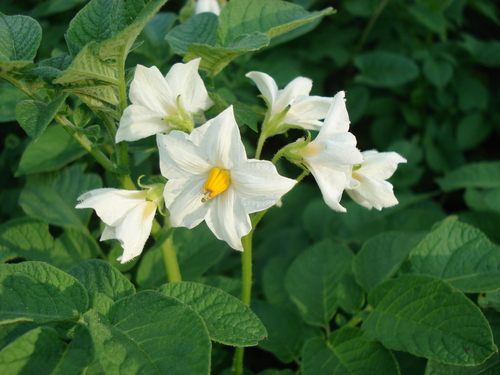
A branched annual plant up to 50 cm high. The stems are soft and 4 angled with compound leaves. The leaves are irregular shape and have 6-8 pairs of leaflets as well as small irregular leaflets between the others. It has swollen stem tubers under the ground. The tubers can vary in colour from white to red and purple. The tuber shape can also vary greatly. The flowers are white pink or purple. The fruit is a berry. It is smooth, round and green but often striped.
Nutrition Score: 47/100
| Part | Moisture | kJ | kcal | Protein | Vit A | Vit C | Iron | Zinc |
|---|---|---|---|---|---|---|---|---|
| Tuber baked | 71.2 | 456 | 109 | 2.3 | 0 | 12.9 | 1.4 | 0.3 |
| Tuber | 77 | 344 | 82 | 2 | 25 | 21 | 0.8 | 0.27 |
| Leaves | 86.1 | — | — | 3.4 | — | — | — | — |
How to Grow
Plants are grown from tubers. Due to virus diseases it is necessary to get fresh seed tubers each few years. Large tubers can be cut to include a bud or "eye". A seed piece of 40-50 g is suitable. It is best to inter-crop as this stops bacterial wilt spreading. The plant is surrounded by dirt when 20-25 cm tall. Later the tubers need to be kept covered with dirt. Providing extra light (4-5 hours) allows plants to form flowers and true seed to be collected.
Propagation: Sow seed in early spring in a warm greenhouse. Prick out seedlings into a fairly rich compost as soon as they are large enough to handle and grow them on quickly. Plant out after the last expected frosts. Alternatively, propagate by division. Harvest tubers in autumn after frost has cut back the top-growth, store in a cool frost-free place over winter, and replant in April.
Medicinal Uses
No known medicinal uses.
Other Uses
No known other uses.
Wikipedia
Source ↗A frost-tender perennial with hermaphroditic, insect-pollinated flowers. Grows in light sandy, medium loamy, and heavy clay soils with well-drained conditions across mildly acid to basic pH. Requires full sun and prefers moist soil.
Production
The time to maturity is between 17 and 24 weeks. Yields of 5 to 12 tons/ha can be expected. Higher yields can be obtained with good care.
Other Information
It is a commercially cultivated vegetable. In Papua New Guinea it is gaining acceptance as a subsistence food crop above about 1900 m altitude. More than 330 million tons are grown worldwide. It has been grown outside the Andes since 1532 AD.
Notes
There are about 1400 Solanum species. A C3 crop so will produce better with higher CO2 with climate change.
Names & Synonyms
Aalu, Aalu ko saag, Aartappel, Ah-lu, Ahr-lu, Alu-gidde, Alu, Ar-loo, Aspos, Aspus, Aswis, Atepote, Bangaladumpa, Batata, Batate, Buteta, Gamja, Huwi kumeli, Jagaimo, Kagow, Kartofel, Kentang, Krompir, Mudabula, Ovy, Owi kentang, Papa, Papas, Ubi kantang, Ubi kentang, Ubi kumandur, Uralagadda, Uralakilangu, Urulan kizhangu, Vateta, Wallaraikilangu, Yang yu