Dioscorea nummularia
Lamarck
Nummularia yam
(c) j_tari, some rights reserved (CC BY-NC)
(c) j_tari, some rights reserved (CC BY-NC)
What to Eat
Edible parts: Tubers, Root
The tubers are cooked and eaten. Plants are traditionally grown near trees for the vine to climb, with the tuber left in place for several years and harvested annually. It can be propagated from tuber pieces or aerial tubers.
Known Hazards
Where to Find It
A tropical plant. Mostly they occur in coastal areas. In Papua New Guinea it has been recorded up to 2,000 m above sea level. Outside Papua New Guinea it occurs in Fiji, Indonesia, Malaysia and the Solomon Islands.
American Samoa, Asia, Australia, Bougainville, Brazil, Cook Islands, Fiji, Guam, Indochina, Indonesia, Laos, Malaysia, Marquesas, Micronesia, New Caledonia, Pacific, Papua New Guinea, PNG, Philippines, Rotuma, Samoa, SE Asia, Solomon Islands, South America, Tuvalu, Vanuatu, Wallis & Futuna, Yap,
How to Identify
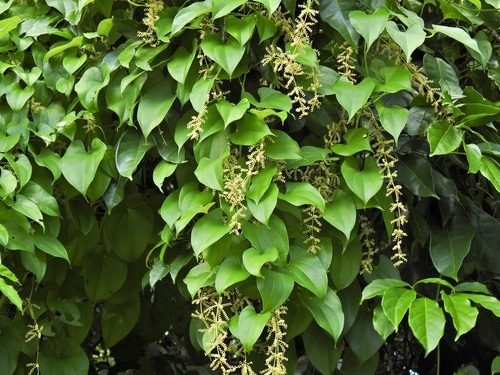
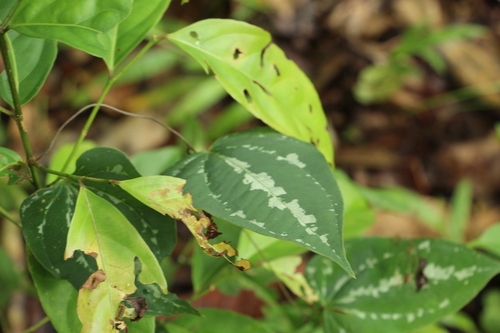
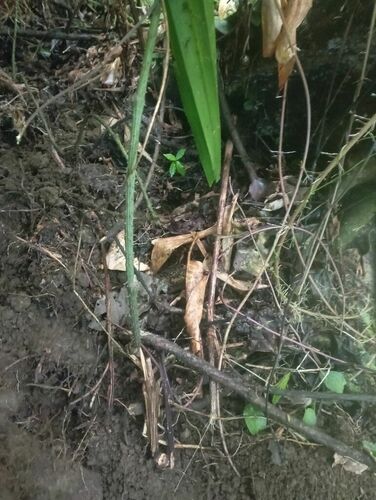
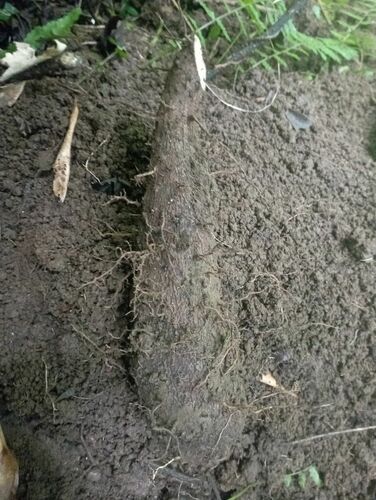
A yam. A vine plant with long spiny stems. The stems are nearly round in cross section. The leaves are oval to heart shaped. They end abruptly in a pointed tip. Often they are alternate lower on the vine then opposite each other higher up the plant. The vines twine to the right. The stems are spiny near the base. The flowers are slender. The flower spikes occur on leafless branches produced in the axils of leaves and these are longer than the leaf near where they are produced. The flower spikes remain of equal size along the length of this flowering branch. Tubers are often deep in the soil and with several lobes.
Nutrition Score: 36/100
| Part | Moisture | kJ | kcal | Protein | Vit A | Vit C | Iron | Zinc |
|---|---|---|---|---|---|---|---|---|
| Tuber | 71.9 | 443 | 106 | 2.04 | 17 | — | 0.38 | 0.5 |
How to Grow
It can be grown from pieces of the tuber. It can also be grown from aerial tubers. Plants are often planted near trees so that the vine can climb the tree and the tuber is left growing in the same spot for several years with tubers being harvested annually.
Propagation: Seed - not normally used to propagate this species. Cuttings of tubers. Small tubers can be cut into 2 - 4 sections, larger ones into 6 - 8 sections. Each section should have 2 - 3 dormant buds. The cut tuber is often left in the sun for several hours to promote wound healing and reduce the risk of fungal infection.
Other Uses
The tough stems are used for cordage.
Production
The leaves die off and re-grow each year. The tuber does not store well.
Other Information
A minor edible yam. It is cultivated.
Notes
There are about 650 species of Dioscorea.
Names & Synonyms
Dago, Dee, Fua kele, Kaukau roa, Kwalo asobe, Nuduo, Parai, Paroi, Pirita, Prickly Yam, Rauva, Rawa, Thap, Tikau, Tivoli, Tivolo yam, Ubing basol, Ubu, Ufi palai, Ufi parai, 'Uh kele, Uhi parai, Uhitonga
References (25)
- Barrau, J., 1976, Subsistence Agriculture in Polynesia and Micronesia. Bernice P. Bishop Museu, Bulletin 223 Honolulu Hawaii. Kraus reprint. p 45
- Borrell, O.W., 1989, An Annotated Checklist of the Flora of Kairiru Island, New Guinea. Marcellin College, Victoria Australia. p 21
- Bourret, D., 1981, Bonnes-Plantes de Nouvelle-Caledonie et des Loyaute. ORSTOM. p 40
- Coursey, D.G., 1979, Yams, in Simmonds N.W.,(ed), Crop Plant Evolution. Longmans. London. p 70
- Flora of Papua New Guinea Lae National Herbarium
- French, B.R., 1986, Food Plants of Papua New Guinea, A Compendium. Asia Pacific Science Foundation p 14
- French, B.R., 2010, Food Plants of Solomon Islands. A Compendium. Food Plants International Inc. p 22
- Gillaumin, R., 1954, Les Plantes utiles des Nouvelles-Hebrides (fin et complement) In: Journal d'agriculture tropicale et de botanique appliquee Vol. 1, No. 10-12 pp 453-460
- Hedrick, U.P., 1919, (Ed.), Sturtevant's edible plants of the world. p 274
- Henderson, C.P. and I.R. Hancock, 1988, A Guide to the Useful Plants of the Solomon Islands. Res. Dept. Min of Ag. & Lands. Honiara, Solomon Islands. p 20
- Johns, R.J. & Hay, A., 1976, Monocotyledons of Papua New Guinea. Part 2 , Forestry College Bulolo, PNG p 11
- J. B. A. P. M. de Lamarck & L. A. J. Desrousseaux, Encycl. 3:231. 1789
- Lebot, V. & Sam, C., Green desert or ‘all you can eat’? How diverse and edible was the flora of Vanuatu before human introductions?. Terra australis 52 p 410
- Lim, T. K., 2015, Edible Medicinal and Non Medicinal Plants. Volume 9, Modified Stems, Roots, Bulbs. Springer p 36
- Low, T., 1991, Wild Food Plants of Australia. Australian Nature FieldGuide, Angus & Robertson. p 121
- Massal, E and Barrau, J., 1973, Food Plants of the South Sea Islands. SPC Technical Paper No 94. Nounea, New Caledonia. p 12-15
- Parham, H. B. R, 1940, Supplement to the Journal of the Polynesian Society No. 16. Fiji Plants: Their Name and Uses.
- Parham, B. E. V., 1972, Plants of Samoa. New Zealand Department of Scientific and Industrial Research. Information Series. No. 85 p 136
- Purseglove, J.W., 1972, Tropical Crops. Monocotyledons. Longmans p 106
- Smith, A.C., 1979, Flora Vitiensis Nova, Lawaii, Kuai, Hawaii, Volume 1 p 170
- Stone, B. C., 1970, The Flora of Guam. A Manual for the Identification of the Vascular Plants of the Island. Micronesica. Journal of the University of Guam. p 128
- Thaman, R. R, 2016, The flora of Tuvalu. Atoll Research Bulletin No. 611. Smithsonian Institute p 47
- Walter, A. & Lebot, V., 2007, Gardens of Oceania. ACIAR Monograph No. 122 p. 92
- World Checklist of Useful Plant Species 2020. Royal Botanic Gardens, Kew
- Zeven, A. C. & de West, J. M. J., 1982, Dictionary of cultivated plants and their regions of diversity. Wageningen. p 52