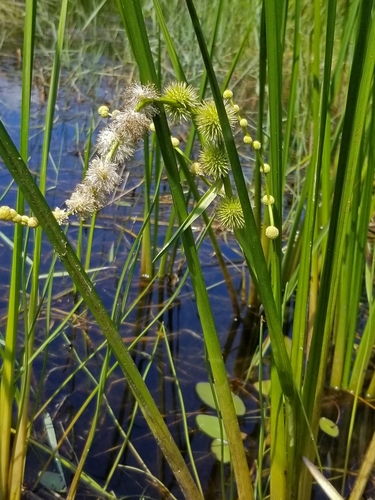
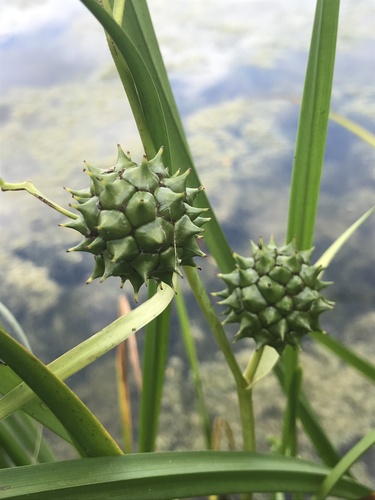
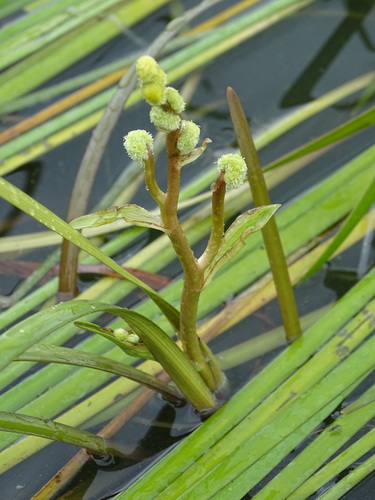
Typha angustifolia
L.
Lesser bulrush, Narrow-leaved cattail
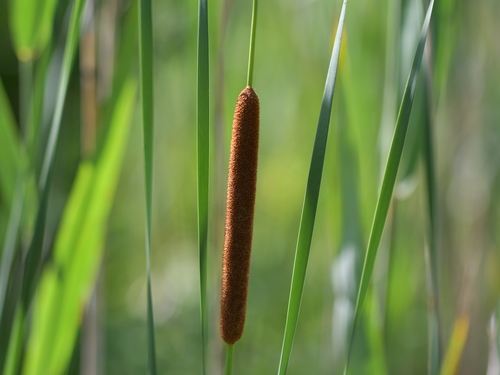
(c) Jeremy Collison, some rights reserved (CC BY-NC), uploaded by Jeremy Collison
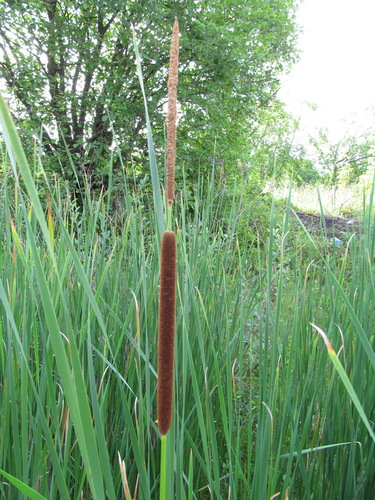
(c) Станислав, some rights reserved (CC BY-NC), uploaded by Станислав

(c) Douglas Goldman, some rights reserved (CC BY-SA), uploaded by Douglas Goldman
What to Eat
Edible parts: Rhizome, Root, Shoots, Vegetable, Flowers, Seeds
Roots can be eaten raw or cooked — boiled like potatoes or macerated and boiled to yield a sweet syrup. They can also be dried, ground into a protein-rich powder and used as a soup thickener or mixed into cereal flours to make biscuits and similar foods. Young spring shoots are eaten raw or cooked as an asparagus substitute. The base of the mature stem is eaten raw or cooked, with the outer part removed first. The young flowering stem can be eaten raw, cooked or made into soup and tastes like sweet corn. Seeds are cooked; they are small and fiddly to harvest but have a pleasant nutty flavour when roasted. An edible oil is also obtained from the seed, though given the seed's small size this is unlikely to be a worthwhile crop. Pollen is a protein-rich addition to flour for bread, porridge and similar foods, and can conveniently be eaten along with the young flowers. To harvest pollen, hold the flowering stem over a wide shallow container and gently tap and brush it free — this also helps pollinate the plant, ensuring both pollen and seeds can be collected.
Where to Find It
A temperate to tropical plant. It grows in wetlands. In Chile it grows from sea level to 2,000 m above sea level. It suits hardiness zone 9.
Africa, Argentina, Asia, Australia, Balkans, Bolivia, Bosnia, Brazil, Canada, Central Africa, Central Asia, Chile, Congo, East Africa, Ethiopia, Europe, Fiji, Georgia, Himalayas, Hungary, India, Indochina, Indonesia, Italy, Japan, Kazakhstan, Korea, Kyrgyzstan, Luxembourg, Madagascar, Malaysia, Mediterranean, Mongolia, Morocco, Myanmar, Mozambique, Myanmar, Nepal, Nigeria, North Africa, North America, Pacific, Pakistan, Paraguay, Philippines, Russia, San Marino, SE Asia, Somalia, South America, Tajikistan, Thailand, Uruguay, USA, Uzbekistan, West Africa,
How to Identify
An erect marsh plant. It keeps growing from year to year. It is slender and grows about 1.2 m high. The leaves are narrow. They are 1 cm wide. They sheath the base of the stem. The flowers are small. They are crowded into a long, brown, cylindrical spike. This is 1.3-2 cm thick. The male and female flowers are separated by a gap of about 2.5 cm.
Nutrition Score: 35/100
| Part | Moisture | kJ | kcal | Protein | Vit A | Vit C | Iron | Zinc |
|---|---|---|---|---|---|---|---|---|
| Stems | 88 | 300 | 72 | 1.4 | — | — | — | — |
| Leaves | 11.4 | — | — | 7 | — | — | — | — |
| Rhizome | 10 | — | — | 5.8 | — | — | — | — |
How to Grow
Experimental Crop Industrial Crop: Biomass Industrial Crop: Fiber Management: Hay Staple Crop: ProteinA very easily grown plant, it grows in boggy pond margins or in shallow water up to 15cm deep. It requires a rich soil if it is to do well. Succeeds in sun or part shade. A very invasive plant spreading freely at the roots when in a suitable site, it is not suitable for growing in small areas. Unless restrained by some means, such as a large bottomless container, the plant will soon completely take over a site and will grow into the pond, gradually filling it in. This species will often form an almost complete monoculture in boggy soil. The dense growth provides excellent cover for water fowl.
Propagation: Seed — surface sow in a pot standing in 3cm of water. Pot up seedlings as soon as possible, gradually increasing the water depth as plants grow, and plant out in summer. Division in spring is very easy — harvest young shoots at 10–30cm tall with some root attached and plant directly into permanent positions.
Medicinal Uses
The pollen is diuretic, emmenagogue and haemostatic. Dried pollen is considered anticoagulant, but when roasted with charcoal it becomes haemostatic instead. Internally, it is used to treat kidney stones, internal haemorrhage of almost any kind, painful menstruation, abnormal uterine bleeding, post-partum pains, abscesses and cancer of the lymphatic system. It should not be prescribed for pregnant women. Externally, it is used in the treatment of tapeworms, diarrhoea and injuries. An infusion of the root has been used in the treatment of gravel.
Other Uses
Stems and leaves are versatile — they make good thatching material, can be used in papermaking, and woven into mats, chairs, hats and similar items. The plant is a good source of biomass, useful as a compost addition or fuel. Fruit hairs are used as stuffing for pillows, offering good insulating and buoyancy properties. Female flowers make excellent tinder, ignitable from a flint spark, and the highly inflammable pollen is used in making fireworks. The plant's extensive root system is well suited to stabilizing wet riverbanks and lakesides.
Wikipedia
Source ↗Typha angustifolia is a perennial herbaceous plant in the genus Typha, native throughout most of Eurasia and locally in northwest Africa; it also occurs widely in North America, where its native status is disputed. It is an "obligate wetland" species that is found in fresh water or brackish locations. It is known in English as lesser bulrush, and in American as narrowleaf cattail.
Notes
There are 10-13 Typha species.
Names & Synonyms
Batro, Batru, Chihubane, Deniruve, Enea, Espadana, Herba ekor kucing berdaun sempit, Landim, Lesser reedmace, Narrow-leaved cattail, Paja de estara, Pan-kanis, Pat, Pith grass, Ram ban, Rogoz uskolisni, Shin-mwe-lon, Small bulrush, Tabebuia, Taboa, Tabouda, Totora, Tuturaco, Umaojsa, Vato, Vatros, Yah-toop
References (41)
- Beckstrom-Sternberg, Stephen M., and James A. Duke. "The Foodplant Database." http://probe.nalusda.gov:8300/cgi-bin/browse/foodplantdb.(ACEDB version 4.0 - data version July 1994)
- Bodkin, F., 1991, Encyclopedia Botanica. Cornstalk publishing, p 997
- Brickell, C. (Ed.), 1999, The Royal Horticultural Society A-Z Encyclopedia of Garden Plants. Convent Garden Books. p 1035
- Cordero, S. E., Abello, L. A., & Galvez, F. L., 2017, Plantas silvestres comestibles y medicinales de Chile y otras partes del mundo. CORMA p 250
- Dangol, D. R. et al, 2017, Wild Edible Plants in Nepal. Proceedings of 2nd National Workshop on CUAOGR, 2017.
- Denes, A., et al, 2012, Wild plants used for food by Hungarian ethnic groups living in the Carpathian Basin. Acta Societatis Botanicorum Poloniae 81 (4): 381-396
- Duke, J.A., 1992, Handbook of Edible Weeds. CRC Press. p 202
- Elias, T.S. & Dykeman P.A., 1990, Edible Wild Plants. A North American Field guide. Sterling, New York p 69
- Esperanca, M. J., 1988. Surviving in the wild. A glance at the wild plants and their uses. Vol. 2. p 104
- Facciola, S., 1998, Cornucopia 2: a Source Book of Edible Plants. Kampong Publications, p 242
- Grubben, G. J. H. and Denton, O. A. (eds), 2004, Plant Resources of Tropical Africa 2. Vegetables. PROTA, Wageningen, Netherlands. p 565
- Hardwick, G., 2001, Economically Useful Plants for Northern Australia: Master Species List. Crusader eBooks.
- Hedrick, U.P., 1919, (Ed.), Sturtevant's edible plants of the world. p 662
- Jardin, C., 1970, List of Foods Used In Africa, FAO Nutrition Information Document Series No 2.p 20, 108
- Kebebew, M. & Leta, G., 2016, Wild Edible Plant Bio-diversity and Utilization System in Nech Sar National Park, Ethiopia. International Journal of Bio-resource and Stress Management 2016, 7(4):885-896
- Kermath, B. M., et al, 2014, Food Plants in the Americas: A survey of the domesticated, cultivated and wild plants used for Human food in North, Central and South America and the Caribbean. On line draft. p 885
- Lazarides, M. & Hince, B., 1993, Handbook of Economic Plants of Australia, CSIRO. p 242
- Lim, T. K., 2015, Edible Medicinal and Non Medicinal Plants. Volume 9, Modified Stems, Roots, Bulbs. Springer p 83
- MacKinnon, A., et al, 2009, Edible & Medicinal Plants of Canada. Lone Pine. p 316
- Malezas Comestibles del Cono Sur, INTA, 2009, Buernos Aires
- Martin, F.W. & Ruberte, R.M., 1979, Edible Leaves of the Tropics. Antillian College Press, Mayaguez, Puerto Rico. p 77, 222
- McMakin, P.D., 2000, Flowering Plants of Thailand. A Field Guide. White Lotus. p 86
- Moerman, D. F., 2010, Native American Ethnobotany. Timber Press. p 573
- Morton,
- Nassif, F., & Tanji, A., 2013, Gathered food plants in Morocco: The long forgotten species in Ethnobotanical Research. Life Science Leaflets 3:17-54
- Parham, H. B. R., 1940, Fiji Plants Their Names and Uses. Supplement to the Journal of the Polynesian Society. Memoir No. 16
- Plants for a Future database, The Field, Penpol, Lostwithiel, Cornwall, PL22 0NG, UK. http://www.scs.leeds.ac.uk/pfaf/
- Redzic, S. J., 2006, Wild Edible Plants and their Traditional Use in the Human Nutrition in Bosnia-Herzegovina. Ecology of Food and Nutrition, 45:189-232
- Scarpa, G. F., 2009, Wild food plants used by the indigenous peoples of South American Gran Chaco: A general synopsis and intercultural comparison. Journal of Applied Botany and Food Quality 83:90-101
- Schmeda-Hirschmann, G., et al, 1999, Proximate Composition and Biological Activity of Food Plants gathered by Chilean Amerindians. Economic Botany Vol. 53. No. 2. pp. 177-187
- Singh, H.B., Arora R.K.,1978, Wild edible Plants of India. Indian Council of Agricultural Research, New Delhi. p 38
- Slocum, P.D. & Robinson, P., 1999, Water Gardening. Water Lilies and Lotuses. Timber Press. p 102
- Sp. pl. 2:971. 1753
- Sukarya, D. G., (Ed.) 2013, 3,500 Plant Species of the Botanic Gardens of Indonesia. LIPI p 1154
- Toupal, R. S. & Hollenback, K., 2009, An Ethnobotany of Indiana Dunes National Lakeshore: Plant Uses of the Ojibwa People. Bureau of Applied Research in Anthropology. University of Arizona
- Ugalde, P. C., et al, 2020, 13,000 years of sociocultural plant use in the Atacama Desert of northern Chile. Vegetation History and Archaeobotany. Springer
- Urgamal, M., Oyuntsetseg, B., Nyambayar, D. & Dulamsuren, Ch. 2014. Conspectus of the vascular plants of Mongolia. (Editors: Sanchir, Ch. & Jamsran, Ts.). Ulaanbaatar, Mongolia.
- Vartak, V.D. and Kulkarni, D.K., 1987, Monsoon wild leafy vegetables from hilly regions of Pune and neighbouring districts, Maharashtra state. J. Econ. Tax. Bot. Vol. 11 No. 2 pp 331-335
- World Checklist of Useful Plant Species 2020. Royal Botanic Gardens, Kew
- www.chileflora.com
- Zhang, Y., et al, 2014, Diversity of wetland plants used traditionally in China: a literature review. Journal of Ethnobiology and Ethnomedicine. 10:72