Sparganium americanum
Nutt.
Bur-reed, American bur-reed

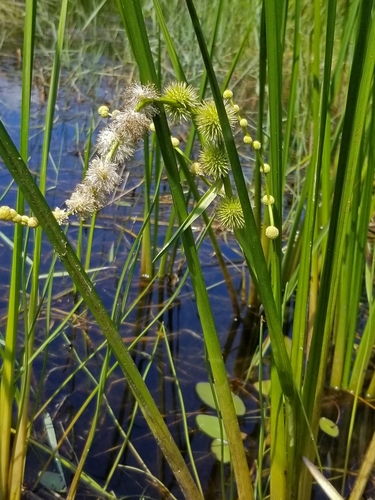
(c) MikeN, some rights reserved (CC BY-NC), uploaded by MikeN

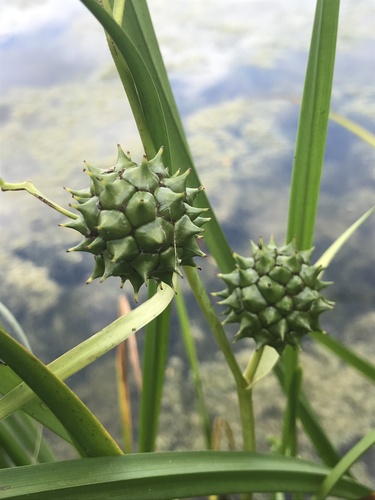
(c) dogtooth77, some rights reserved (CC BY-NC-SA)

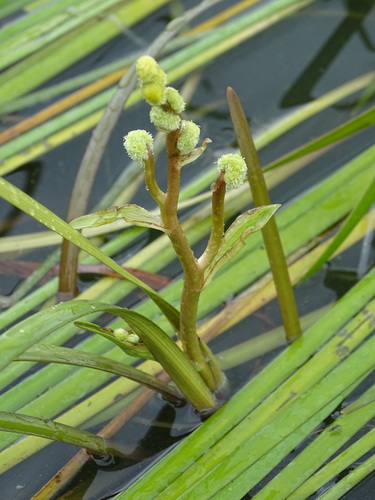
(c) Jason Hollinger, some rights reserved (CC BY)
What to Eat
Edible parts: Root, Stem
Both the root and the base of the stem are edible when cooked.
Where to Find It
They are temperate plants. It grows on the edges of ponds.
North America, USA,
How to Identify
The leaves can be erect, floating or under the water. The erect leaves are rigid while the leaves under water are ribbon-like and soft. The leaves under the water can be 3 cm across. The erect leaves are 1.3 cm wide. The flowers are in greenish-white heads.
How to Grow
We have very little information on this species and do not know if it will be hardy in Britain, though judging by its native range it should succeed outdoors in many parts of the country. The following notes are based on the general needs of the genus. A plant of wet ground, it should be grown in a bog garden or in shallow water up to 30cm deep. Requires a rich soil. Tolerates some shade.
Propagation: Seed is best sown as soon as it is ripe in pots in a greenhouse stood in 2–3cm of water. Prick out seedlings into individual pots when large enough to handle, gradually increasing the water depth as they grow until it reaches roughly the top of the pots. Plant out in summer if growth is sufficient, otherwise in the following spring. Divide plants in spring or autumn — larger divisions can go directly into permanent positions, while smaller ones are best potted up and grown on in a lightly shaded cold frame, then planted out once well established in summer.
Medicinal Uses
None known
Other Uses
None known
Wikipedia
Source ↗Sparganium americanum, American bur-reed, is a perennial plant found in the United States of America and Canada. Though this species resembles a grass, it is a type of bur-reed. This species is important for conservation purposes because it has the ability to remove nitrogen and phosphorus runoff from water, like many other wetland species. By doing this, it protects waterways from excess nitrogen which can cause eutrophication. This increased nitrogen is especially a problem during the farmers' growing season. During this same time frame the S. americanum is growing and taking up nitrogen.
Notes
There are 21 Sparganium species. They are mostly temperate. These were originally in the Sparganiaceae family.
References (3)
- Gen. N. Amer. pl. 2:203. 1818
- Plants for a Future database, The Field, Penpol, Lostwithiel, Cornwall, PL22 0NG, UK. http://www.scs.leeds.ac.uk/pfaf/
- Slocum, P.D. & Robinson, P., 1999, Water Gardening. Water Lilies and Lotuses. Timber Press. p 102