Sparganium erectum
L.
Bur reed

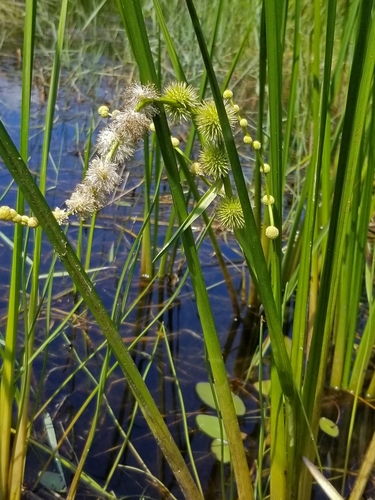
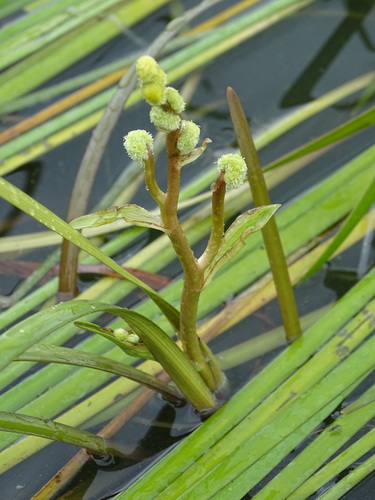
(c) Bastiaan, some rights reserved (CC BY-NC-ND)

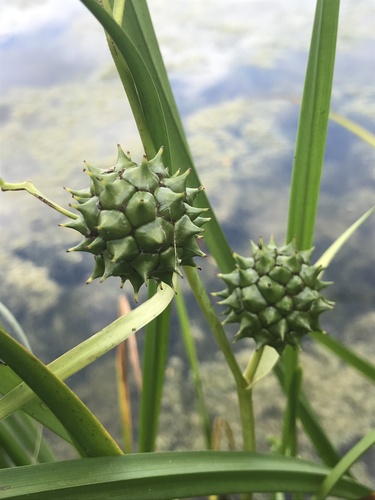
(c) Bas Kers, some rights reserved (CC BY-NC-SA)
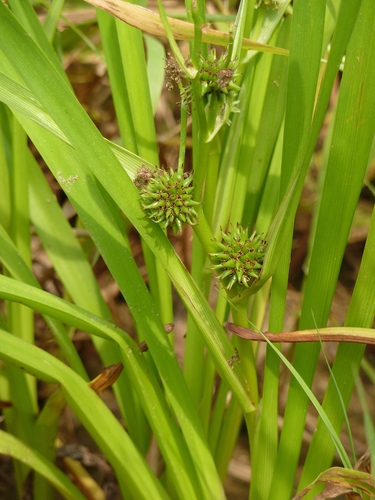
(c) Serge M. Appolonov, some rights reserved (CC BY-NC), uploaded by Serge M. Appolonov
What to Eat
Edible parts: Root, Stem
The root is cooked and has a sweetish flavour. The base of the stem is also edible when cooked.
Where to Find It
It can grow in water up to 45 cm deep.
Asia, Australia, Britain, Central Asia, Europe, Germany, India, Italy, Luxembourg, Mediterranean, Myanmar, SE Asia, Tajikistan,
How to Identify
The roots are like rhizomes. They have strong pointed tips. They have rings of sword like leaves which are triangle shaped at the base. They grow 1-1.2 m long and 1.3-2.5 cm wide. The flower is branched. The female flowers at the base are rounded with smaller male flowers at the top.
How to Grow
Grows in muddy ground or water up to 30cm deep. Requires a rich soil. Tolerates some shade. Tolerates deep shade. An important autumn and winter food source for wild fowl.
Propagation: Seed is best sown as soon as it is ripe in pots in a greenhouse stood in 2–3cm of water. Prick out seedlings into individual pots when large enough to handle, gradually increasing the water depth as they grow until it reaches roughly the top of the pots. Plant out in summer if growth is sufficient, otherwise in the following spring. Divide plants in spring or autumn — larger divisions can go directly into permanent positions, while smaller ones are best potted up and grown on in a lightly shaded cold frame, then planted out once well established in summer.
Medicinal Uses
An infusion of the whole plant, combined with other plant leaves, has been used in the treatment of chills.
Other Uses
None known
Wikipedia
Source ↗Sparganium erectum, the simplestem bur-reed or branched bur-reed, is a perennial plant species in the genus Sparganium. The larvae of the moth Plusia festucae feed on Sparganium erectum. Subspecies: Sparganium erectum subsp. microcarpum (Neuman) Domin (synonym: Sparganium microcarpum (Neuman) Celak.)
Names & Synonyms
References (4)
- Plants for a Future database, The Field, Penpol, Lostwithiel, Cornwall, PL22 0NG, UK. http://www.scs.leeds.ac.uk/pfaf/
- Romanowski, N., 2007, Edible Water Gardens. Hyland House. p 115
- Slocum, P.D. & Robinson, P., 1999, Water Gardening. Water Lilies and Lotuses. Timber Press. p 102
- Sp. pl. 2:971. 1753