Typha capensis
(Rohrb.) N. E.Br.
Bullrush, Reedmace
(c) Kobie du Preez, some rights reserved (CC BY-NC), uploaded by Kobie du Preez

(c) Peter Vos, some rights reserved (CC BY-NC), uploaded by Peter Vos
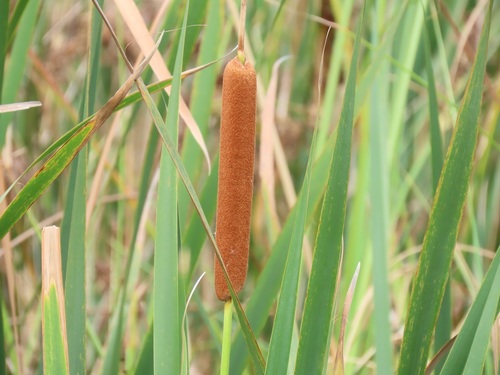
(c) magdastlucia, some rights reserved (CC BY-NC), uploaded by magdastlucia
What to Eat
Edible parts: Shoots, Rhizomes, Root, Flowers, Stems
The fleshy, spongy rhizomes are dug up and may be pounded to a meal and used as a source of starch. The pollen can be used as a high-protein food. Typha capensis can be used as a subsistence crop as all parts of the plant can be eaten. Some species of Typa are grown as a speciality food source in America. No more specific details have been given - below are the edible uses of the closely related Typha latifolia:- Rhizomes - raw or cooked. A sweet flavour. Rich in starch, around 30 - 46%, they can be boiled and eaten like potatoes or macerated and then boiled to yield a sweet syrup. The rhizome can also be dried and ground into a powder, this powder is rich in protein and can be mixed with wheat flour and then used for making bread, biscuits, muffins etc. The rhizomes at the base of erect shoots are mostly horizontal, unbranched, up to 70 cm long and 5 - 40mm in diameter. They are starchy, firm and scaly. The plant is best harvested from late autumn to early spring since it is richest in starch at this time. The root contains about 80% carbohydrate (30 - 46% starch) and 6 - 8% protein. Young shoots in spring - raw or cooked. An asparagus substitute. They taste like cucumber. The shoots can still be used when they are up to 50cm long. Base of mature stem - raw or cooked. It is best to remove the outer part of the stem. The base of the stem where it attaches to the rhizome can be boiled or roasted like potatoes. It is called 'Cossack asparagus'. Immature flowering spike - raw, cooked or made into a soup. It tastes like sweet corn. Seed - raw or cooked. The seed is rather small and fiddly to utilize, but has a pleasant nutty taste when roasted. The seed can be ground into a flour and used in making cakes etc. An edible oil is obtained from the seed. The seeds contain about 18 - 20% oil, of which69% is linolenic acid. Due to the small size of the seed this is probably not a very worthwhile crop. Pollen - raw or cooked. The pollen can be used as a protein rich additive to flour when making bread, porridge etc. It can also be eaten with the young flowers, which makes it considerably easier to utilize. The pollen is a bright yellow or green colour, and turns pancakes, cookies or biscuits a pretty yellow colour. The pollen can be harvested by placing the flowering stem over a wide but shallow container and then gently tapping the stem and brushing the pollen off with a fine brush. This will help to pollinate the plant and thereby ensure that both pollen and seeds can be harvested.
Where to Find It
It is a subtropical plant. It grows in water. It grows along streams and on the edges of dams
Swamps; dams; lagoons; river banks; at elevations up to 2,000 metres.
How to Identify
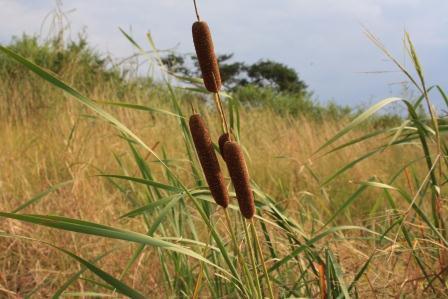
A herb. The leaves are soft and dark green. The leaves are 1 m above the water and a few cm wide. The stems are taller than the leaves. They can be 2 m above the water. The flowers are on spikes at the ends of the stalks. Male flowers are light brown. Female flowers are dark brown. The fruit are very small and have one seed and many hairs.
How to Grow
Grows in boggy pond margins or shallow water to 15cm deep. Requires a rich soil if it is to do well. Succeeds in sun or part shade. Provides excellent cover for water fowl. Plants can be very invasive, spreading freely at the roots when in a suitable site. Seedlings rapidly form clones by means of rhizomes in their first season, flower the second season, and often form very large, persistent, often monospecific stands. It is quite likely that Typha capensis has arisen through hybridization between Typha latifolia and Typha domingensis, followed perhaps by polyploidy.
Propagation: Seed - surface sow in a pot and stand it in 3cm of water. Pot up the young seedlings as soon as possible and, as the plants develop, increase the depth of water. Plant out when large enough. Division. Very easy, harvest the young shoots when they are about 10 - 30cm tall, making sure there is at least some root attached, and plant them out into their permanent positions.
Medicinal Uses
A decoction of the rhizomes is used for venereal diseases or during pregnancy to ensure easy delivery: decoctions are taken orally or applied externally to promote expulsion of the placenta. It is also said to strengthen uterine contractions. It is also taken to promote fertility in women, to enhance male potency and libido, to improve circulation and for diarrhoea and dysentery.
Other Uses
At a symposium on Typha held in cape Town in 1989, it was reported that Typha, despite its potential to be an invader, does have several economic benefits. The leaves are used to make hand brooms and are also used to some extent in weaving, caulking barrels and thatching. The pollen is used to produce a plant growth regulator in Japan. The plant can be used for craft work and house building. No more specific details have been given - below are the edible uses of the closely related Typha latifolia, which should, in the main, also apply here:- The plant produces large amounts of biomass, comparable to the most productive agricultural crops.This is a potential source of energy - it can, for example, be used for alcohol manufacture. On a domestic level, the stems make an excellent addition to the compost heap or can be dried and used as a source of fuel etc. After dipping in kerosene the female inflorescences can be used as torches The female inflorescences can used as decorative dry flowers. The seed floss can be used for stuffing and padding. The plants have also been used to make paper in South America. The plant can also be used for water purification and green manure. The plant's extensive root system makes it very good for stabilizing wet banks of rivers, lakes etc. It can be grown in reed beds and other water purification systems in order to remove various kinds of pollutants from the water and soil. The top growth is removed once or twice during the growing season - it can either be used as a fuel or the materials recovered from it.
Wikipedia
Source ↗Typha capensis is an aquatic plant known from southern and eastern Africa as far north as Uganda. It has also been reported from Brazil. The rhizomes of Typha capensis are used medicinally in southern Africa. It is reported to improve circulation and to enhance male libido and performance.
Production
There are 10 Typha species.
Names & Synonyms
Libhuma, Matjiesgoed, Musama, Papkuil
References (17)
- De Vynk, J. C., et al, 2016, Indigenous edible plant use by contemporary Khoe-San descendants of South Africa's Cape South Coast. South African Journal of Botany. 102 (2016) 60-69
- Fox, F. W. & Young, M. E. N., 1982, Food from the Veld. Delta Books. p 357
- https://growwild.co.za Edible Indigenous plants
- Jardin, C., 1970, List of Foods Used In Africa, FAO Nutrition Information Document Series No 2.p 20, 108 (As Typha latifolia subsp. capensis)
- Joffe, P., 2007, Creative Gardening with Indigenous Plants. A South African Guide. Briza. p 335
- Lim, T. K., 2015, Edible Medicinal and Non Medicinal Plants. Volume 9, Modified Stems, Roots, Bulbs. Springer p 83
- Long, C., 2005, Swaziland's Flora - siSwati names and Uses http://www.sntc.org.sz/flora/
- Magwede, K., van Wyk, B.-E., & van Wyk, A. E., 2019, An inventory of Vhavenḓa useful plants. South African Journal of Botany 122 (2019) 57–89
- Martin, F.W. & Ruberte, R.M., 1979, Edible Leaves of the Tropics. Antillian College Press, Mayaguez, Puerto Rico. p 221
- Peters, C. R., O'Brien, E. M., and Drummond, R.B., 1992, Edible Wild plants of Sub-saharan Africa. Kew. p 41 (As Typha latifolia subsp. capensis)
- Pickering, H., & Roe, E., 2009, Wild Flowers of the Victoria Falls Area. Helen Pickering, London. p 111
- Ruiters-Welcome, A. K., 2019, Food plants of southern Africa. Ph.D. thesis. Univ. of Johannesburg p 105
- Swaziland's Flora Database http://www.sntc.org.sz/flora
- van Wyk, Be., & Gericke, N., 2007, People's plants. A Guide to Useful Plants of Southern Africa. Briza. p 96
- Welcome, A. K. & Van Wyk, B.-E., 2019, An inventory and analysis of the food plants of southern Africa. South African Journal of Botany 122 (2019) 136–179
- Williamson, J., 2005, Useful Plants of Malawi. 3rd. Edition. Mdadzi Book Trust. p 254 (As Typha latifolia subsp. capensis)
- World Checklist of Useful Plant Species 2020. Royal Botanic Gardens, Kew