Typha domingensis
Pers.
Bulrush, Cattail, Narrowleaf Cumbungi
(c) Todd Fitzgerald, some rights reserved (CC BY-NC), uploaded by Todd Fitzgerald
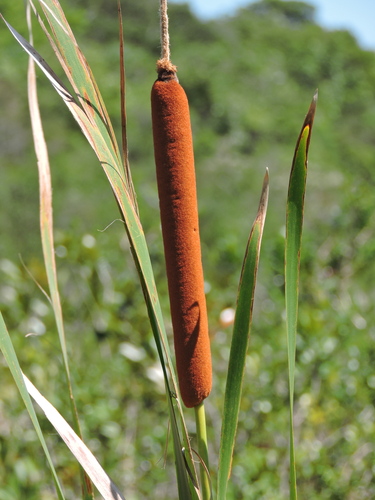
(c) Fabrício Mil Homens Riella, some rights reserved (CC BY), uploaded by Fabrício Mil Homens Riella
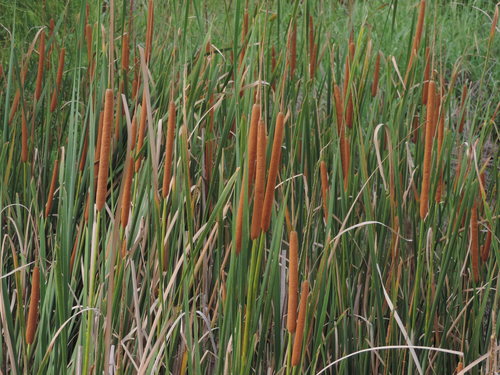
(c) Bryan, some rights reserved (CC BY-NC), uploaded by Bryan
What to Eat
Edible parts: Leaves, Shoots, Rhizome, Root, Pollen, Pith, Vegetable, Flowers
Rhizomes are eaten raw or cooked and have a sweet flavour. Rich in starch (around 30–46%), they can be boiled like potatoes or macerated and boiled to yield a sweet syrup. Dried and ground into a protein-rich flour, they work as a soup thickener, a cereal flour supplement, or the base for biscuits, bread and cakes. The rhizomes at the base of erect shoots are mostly horizontal and unbranched, up to 70cm long and 5–40mm in diameter — starchy, firm and scaly. To remove the fibrous content, peel 20–25cm lengths, dry briefly by a fire, then twist to loosen the fibres so the starch can be shaken out. Young spring shoots — only the inner core — are eaten raw or cooked as an asparagus substitute; cut from underground stems when 10–40cm long. The base of the mature stem, where it joins the rhizome, can be eaten raw or cooked with the outer layer removed, or boiled and roasted like potatoes. The young flowering stem is eaten raw, cooked or made into soup and tastes like sweet corn. Seeds are cooked; small and fiddly, they have a pleasant nutty flavour when roasted. An edible oil is obtained from the seed — seeds contain about 18–20% oil, of which 69% is linolenic acid — though the small seed size makes this an impractical crop. Pollen is a protein-rich flour additive for bread and porridge, and turns pancakes, cookies and biscuits a distinctive yellow colour due to its bright yellow-green colour. It is easier to use when eaten with the young flowers. To harvest, hold the flowering stem over a wide shallow container and gently tap and brush off the pollen — this also aids pollination, helping ensure both pollen and seeds can be collected.
Where to Find It
It is a subtemperate plant. They grow in stagnant and slow moving water. It grows in wetlands. It needs wet soils and an open sunny position. It is resistant to frost. It can grow in arid places. In Argentina it grows below 100 m above sea level. Tasmanian Herbarium. In Sichuan and Yunnan.
Africa, Argentina, Asia, Australia*, Bangladesh, Botswana, Brazil, British Indian Ocean Terr., BIOT, Burkina Faso, Central America, Central Asia, Chile, China, Costa Rica, Cuba, Dominican Republic, East Africa, East Timor, Egypt, Ethiopia, Ghana, Guatemala, Guiana, Guianas, Guinea, Guinée, Guinea-Bissau, Guyana, Haiti, Himalayas, India, Indonesia, Iraq, Jamaica, Japan, Kazakhstan, Korea, Kyrgyzstan, Malaysia, Mexico, Middle East, Mongolia, Mozambique, Myanmar, Nepal, New Zealand, Nicaragua, Nigeria, North America, Northeastern India, Pakistan, Paraguay, Philippines, Puerto Rico, Russia, SE Asia, Senegal, South America*, Sri Lanka, Suriname, Taiwan, Tajikistan, Tasmania*, Timor-Leste, Uruguay, USA, Uzbekistan, Venezuela, Vietnam, West Africa, West Indies*, Zambia,
How to Identify
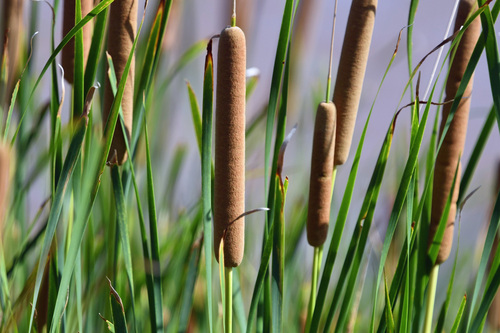
A tall reed-like plant. It grows in water and keeps growing from year to year. They grow up to 4.5 m high. They form dense thickets around swamps. The leaves are long and blade-like and enclosed in a sheath. They are grass-green. They grow in two opposite rows. The flowers are brown. They are produced in long cylindrical spikes. These look like sausages on spikes. These are up to 20 mm wide. The flowers are usually separated into male (above) and female (below) sections. When mature they turn into a mass of fluff.
Nutrition Score: 71/100
| Part | Moisture | kJ | kcal | Protein | Vit A | Vit C | Iron | Zinc |
|---|---|---|---|---|---|---|---|---|
| pollen | 9 | 1657 | 396 | 11.3 | — | 98 | 21.3 | — |
| Roots | 71.5 | 288 | 69 | 1.7 | — | — | 1.2 | 0.6 |
How to Grow
Plants can be grown by division.
Propagation: Seed — surface sow in a pot standing in 3cm of water. Pot up seedlings as soon as possible, gradually increasing the water depth as plants develop, and plant out in summer. Division in spring is very easy — harvest young shoots at 10–30cm tall with some root attached and plant directly into permanent positions.
Medicinal Uses
The leaves are diuretic. The pollen is astringent, desiccant, diuretic, haemostatic and vulnerary, used in the treatment of nosebleeds, haematemesis, haematuria, uterine bleeding, dysmenorrhoea, postpartum abdominal pain, gastralgia, scrofula and abscesses. It is contraindicated for pregnant women. The seed down is haemostatic. The rootstock is astringent and diuretic.
Other Uses
The plant's extensive root system makes it well suited to stabilizing wet riverbanks and lakesides. It can be grown in reed beds and water purification systems to remove pollutants from water and soil, with top growth removed once or twice during the growing season for use as fuel or recovered materials. Stems and leaves are useful for thatching roofs, making walls and floor coverings, weaving into mats, chairs, hats and other handicrafts, and as a caulking material for barrels and boats. Fibre from the leaves and stems can be used in papermaking; fibre from the roots can be made into string. The plant produces biomass comparable to the most productive agricultural crops and is a potential energy source, including for alcohol manufacture. On a domestic scale, stems make an excellent compost addition or fuel. Fruit hairs are used as stuffing for pillows, mattresses and toys, with good buoyancy properties suitable for life preservers and excellent insulation properties for use in construction. Female flowers make outstanding tinder, ignitable from a flint spark, and the highly inflammable pollen is used in making fireworks.
Wikipedia
Source ↗Typha domingensis, known commonly as southern cattail or cumbungi, is a perennial herbaceous plant of the genus Typha.
Production
The pollen is shaken from the male flower over a container. The yield of starch flour can be 2500 kg from 0.5 ha of bulrushes. The harvested shoots can be stored for 6-7 days.
Notes
There are 10 Typha species.
Names & Synonyms
Aanechondu, Aane jondu, Aapu, Akho, Ane jondu, Baaliyan, Cheena, Chi'na, Chiena, Dabbu-jammu, Ekho, Fapu', Ghabajario, Googol bon, Hati ghah, Hogla, Jammu, Jammugaddi, Jangli-bajri, Jwi'na, Kai, Kaw, Kaylampa, Kundar, Lesser cats tail, Lookh, Malo, Maranda, Maribala, Ngallowayn, Panjabris, Pankanis, Pario, Patera, Pitz, Pun, Poorteetch, Puwarji, Reedmace, Sambu, Taboa, Tabua, Totora, Tule, Wana-yuk, Wa'na, Wonga
References (80)
- Addis, G., Asfaw, Z & Woldu, Z., 2013, Ethnobotany of Wild and Semi-wild Edible Plants of Konso Ethnic Community, South Ethiopia. Ethnobotany Research and Applications. 11:121-141
- Ambasta, S.P. (Ed.), 2000, The Useful Plants of India. CSIR India. p 658 (As Typha australis)
- Anonymous, 2000, Selected edible wild plants of Pakistan north of Lahore, Including Pakistan-held Jammu-Kashmir. Central Intelligence Agency. (As Typha angustata)
- Arenas, P. & Scarpa, G. F., 2003, The Consumption of Typha domingensis (Pers.) (Typhaceae) among the Ethnic Groups of the Gran Chaco, South America. Economic Botany 57(2) pp. 181-188.
- Bidak, L. M., et al, 2015, Goods and services provided by native plants in desert ecosystems: Examples from the northwestern coastal desert of Egypt. Global Ecology and Conservation 3 (2015) 433–447
- Bindon, P., 1996, Useful Bush Plants. Western Australian Museum. p 259
- Bodkin, F., 1991, Encyclopedia Botanica. Cornstalk publishing, p 997
- Bortolotto, I. M., et al, 2018, Lista preliminar das plantas alimenticias nativas de Mato Grosso do Sul, Brasil. Iheringia, Serie Botanica, Porto Alegre, 73 (supl.):101-116
- Burkill, H. M., 1985, The useful plants of west tropical Africa, Vol. 5. Kew.
- Cancilla, D., 2018, Ethnobotanical and Ethnozoological Values Desktop Assessment - Eliwana Project. p 15
- Cherikoff V. & Isaacs, J., The Bush Food Handbook. How to gather, grow, process and cook Australian Wild Foods. Ti Tree Press, Australia p 191, 197
- Cowie, I, 2006, A Survey of Flora and vegetation of the proposed Jaco-Tutuala-Lore National Park. Timor-Lests (East Timor) www.territorystories.nt/gov.au p 55
- Curtis, W.M., & Morris, D.I., 1994, The Student's Flora of Tasmania. Part 4B St David's Park Publishing, Tasmania, p 363
- Dashorst, G.R.M., and Jessop, J.P., 1998, Plants of the Adelaide Plains & Hills. Botanic Gardens of Adelaide and State Herbarium. p 190
- Daw, B., Walley, T. & Keighery, G., 2001, Bush Tucker. Plants of the South-West. Department of Conservation and Land Management. Western Australia. p 54
- De Angelis, D., 2005, Aboriginal Plant Use of the Greater Melbourne Area. La Trobe University Environment Collective
- Desert Survivors Online Plant Database
- Dutta, U., 2012, Wild Vegetables collected by the local communities from the Churang reserve of BTD, Assam. International Journal of Science and Advanced Technology. Vol. 2(4) p 124 (As Typha angustata)
- Facciola, S., 1998, Cornucopia 2: a Source Book of Edible Plants. Kampong Publications, p 242
- Flora of Australia Volume 49, Oceanic Islands 1, Australian Government Publishing Service, Canberra. (1994) p 499
- Flora of Pakistan. www.eFloras.org
- Fowler, D. G., 2007, Zambian Plants: Their Vernacular Names and Uses. Kew. p 74 (Also as Typha australis)
- Gott, B & Conran, J., 1991, Victorian Koorie Plants. PO Box 666 Hamilton, Victoria 3300, Australia. p 8
- Grivetti, L. E., 1980, Agricultural development: present and potential role of edible wild plants. Part 2: Sub-Saharan Africa, Report to the Department of State Agency for International Development. p 24 (As Typha australis)
- Grubben, G. J. H. and Denton, O. A. (eds), 2004, Plant Resources of Tropical Africa 2. Vegetables. PROTA, Wageningen, Netherlands. p 565
- Hardwick, G., 2001, Economically Useful Plants for Northern Australia: Master Species List. Crusader eBooks.
- Hardwick, R.J., 2000, Nature's Larder. A Field Guide to the Native Food Plants of the NSW South Coast. Homosapien Books. p 116
- Hastings Advance Community College, 2017, Uses for Native Plants of the Mornington Peninsula. 86pp. p 79
- Hibbert, M., 2002, The Aussie Plant Finder 2002, Florilegium. p 304
- Hiddins, L., 1999, Explore Wild Australia with the Bush Tucker Man. Penguin Books/ABC Books. p130
- Hossain, U. & Rahman, A., 2018, Study and quantitative analysis of wild vegetable floral diversity available in Barisal district, Bangladesh. Asian J. Med. Biol. Res. 2018, 4 (4), 362-371 (As Typha angustata)
- Hussey, B.M.J., Keighery, G.J., Cousens, R.D., Dodd, J., Lloyd, S.G., 1997, Western Weeds. A guide to the weeds of Western Australia. Plant Protection Society of Western Australia. p 74
- IRVINE, (As Typha australis)
- Isaacs, J., 1987, Bush Food, Aboriginal Food and Herbal Medicine. Weldons. p 104, 122
- Kenneally, K.E., Edinger, D. C., and Willing T., 1996, Broome and Beyond, Plants and People of the Dampier Peninsula, Kimberley, Western Australia. Department of Conservation and Land Management. p 228
- Kermath, B. M., et al, 2014, Food Plants in the Americas: A survey of the domesticated, cultivated and wild plants used for Human food in North, Central and South America and the Caribbean. On line draft. p 885
- Kinupp, V. F., 2007, Plantas alimenticias nao-convencionais da regiao metropolitana de Porto Alegre, RS, Brazil p 104
- Kinupp, V. F. & Bergman, I., 2008, Protein and minerals of native species, potential vegetables and fruits. Cienc.Tecnol. Aliment. Vol. 28 No. 4 Campinas Oct/Dec.
- Kiple, K.F. & Ornelas, K.C., (eds), 2000, The Cambridge World History of Food. CUP p 1747
- Lamp, C & Collet F., 1989, Field Guide to Weeds in Australia. Inkata Press. p 315
- Latz, P.K., 1996, Bushfires and Bushtucker: Aboriginal plant use in Central Australia. IAD Press Alice Springs p 294
- Lazarides, M. & Hince, B., 1993, Handbook of Economic Plants of Australia, CSIRO. p 242
- Lim, T. K., 2015, Edible Medicinal and Non Medicinal Plants. Volume 9, Modified Stems, Roots, Bulbs. Springer p 83
- Low, T., 1991, Wild Herbs of Australia and New Zealand. Angus & Robertson. p 106
- Low, T., 1991, Wild Food Plants of Australia. Australian Nature FieldGuide, Angus & Robertson. p 54
- Low, T., 1992, Bush Tucker. Australia’s Wild Food Harvest. Angus & Robertson. p 109
- Malaisse, F., 1997, Se nourrir en floret claire africaine. Approche ecologique et nutritionnelle. CTA., p 69
- Marinelli, J. (Ed), 2004, Plant. DK. p 278
- Moerman, D. F., 2010, Native American Ethnobotany. Timber Press. p 573
- Morley, B.D., & Toelken, H.R., (Eds), 1983, Flowering Plants in Australia. Rigby. p 403
- Paczkowska, G. & Chapman, A.R., 2000, The Western Australian Flora. A Descriptive Catalogue. Western Australian Herbarium. p 130
- Pagag, K. & Borthakur, S.K., 2012, Wild edible wetland plants from Lakhimpur district of Assam, India. Pleione 6(2): 322 - 327 (As Typha angustata)
- Patiri, B. & Borah, A., 2007, Wild Edible Plants of Assam. Geethaki Publishers. p 153 (As Typha angustata)
- Peters, C. R., O'Brien, E. M., and Drummond, R.B., 1992, Edible Wild plants of Sub-saharan Africa. Kew. p 41
- Piedra-Malagón, E. M., et al, 2022, Edible native plants of the Gulf of Mexico Province. Biodiversity Data Journal 10: e80565 p 31
- Plants for a Future database, The Field, Penpol, Lostwithiel, Cornwall, PL22 0NG, UK. http://www.scs.leeds.ac.uk/pfaf/
- Plants of Haiti Smithsonian Institute http://botany.si.edu/antilles/West Indies
- Polini, G., et al, Useful and edible plants of Paraguay Region of Chaco. p 132
- Prashanth Kumar, G.M. and Shiddamallayya, N., 2015, Ethnobotanical Study of Less Known Wild Edible Plants of Hakki Pikki Tribes of Angadihalli, Hassan District, Karnataka. Journal or Medicinal Plants Studies 3(5):80-85
- Rajasab, A. H. et al, 2004, Documentation of folk knowledge on edible wild plants of North Karnataka. Indian Journal of Traditional Knowledge. Vol 3(4) pp 419-429 (As Typha angustata)
- Robins, J., 1996, Wild Lime. Cooking from the Bush food garden. Allen & Unwin p 149
- Scarpa, G. F., 2009, Wild food plants used by the indigenous peoples of South American Gran Chaco: A general synopsis and intercultural comparison. Journal of Applied Botany and Food Quality 83:90-101
- Sainty, G.R. & Jacobs, S.W.L., 1981, Waterplants of New South Wales. Water Resources Commission. NSW p 417
- Singh, H.B., Arora R.K.,1978, Wild edible Plants of India. Indian Council of Agricultural Research, New Delhi. p 85 (As Typha angustata)
- Smith, N., Mori, S.A., et al, 2004, Flowering Plants of the Neotropics. Princeton. p 489
- Stephens, K.M., & Dowling, R.M., 2002, Wetland Plants of Queensland. A field guide. CSIRO p 89
- Swapna, M. M. et al, 2011, A review on the medicinal and edible aspects of aquatic and wetland plants of India. J. Med. Plants Res. 5 (33) pp. 7163-7176
- Syn. pl. 2(2):532. 1807
- Tareen, N. M., et al, 2016, Ethnomedicinal Utilization of Wild Edible Vegetables in District Harnai of Balochistan Province - Pakistan. Pakistan Journal of Botany 48(3): 1159-1171
- Tasmanian Herbarium Vascular Plants list p 92
- Topp, J. M. W., 1988, An Annotated Check List of the Flora of Diego Garcia, British Ocean Territory. Atoll Research Bulletin No. 313
- Ulian, T., et al, 2020, Unlocking plant resources to support food security and promote sustainable agriculture. Plants, People, Planet. 2020;2:421–445.
- UPHOF, (As Typha australis)
- Urgamal, M., Oyuntsetseg, B., Nyambayar, D. & Dulamsuren, Ch. 2014. Conspectus of the vascular plants of Mongolia. (Editors: Sanchir, Ch. & Jamsran, Ts.). Ulaanbaatar, Mongolia.
- WATT, (As Typha angustata)
- Wheeler, J.R.(ed.), 1992, Flora of the Kimberley Region. CALM, Western Australian Herbarium, p 1017
- Wightman, Glenn et al. 1992, Mangarrayi Ethnobotany: Aboriginal Plant Use from the Elsey Area Northern Australia. Northern Territory Botanical Bulletin No 15. Parks and Wildlife Commission of the Northern Territory. p 47.
- Wild edible plants of Himachal Pradesh (As Typha angustata)
- Williams A. & Sides, T., 2008, Wiradjuri Plant Use in the Murrumbidgee Catchment. Murrumbidgee Catchment Management Authority. Wagga Wagga, p 93
- World Checklist of Useful Plant Species 2020. Royal Botanic Gardens, Kew