Typha latifolia
Linn.
Bulrush, Greater reedmace
(c) cgbb2004, some rights reserved (CC BY-NC), uploaded by cgbb2004
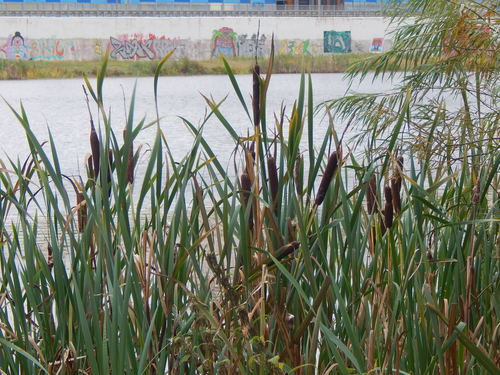
(c) Алена Фронтова, some rights reserved (CC BY-NC), uploaded by Алена Фронтова

(c) Douglas Goldman, some rights reserved (CC BY-SA), uploaded by Douglas Goldman
What to Eat
Edible parts: Shoots, Leaves, Seeds, Root, Rhizome, Stems, Flowers, Pollen
Roots can be eaten raw or cooked — boil them like potatoes or macerate and boil to produce a sweet syrup. They can also be dried and ground into a protein-rich powder that mixes well with wheat flour for making bread, biscuits, and muffins. One hectare of plants can yield 8 tonnes of flour from the rootstock. Roots are richest in starch from late autumn to early spring and contain around 80% carbohydrate (30–46% starch) and 6–8% protein. Young spring shoots are eaten raw or cooked as an asparagus substitute with a cucumber-like flavour; they remain usable up to 50cm long. The base of the mature stem is edible raw or cooked with the outer layer removed — this part is traditionally called 'Cossack asparagus'. The immature flowering spike can be eaten raw, cooked, or made into soup and tastes like sweet corn. Seeds are small and fiddly but have a pleasant nutty flavour when roasted and can be ground into flour for cakes; an edible oil is also obtained from the seed, though the small seed size limits its practical value. Pollen serves as a protein-rich flour additive for bread and porridge, or can be eaten with the young flowers for ease of use. To harvest pollen, hold the flowering stem over a wide, shallow container and gently tap and brush it free; this also aids pollination to ensure future pollen and seed yields.
Known Hazards
Where to Find It
It grows in tropical and temperate places. Deccan. It grows in swamps. It needs rich silty soils and an open, sunny position. It is hardy to frost. It grows between sea level and 1,950 m above sea level. It can grow in salty soils. It grows in wetlands. It can grow in arid places. Tasmanian Herbarium. in Sichuan and Yunnan.
Afghanistan, Africa, Alaska, Arctic, Argentina, Asia, Australia, Balkans, Bosnia, Botswana, Brazil, Britain, Canada, Central Africa, Central America, Central Asia, China, Congo, Czech Republic, East Africa, Eswatini, Europe*, Gabon, Georgia, Guatemala, Hungary, India, Ireland, Israel, Japan, Kazakhstan, Kenya, Korea, Kyrgyzstan, Lesotho, Libya, Luxembourg, Mediterranean, Mexico, Middle East, Morocco, Mozambique, Namibia, Nepal, Netherlands, Nigeria, North Africa, North America, Norway, Pakistan, Paraguay, Russia, Scandinavia, Slovenia, South Africa, South America, Southern Africa, Swaziland, Syria, Tajikistan, Tasmania, Tibet, Turkmenistan, Uganda, USA, Uzbekistan, West Africa, Zimbabwe,
How to Identify
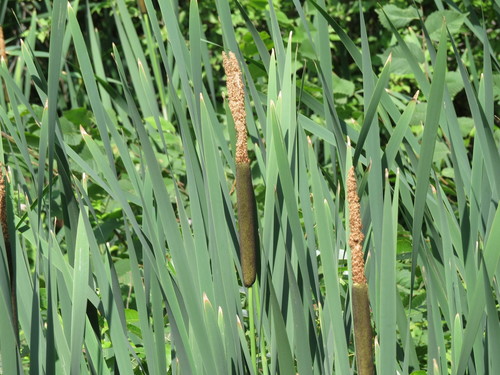
A herb. It is a reed which grows in water. They spread by underground rhizomes. The leaves are bluish-green and like straps. They can be 2-2.5 m long and 2.5 cm wide. The flower heads form a compact cylinder. This is 15-23 cm long and 2.5 cm across. The upper part is male and yellow. The lower part is female and stays dark brown. These are not separated. The seeds have hairs attached to them.
Nutrition Score: 28/100
| Part | Moisture | kJ | kcal | Protein | Vit A | Vit C | Iron | Zinc |
|---|---|---|---|---|---|---|---|---|
| Shoots | 92.7 | 105 | 25 | 1.2 | — | — | 909 | 245 |
How to Grow
A very easily grown plant, succeeding in the boggy margins of ponds or in shallow water up to 15cm deep. It succeeds in acid and calcareous soils and requires a less organic-rich soil than T. angustifolia in order to do well. It succeeds in sun or part shade. A very invasive plant spreading freely at the roots when in a suitable site, it is not suitable for growing in small areas. Unless restrained by some means, such as a large bottomless container, the plant will soon completely take over a site and will grow into the pond, gradually filling it in. This species will often form an almost complete monoculture in boggy soil. Provides excellent cover for wild fowl.
Propagation: Surface sow seed in a pot stood in 3cm of water. Pot up seedlings as soon as possible and gradually increase the water depth as the plants develop. Plant out in summer. Division in spring is very easy — harvest young shoots when they are 10–30cm tall with some root attached and plant directly into permanent positions.
Medicinal Uses
The leaves are diuretic and have been mixed with oil and applied as a poultice on sores. The pollen is astringent, diuretic, emmenagogue, haemostatic, refrigerant, sedative, suppurative, and vulnerary. Dried pollen is said to be anticoagulant, but when roasted with charcoal it becomes haemostatic. Internally, pollen is used to treat kidney stones, haemorrhage, painful menstruation, abnormal uterine bleeding, post-partum pains, abscesses, and cancer of the lymphatic system. It should not be prescribed for pregnant women. Externally it is used in the treatment of tapeworms, diarrhoea, and injuries. A decoction of the stems has been used to treat whooping cough. The roots are diuretic, galactogogue, refrigerant, and tonic. Pounded to a jelly-like consistency, the roots are applied as a poultice to wounds, cuts, boils, sores, carbuncles, inflammations, burns, and scalds. The flowers are used to treat a wide range of ailments including abdominal pain, amenorrhoea, cystitis, dysuria, metrorrhagia, and vaginitis. Young flower heads eaten fresh are a treatment for diarrhoea. Seed down has been used as a dressing on burns and scalds.
Other Uses
Stems and leaves gathered in autumn make good thatching material, can be used in paper production, and woven into mats, chairs, and hats. They are a useful biomass resource for composting or fuel. The plant pulp can be converted into rayon. Stems can be made into rush lights: strip the outer skin leaving a narrow spine of about 10mm to keep the stem erect, then soak in oil and use like a candle. Female flowers make excellent tinder and can be lit from a flint spark. Fibre is obtained from both the blossom stem and flowers. Leaf fibre can also be used for papermaking — harvest leaves in summer, autumn, or winter, soak in water for 24 hours, cook the fibres for 2 hours with soda ash, then beat in a ball mill for 1½ hours to produce green or brown paper. Fruit hairs are used for stuffing pillows, providing good insulation and buoyancy; they have also been used as wound dressings and as lining for babies' nappies. Dried flowering stems are useful for insulation and also have good buoyancy properties. Pollen is highly flammable and is used in making fireworks.
Wikipedia
Source ↗Typha latifolia is a perennial herbaceous wetland plant in the genus Typha. It is known in English as bulrush (sometimes as common bulrush to distinguish from other species of Typha), and in North America as broadleaf cattail. It is found as a native plant species throughout most of Eurasia and North America, and more locally in Africa and South America. The genome of T. latifolia was published in 2022.
Other Information
The tender shoots are considered a delicacy. They are sold for banquets.
Notes
Chemical composition (root): Protein - 6%. Fat = 0.29%. Carbohydrate = 17.5% (including 15.4% starch). Ash = 2.54%. There are 10 Typha species.
Names & Synonyms
Brad-dunkjevle, Cattail, Common cattail, Cossack asparagus, Lisdodde, Pat, Reedmace, Rogoz velelisni, Shikima, širokolistni rogoz, Toiby
References (56)
- Beckstrom-Sternberg, Stephen M., and James A. Duke. "The Foodplant Database." http://probe.nalusda.gov:8300/cgi-bin/browse/foodplantdb.(ACEDB version 4.0 - data version July 1994)
- Bocek, B. R., 1984, Ethnobotany of Costanoan Indians, California, Based on Collections by John P. Harrington. Economic Botany 38(2): 240-255
- Bodkin, F., 1991, Encyclopedia Botanica. Cornstalk publishing, p 997
- Brickell, C. (Ed.), 1999, The Royal Horticultural Society A-Z Encyclopedia of Garden Plants. Convent Garden Books. p 1035
- Bowser, M., 2017, Handout on Edible Plants of the Kenai Peninsula. USFWS Kenai National Wildlife Refuge p 18
- Burkill, H. M., 1985, The useful plants of west tropical Africa, Vol. 5. Kew.
- Cerne, M., 1992, Wild Plants from Slovenia used as Vegetables. Acta Horticulturae 318.
- Couture, M. D., 1978, Recent and Contemporary Foraging Practices of the Harney Valley Paiute. Thesis, Portland State University
- Coutre, M. D., et al, 1986, Foraging Behaviour of a Contemporary Northern Great Basin Population. Journal of California and Great Basin Anthropology Vol. 8(2) pp 150-160
- Curtis, W.M., & Morris, D.I., 1994, The Student's Flora of Tasmania. Part 4B St David's Park Publishing, Tasmania, p 363
- Dangol, D. R. et al, 2017, Wild Edible Plants in Nepal. Proceedings of 2nd National Workshop on CUAOGR, 2017.
- Denes, A., et al, 2012, Wild plants used for food by Hungarian ethnic groups living in the Carpathian Basin. Acta Societatis Botanicorum Poloniae 81 (4): 381-396
- Elias, T.S. & Dykeman P.A., 1990, Edible Wild Plants. A North American Field guide. Sterling, New York p 69
- Esperanca, M. J., 1988. Surviving in the wild. A glance at the wild plants and their uses. Vol. 1. p 198
- Facciola, S., 1998, Cornucopia 2: a Source Book of Edible Plants. Kampong Publications, p 243
- Flora of Pakistan. www.eFloras.org
- Girard, N. J., 2020, Sustainable Foraging of Wild Edible Plants in Norway. A Biocultural Approach. M. Sc. thesis Norwegian University. p 135
- Hedrick, U.P., 1919, (Ed.), Sturtevant's edible plants of the world. p 662
- Heller, C. A., 1962, Wild Edible and Poisonous Plants of Alaska. Univ. of Alaska Extension Service. p 61
- https://en.wikibooks.org/wiki/Adventist_Youth_Honors_Answer_Book/Nature/Edible_Wild_Plants
- http://www.botanic-gardens-ljubljana.com/en/plants
- Hu, Shiu-ying, 2005, Food Plants of China. The Chinese University Press. p 280
- Irving, M., 2009, The Forager Handbook, A Guide to the Edible Plants of Britain. Ebury Press p 317
- Kermath, B. M., et al, 2014, Food Plants in the Americas: A survey of the domesticated, cultivated and wild plants used for Human food in North, Central and South America and the Caribbean. On line draft. p 885
- Lazarides, M. & Hince, B., 1993, Handbook of Economic Plants of Australia, CSIRO. p 242
- Lim, T. K., 2015, Edible Medicinal and Non Medicinal Plants. Volume 9, Modified Stems, Roots, Bulbs. Springer p 83
- MacKinnon, A., et al, 2009, Edible & Medicinal Plants of Canada. Lone Pine. p 316
- Mahklouf, M. H., 2019, Ethnobotanical Study of Edible Wild Plants in Libya. European Journal of Ecology. 5(2): 30-40
- Marinelli, J. (Ed), 2004, Plant. DK. p 278
- Menninger, E.A., 1977, Edible Nuts of the World. Horticultural Books. Florida p 152
- Moerman, D. F., 2010, Native American Ethnobotany. Timber Press. p 573
- Morley, B.D., & Toelken, H.R., (Eds), 1983, Flowering Plants in Australia. Rigby. p 403
- Morley, B. & Everard, B., 1970, Wild Flowers of the World. Ebury press. Plate 23
- Nassif, F., & Tanji, A., 2013, Gathered food plants in Morocco: The long forgotten species in Ethnobotanical Research. Life Science Leaflets 3:17-54
- Phillips, K. M., et al, 2014, Nutrient composition of selected traditional United States Northern Plains Native American plant foods. Journal of Food Composition and Analysis 34 (2014) 136–152 141
- Plants for a Future database, The Field, Penpol, Lostwithiel, Cornwall, PL22 0NG, UK. http://www.scs.leeds.ac.uk/pfaf/
- READ,
- Redzic, S. J., 2006, Wild Edible Plants and their Traditional Use in the Human Nutrition in Bosnia-Herzegovina. Ecology of Food and Nutrition, 45:189-232
- Romanowski, N., 2007, Edible Water Gardens. Hyland House. p 71
- Royal Botanic Gardens, Kew (1999). Survey of Economic Plants for Arid and Semi-Arid Lands (SEPASAL) database. Published on the Internet; http://www.rbgkew.org.uk/ceb/sepasal/internet [Accessed 13th June 2011]
- Saunders, C.F., 1948, Edible and Useful Wild Plants. Dover. New York. p 40
- Simkova, K. et al, 2014, Ethnobotanical review of wild edible plants used in the Czech Republic. Journal of Applied Botany and Food Quality 88, 49-67
- Slocum, P.D. & Robinson, P., 1999, Water Gardening. Water Lilies and Lotuses. Timber Press. p 103
- Sp. pl. 2:971. 1753
- Tasmanian Herbarium Vascular Plants list p 92
- Toupal, R. S. & Hollenback, K., 2009, An Ethnobotany of Indiana Dunes National Lakeshore: Plant Uses of the Ojibwa People. Bureau of Applied Research in Anthropology. University of Arizona
- Tredgold, M.H., 1986, Food Plants of Zimbabwe. Mambo Press. p 28
- Turner, N., 1997, Food Plants of Interior First Peoples. Royal BC Museum Handbook p 76
- Ulian, T., et al, 2020, Unlocking plant resources to support food security and promote sustainable agriculture. Plants, People, Planet. 2020;2:421–445.
- Vorstenbosch, T., et al, 2017, Famine food of vegetal origin consumed in the Netherlands during World War II. Journal of Ethnobiology and Ethnomedicine (2017) 13:63
- WATT,
- Williams, D., 2017, Ainu Ethnobiology. Contributions in Ethnobiology. Society of Ethnobiology. p 115
- World Checklist of Useful Plant Species 2020. Royal Botanic Gardens, Kew
- Wujisguleng, W., & Khasbagen. K., 2010, An integrated assessment of wild vegetable resources in Inner Mongolian Autonomous Region, China. Journal of Ethnobiology and Ethnomedicine 6:34
- www.ediblewildfood.com
- Zhang, Y., et al, 2014, Diversity of wetland plants used traditionally in China: a literature review. Journal of Ethnobiology and Ethnomedicine. 10:72