Typha laxmannii
Lepech.
Scented-flag, Graceful cattail
(c) Václav Dvořák, some rights reserved (CC BY-NC), uploaded by Václav Dvořák
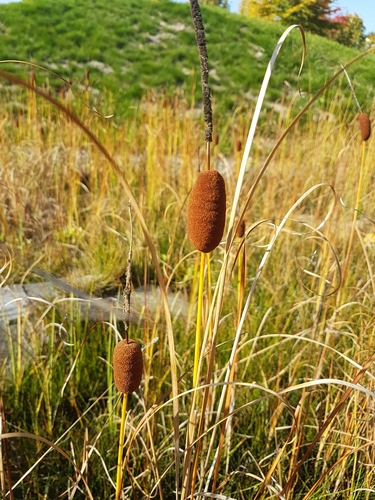
(c) Věra Kafková, some rights reserved (CC BY-NC), uploaded by Věra Kafková

(c) Aleksandr Ebel, some rights reserved (CC BY-NC), uploaded by Aleksandr Ebel
What to Eat
Edible parts: Flowers, Leaves, Pollen, Root, Seeds, Stem
Roots can be eaten raw or cooked — boil them like potatoes or macerate and boil to produce a sweet syrup. They can also be dried, ground into a protein-rich flour, and used as a soup thickener or blended with cereal flours to make biscuits, bread, and cakes. Young spring shoots are eaten raw or cooked as an asparagus substitute. The base of the mature stem is edible raw or cooked with the outer layer removed. The young flowering stem, as well as the cooked flowering stem, can be eaten raw, cooked, or made into soup and tastes like sweet corn. Seeds are small and fiddly but have a pleasant nutty flavour when roasted; an edible oil is also obtained from the seed, though the small seed size makes this a marginal crop. Pollen is a protein-rich addition to flour for bread and porridge, and is easiest used by eating it along with the young flowers. To harvest pollen, hold the flowering stem over a wide, shallow container and gently tap and brush it free; this also aids pollination to ensure future pollen and seed yields.
Where to Find It
It is a temperate plant. It can grow in pools and swamps. In Sichuan.
Afghanistan, Asia, Australia, Central Asia, China, Europe, Georgia, India, Iran, Japan, Kazakhstan, Korea, Kyrgyzstan, Middle East, Mongolia, Pakistan, Russia, Slovenia, Tajikistan, Turkey, Türkiye, Turkmenistan, Uzbekistan,
How to Identify
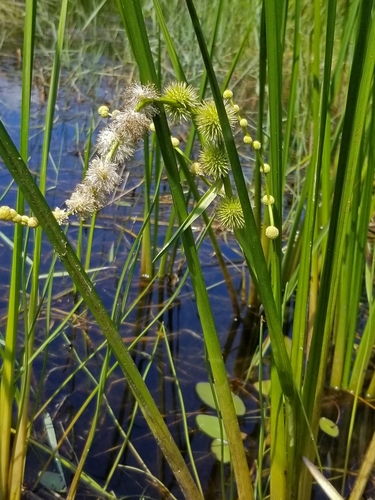
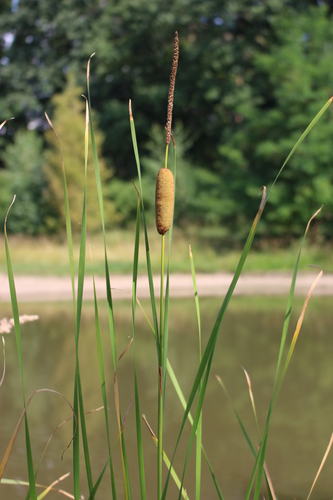
A rush. It grows 1.2 m tall. The leaves are greyish-green and narrow and half round. They have a groove on one side and are round on the other. The flowers are in a spike. The male flowers are light brown and above and separated from the dark brown female flowers below.
How to Grow
Grow in a rich soil in boggy pond margins or shallow water to 15cm deep. Succeeds in sun or part shade. A very invasive plant spreading freely at the roots when in a suitable site, it is not suitable for growing in small areas. Unless restrained by some means, such as a large bottomless container, the plant will soon completely take over a site and will grow into the pond, gradually filling it in. This species will often form an almost complete monoculture in boggy soil. Provides excellent cover for wildlife.
Propagation: Surface sow seed in a pot stood in 3cm of water. Pot up seedlings as soon as possible and gradually increase the water depth as the plants develop. Plant out in summer. Division in spring is very easy — harvest young shoots when they are 10–30cm tall with some root attached and plant directly into permanent positions.
Medicinal Uses
The stamens and pollen are used as an astringent and styptic.
Other Uses
Stems gathered in autumn make good thatching material, can be used in paper production, and woven into mats, chairs, and hats. They are a useful biomass resource for composting or fuel. Leaf fibre can be used for papermaking — harvest leaves in summer, autumn, or winter, soak in water for 24 hours, cook fibres for 2 hours with soda ash, then beat in a ball mill for 1½ hours to produce green or brown paper. Fruit hairs are used for stuffing pillows, providing good insulation and buoyancy; they have also been used as wound dressings and as lining for babies' nappies. Stems can be made into rush lights by removing the outer skin and leaving a spine running the full length for stability, then soaking in oil. Fibre is also obtained from the blossom stem and flowers. Pollen is highly flammable and is used in making fireworks.
Wikipedia
Source ↗Typha laxmannii, the graceful cattail, is a wetland plant species, widespread across Europe and Asia. Typha laxmannii is not as tall as many of the other species in the genus, rarely more than 130 cm high. A noticeable space separates the staminate (male) flowers from the pistillate (female) ones.
Notes
There are 10 Typha species.
Names & Synonyms
Laxmannov rogoz
References (13)
- Ambasta, S.P. (Ed.), 2000, The Useful Plants of India. CSIR India. p 659
- Facciola, S., 1998, Cornucopia 2: a Source Book of Edible Plants. Kampong Publications, p 243
- Flora of Pakistan. www.eFloras.org
- Hedrick, U.P., 1919, (Ed.), Sturtevant's edible plants of the world. p 662
- Hibbert, M., 2002, The Aussie Plant Finder 2002, Florilegium. p 304
- https://en.wikipedia.org/wiki/List of wild edible plants in Mongolian cuisine
- http://www.botanic-gardens-ljubljana.com/en/plants
- Lim, T. K., 2015, Edible Medicinal and Non Medicinal Plants. Volume 9, Modified Stems, Roots, Bulbs. Springer p 83
- Nova Acta Acad. Sci. Imp. Petrop. Hist. Acad. 12:84, 335. 1801
- Plants for a Future database, The Field, Penpol, Lostwithiel, Cornwall, PL22 0NG, UK. http://www.scs.leeds.ac.uk/pfaf/
- Romanowski, N., 2007, Edible Water Gardens. Hyland House. p 71
- Slocum, P.D. & Robinson, P., 1999, Water Gardening. Water Lilies and Lotuses. Timber Press. p 103
- Urgamal, M., Oyuntsetseg, B., Nyambayar, D. & Dulamsuren, Ch. 2014. Conspectus of the vascular plants of Mongolia. (Editors: Sanchir, Ch. & Jamsran, Ts.). Ulaanbaatar, Mongolia.