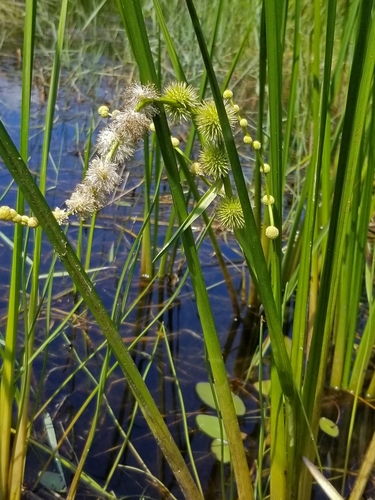
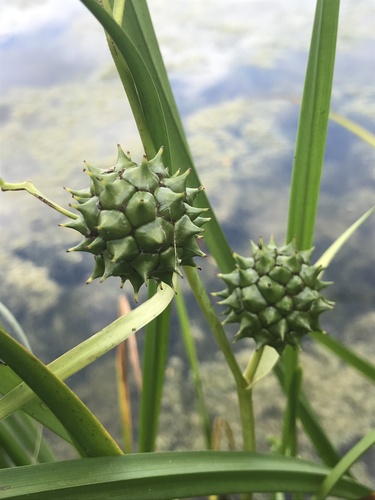
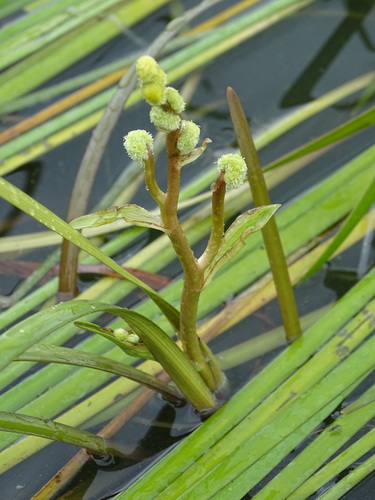
Sparganium stoloniferum
Buch.-Ham.

(c) onidiras-iNaturalist, some rights reserved (CC BY-NC), uploaded by onidiras-iNaturalist

(c) onidiras-iNaturalist, some rights reserved (CC BY-NC), uploaded by onidiras-iNaturalist
What to Eat
Edible parts: Stem
Young stems - boiled.
Where to Find It
E. Asia - China, Japan.
TEMPERATE ASIA: Afghanistan, Russian Federation (Buryatia, Chita), Kazakhstan, Kyrgyzstan, Tajikistan, Russian Federation (Primorye, Kamcatskij kraj, Sakhalin), China, Korea, Japan (Hokkaidô, Honshu, Kyushu, Shikoku) TROPICAL ASIA: India (north), Nepal, Pakistan (northeast) NORTHERN AMERICA: Canada (Northwest Territories, Québec, Nova Scotia, Ontario, Prince Edward Island, New Brunswick, Newfoundland and Labrador, Saskatchewan, Alberta, Manitoba, British Columbia), United States (Indiana, Maine, Massachusetts, Michigan, New Hampshire, New Jersey, New York, Ohio, Pennsylvania, Rhode Island, Vermont, West Virginia, Connecticut, Iowa, Kansas, Minnesota, Missouri, Nebraska, North Dakota, Oklahoma, South Dakota, Wisconsin, Colorado, Idaho, Montana, Oregon, Washington, Delaware, Kentucky, Maryland, Virginia, New Mexico, Arizona, California, Nevada, Utah), Mexico (Baja California (Norte))
How to Identify
Sparganium stoloniferum is a PERENNIAL. It is in flower from May to October, and the seeds ripen from May to October. The species is monoecious (individual flowers are either male or female, but both sexes can be found on the same plant) and is pollinated by Wind. Suitable for: light (sandy), medium (loamy) and heavy (clay) soils. Suitable pH: mildly acid, neutral and basic (mildly alkaline) soils. It can grow in semi-shade (light woodland) or no shade. It prefers wet soil and can grow in water.
How to Grow
We have very little information on this species and do not know if it will be hardy in Britain, though judging by its native range it should succeed outdoors in many parts of the country. The following notes are based on the general needs of the genus. A plant of wet ground, it should be grown in a bog garden or in shallow water up to 30cm deep. Requires a rich soil. Tolerates some shade.
Propagation: Seed - best sown as soon as it is ripe in a pot in the greenhouse. Stand the pots in 2 - 3cm of water. Prick out the seedlings into individual pots when they are large enough to handle and gradually increase the depth of water as the plants grow until it is about level with the tops of the pots. Plant them out in the summer if they have grown sufficiently, otherwise plant them out in the following spring. Division in spring or autumn. Larger divisions can be planted out direct into their permanent positions. We have found it best to pot up the smaller divisions and grow them on in a lightly shaded position in a cold frame, planting them out once they are well established in the summer.
Medicinal Uses
Abortifacient Emmenagogue Galactogogue Sedative. The root is abortifacient, emmenagogue, galactogogue and sedative. A decoction of the root is used in the treatment of abdominal pain, amenorrhoea, dysmenorrhoea and chest pains.